
A decision autopsy reconstructs what a team actually decided and what it assumed at the time, not what went wrong afterwards. Most post-mortems focus on the failure. The autopsy focuses on the reasoning, because a good decision made on sound assumptions can still produce a poor outcome.
Most reviews of past decisions are backward-looking catalogues of blame or boilerplate lessons no one reads. A decision autopsy is neither. It is a structured comparison of what was assumed before the decision was made and what actually occurred, assessed using the same Universal Decision-Making Method that Roger Estall and I developed in Deciding.
The purpose is not to assign fault. It is to answer the only question that matters in any post-decision review: could the Decider have known? When Roger Estall and I wrote Deciding, we included guidance on reviewing historical decisions precisely because most organisations have no structured way to do this. They produce post-mortems that catalogue what went wrong. They circulate lessons-learned documents that no one reads. What they rarely do is reconstruct what was assumed before the decision was made, compare it to what actually happened, and ask whether the gap was foreseeable. That reconstruction is the decision autopsy.
A decision autopsy is a retrospective examination of a specific choice that reconstructs its premises, reasoning, and results to see where judgment held or failed.
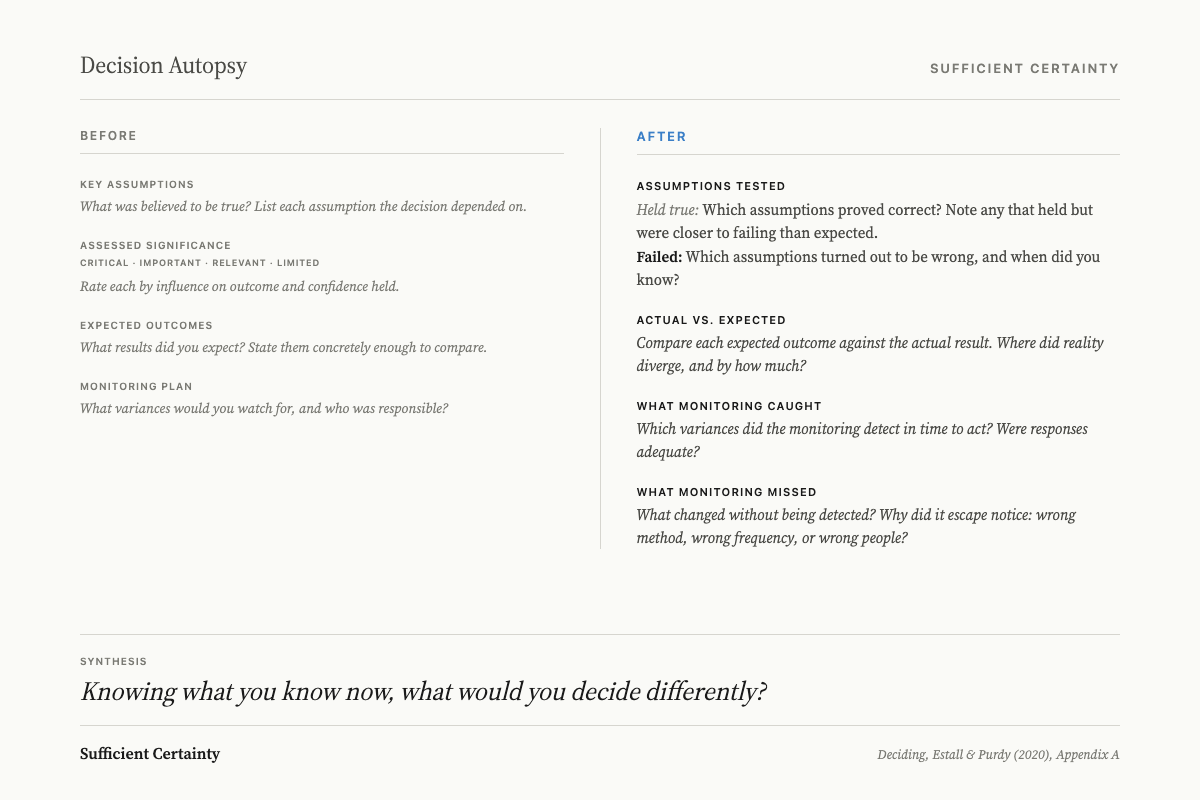
What the autopsy examines
The autopsy places two columns side by side. Column one records the state of knowledge before the decision: the Purpose, the chosen option, the assumptions the Decider relied on, and whatever monitoring conditions were specified. Column two records what actually happened. For every assumption, the question is simple: did it hold, or did it break?
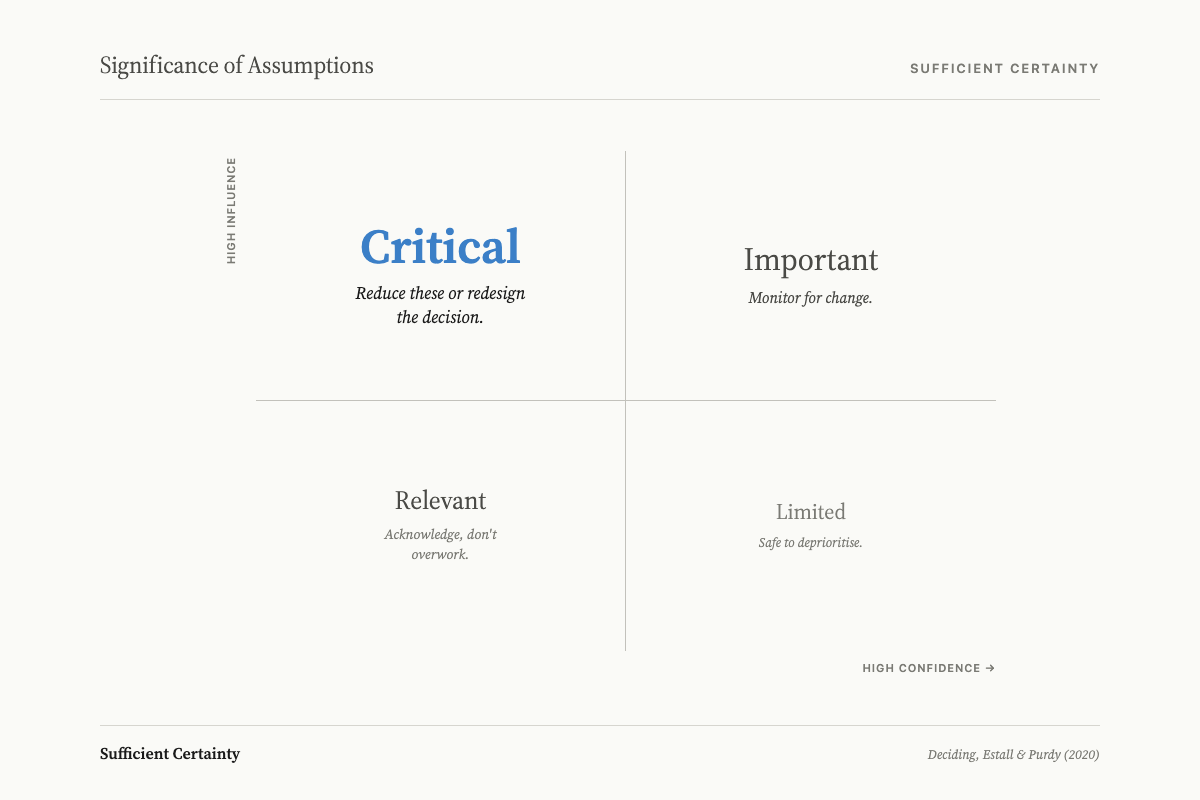
The value of any post-decision review is in the gap between those two columns. Where an assumption broke, the autopsy asks whether the Decider could have known at the time. Was the information available? Was it available but ignored? Or was the change genuinely unforeseeable? Where an assumption held, the autopsy asks a harder question: was that skill or luck? If the Decider rated an assumption as Limited significance and it turned out to be the load-bearing plank of the entire decision, the fact that it happened to hold does not mean the rating was sound.
Decisions fail for four broad reasons, and the autopsy must distinguish between them. The first is a defective process: the decision was poorly reasoned from the start. The second is faulty implementation: the decision was sound but was not carried out as intended. The third is that secondary elements, the safeguards and contingencies built around the primary decision, malfunctioned or degraded over time. The fourth is a change in Context that was not contemplated when the decision was made. Each produces a different kind of variance, and each demands a different remedy. A post-mortem that lumps them all under "things that went wrong" cannot tell you which lever to pull next time.
Consider the Australian newspaper industry. Fairfax Media operated for decades on the assumption that classified advertising revenue, the "rivers of gold," would remain stable. That assumption was never written down. It was never stress-tested. When online advertising invalidated it entirely, institutional memory of the original reasoning had already faded with departing executives. The company was eventually sold at vastly degraded value. A decision autopsy conducted even five years before the collapse would have surfaced one Critical assumption with zero supporting evidence, because no one had ever articulated what the business model was actually resting on.
Run a live decision through the five steps and expose the unwritten assumption that would show up in an autopsy later. Start the Walk →
How to run one
Start with the original Decision Record. In Deciding (Chapter 8), we argue that significant decisions should be recorded: what was decided, what was assumed, the significance of each assumption, the monitoring plan, and the prevailing Context. If a Decision Record exists, the autopsy is straightforward. If none exists, and for most historical decisions none will, you must reconstruct what was assumed at the time. In Appendix A of the book, we describe two approaches. The first is to work backward: identify the most important present activities, determine when the original decision was made, research the Context that prevailed, and infer the assumptions. The second is more pragmatic: treat the continuation of existing arrangements as a new decision and apply the Universal Decision-Making Method fresh.
Whichever approach you use, the post-decision review follows the same structure. State each assumption. Record its original significance rating. Then record what actually happened. Where there is a variance, use the seven-column analysis from Appendix A, Figure 11, which traces each variance from its root cause through to why monitoring did not catch it. That last column is the one most organisations skip, and it tells you whether your monitoring was working. It is also the discipline most post mortem analysis never attempts.
The conversation matters more than the document. The autopsy works best when the original Decider is in the room and willing to examine their own reasoning honestly. Select participants who bring a cross-section of expertise. Appoint a facilitator who is not the most senior person present; our experience is that less-senior facilitators produce less defensive conversations. Frame the opening explicitly: we are here to understand what was assumed, not to assign blame. State the scope. State what is not on the table. Then work through the assumptions one by one, comparing the before-column to the after-column.
The Boeing 737 MAX is instructive. The flight control software, MCAS, relied on a single angle-of-attack sensor. The assumption that one sensor was sufficient for a safety-critical system was never surfaced or challenged. It sat in the Critical quadrant of the significance matrix, high influence on the outcome, low confidence, but no one placed it there because no one asked the question. 346 people died in two crashes. The subsequent investigations produced thousands of pages of findings. A decision autopsy conducted before the first crash would have required a single question: what are we assuming about sensor redundancy, and how confident are we? The Universal Decision-Making Method would have forced that question into the open. The 'risk management' apparatus Boeing had in place did not.
When an autopsy is worth the effort
Not every decision warrants a post-decision review. A decision autopsy is worth the effort in three situations. First, when outcomes diverged significantly from what was intended, for better or worse. Second, when the decision was important enough that understanding its assumptions will improve future decisions of the same kind. Third, when a long-standing decision has never been formally reviewed and is still shaping operations.
Skip it when the decision was low-significance and the outcome was broadly as expected. Skip it when the variance was caused by a one-off implementation error that has already been corrected. The point is not to autopsy everything. It is to autopsy decisions where the gap between what was assumed and what happened reveals something about how your organisation thinks.
A statutory public safety organisation I chaired had been spending 0.03% of its budget on a safety program that was its prime legislative function. When we finally examined the assumptions behind that allocation, one Critical assumption, that existing controls were effective, turned out to be completely unsupported. We raised the allocation to 0.5%. Mortality dropped 60% within two years. That was not a post-mortem. It was a post-decision review of a historical decision whose assumptions had never been surfaced. The organisation had been operating on autopilot for years, continuing to implement a decision no one remembered making, resting on an assumption no one had ever tested. No risk register would have caught it, because a register catalogues hazards in the abstract. The autopsy connected a specific assumption to a specific decision to a specific outcome.
After the 2011 Brisbane floods, the inquiry into the Wivenhoe Dam produced 177 recommendations. The dam operators had followed a rule-based operating manual whose assumptions about rainfall patterns and dam capacity turned out to be invalid. 177 recommendations is not an autopsy. It is a catalogue. None of those recommendations helped anyone decide anything, because none of them reconstructed the assumptions the original Deciders had relied on and asked whether those assumptions were defensible at the time. A proper autopsy would have asked: what did the operators assume about inflow rates? What did they assume about downstream capacity? Were those assumptions rated Critical? Were they monitored? Could the Deciders have known? That is five questions, not 177 recommendations.
I have spent nearly fifty years helping organisations make better decisions using the Universal Decision-Making Method. The lesson from all of that work is not that people decide badly. It is that they decide without recording what they are assuming, and then cannot learn from the result. The decision autopsy exists to close that loop, not to relitigate or to blame, but to reconstruct the reasoning, compare it to reality, and carry the insight forward into the next decision. That is what sufficient certainty looks like over time: not getting every decision right, but getting better at knowing what you are resting on.
You could skip the autopsy and repeat the same call with no record why.
Work through your decisionNo sign-up. Just pick your decision and start.
Grant Purdy is the co-author, with Roger Estall, of Deciding (2020), and the architect of the Universal Decision-Making Method.