Decision Fatigue
Decision fatigue is not about willpower. It is about bad process. Fix the process and the fatigue goes away.
Read the full guide →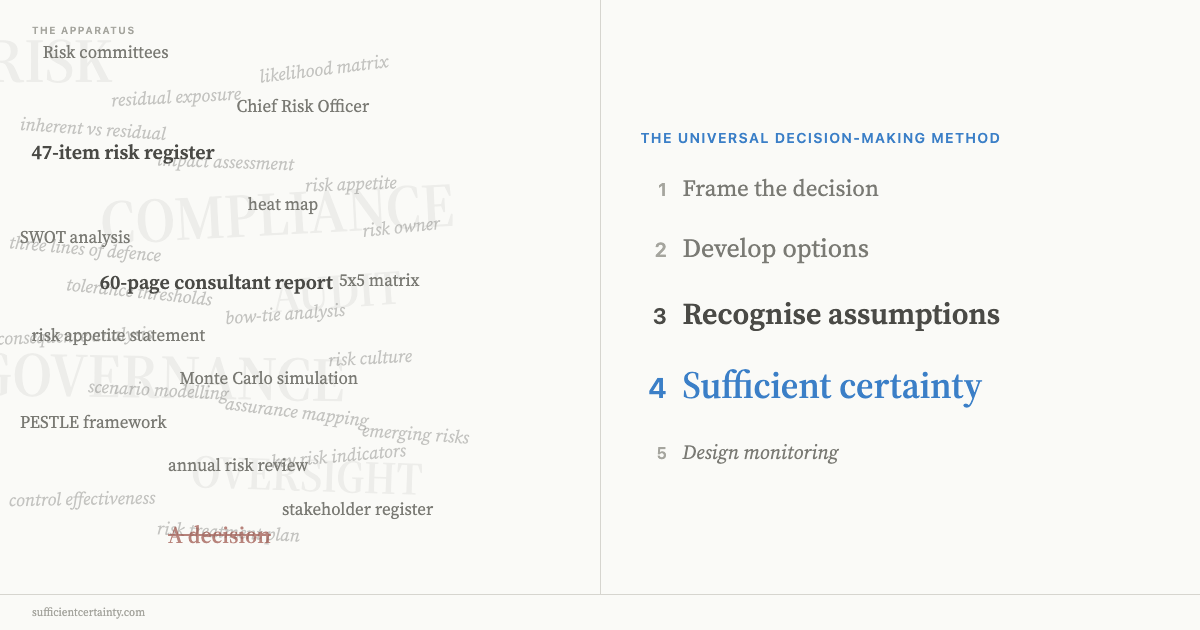 June 2026
 Decision Fatigue Research: Which Findings Replicated
Decision fatigue research built 600 papers on four lab studies. The brain-as-battery model did not replicate. Here is what the evidence still supports.
Accountability in Leadership
Most accountability advice treats it as a character trait. It is structural: one person decides, assumptions are visible, reasoning is recorded.
Read the full guide →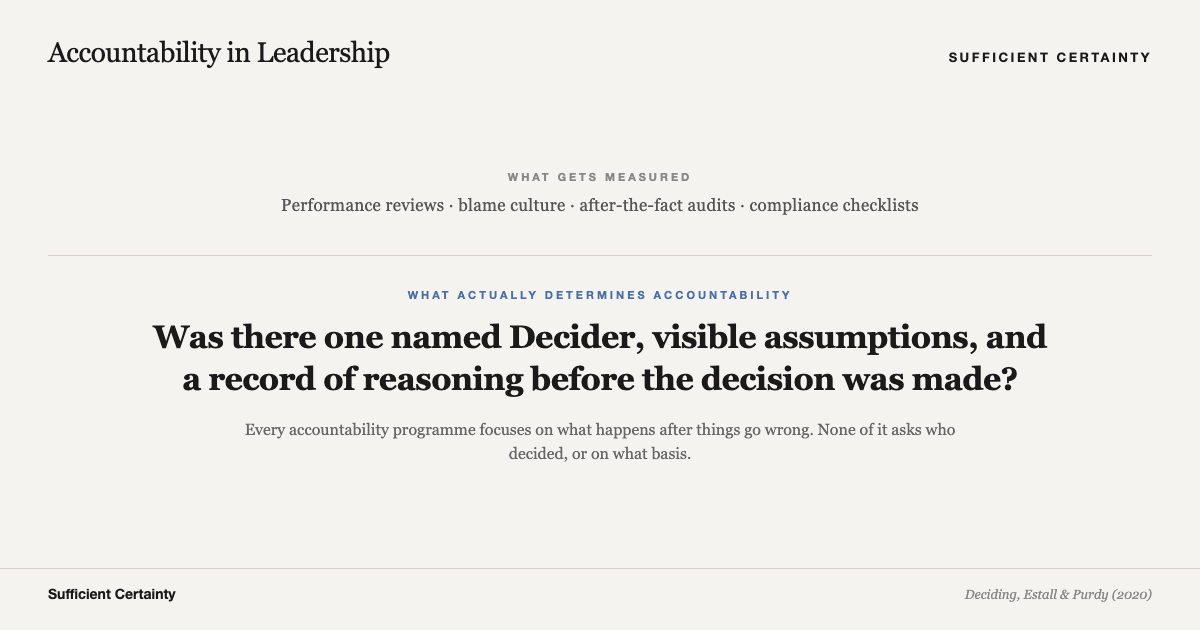 March 2020
 What Is a Decider? The Role Most Organisations Overlook
Every organisation has people whose choices determine outcomes. Most have no way to identify them or equip them. The Decider role fixes that.
AI Decision Making
AI decision making works when AI tests what a choice depends on, not when it makes the choice. Five steps keep the thinking with you.
Read the full guide →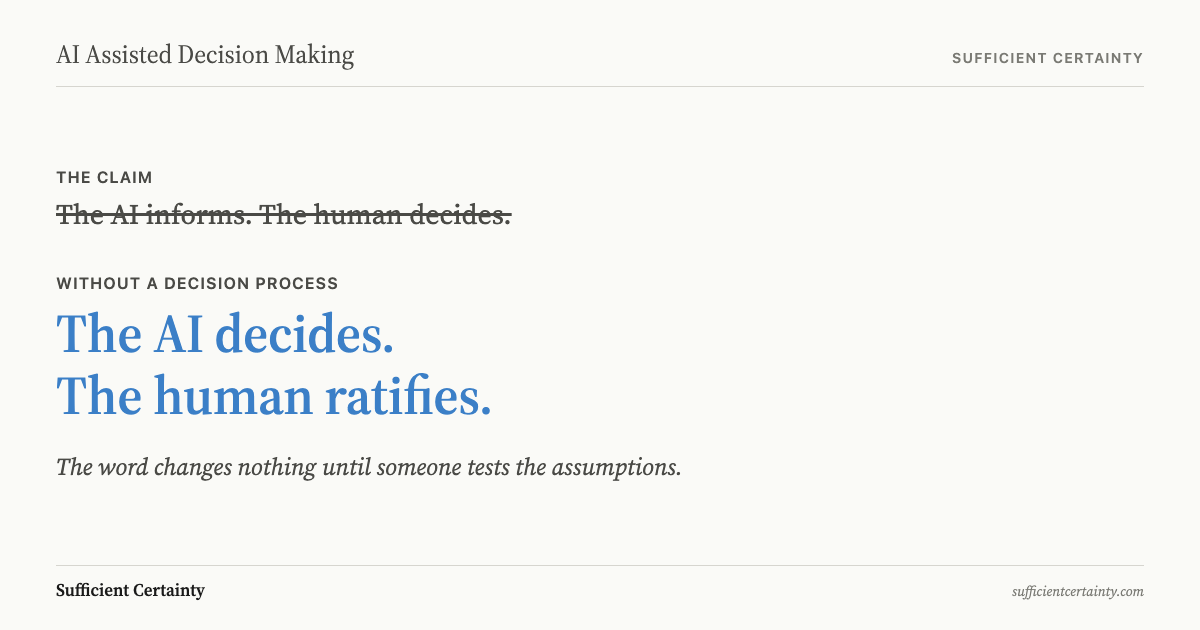 September 2026
 Using AI to Make Decisions: What I Tell Every Client
Most teams give AI the decision and call it assistance. Three steps that keep the tool useful and the judgement yours.
Analysis Paralysis
Analysis paralysis is the pursuit of maximum certainty by another name. The cure is not less analysis. It is knowing how much is enough.
Read the full guide →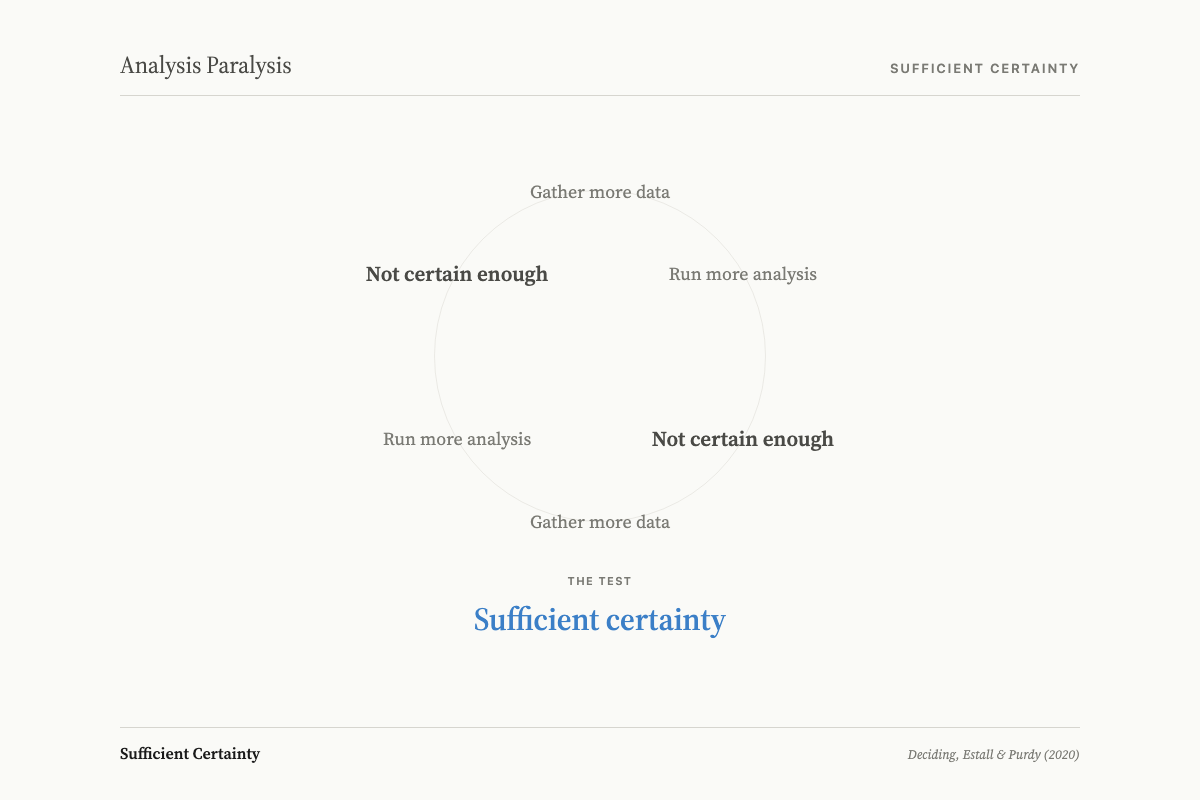 July 2026
 Choice Overload Starts Earlier Than It Looks
Choice overload does not start with option count. It starts when criteria sprawl and nobody can say what would be enough.
Balanced Scorecard
A balanced scorecard tracks execution. It cannot test whether the strategy underneath still deserves belief.
Read the full guide →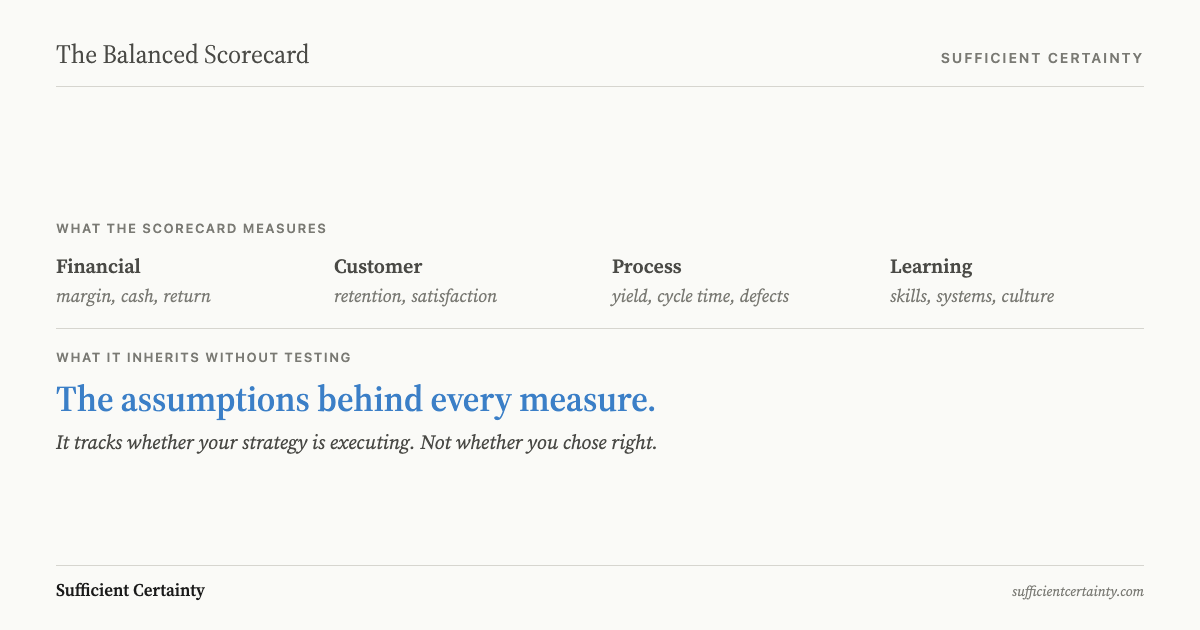 October 2026
 What to Do After a KPI Review
After a KPI review, compare the reported result with pending work and set a trigger that makes the decision owner reconsider.
Change Management
ADKAR, Kotter, and Lewin do real work. How they fit, when they help, and the five-step test they all skip before rollout begins.
Read the full guide →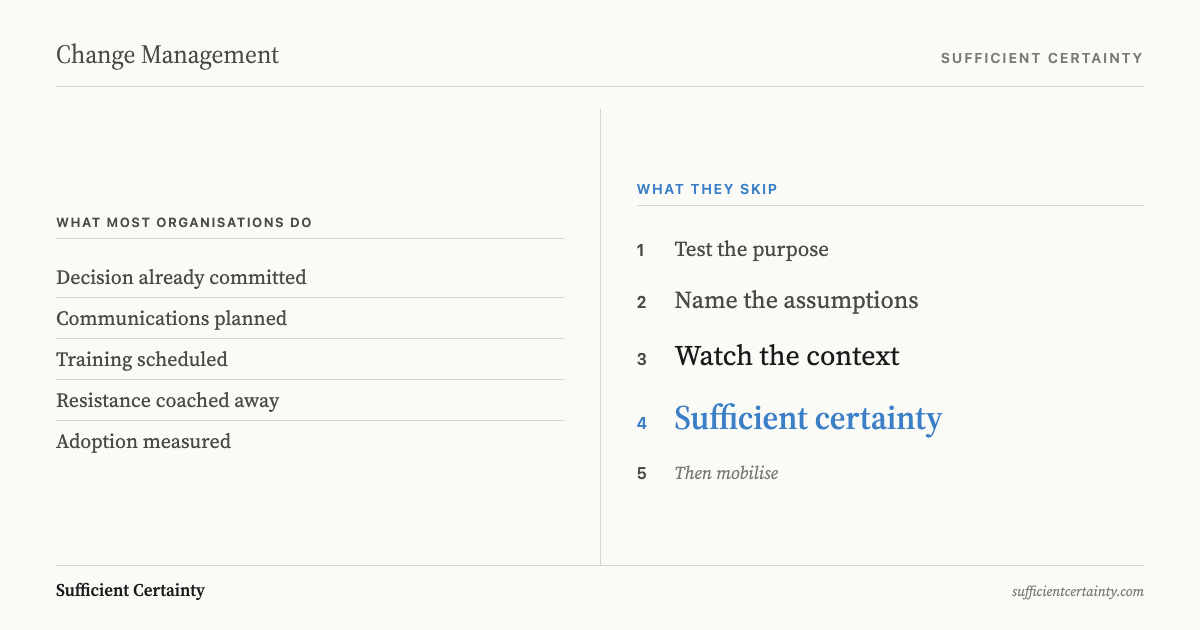 October 2026
 What to Do After a Design Sprint
A sprint's Friday verdict comes from five users in one week. Record the conditions it depended on and set a trigger to reopen it before it ships.
Cognitive Biases
Every cognitive bias operates through an assumption that was never tested. One structured process surfaces them all, without memorizing two hundred names.
Read the full guide →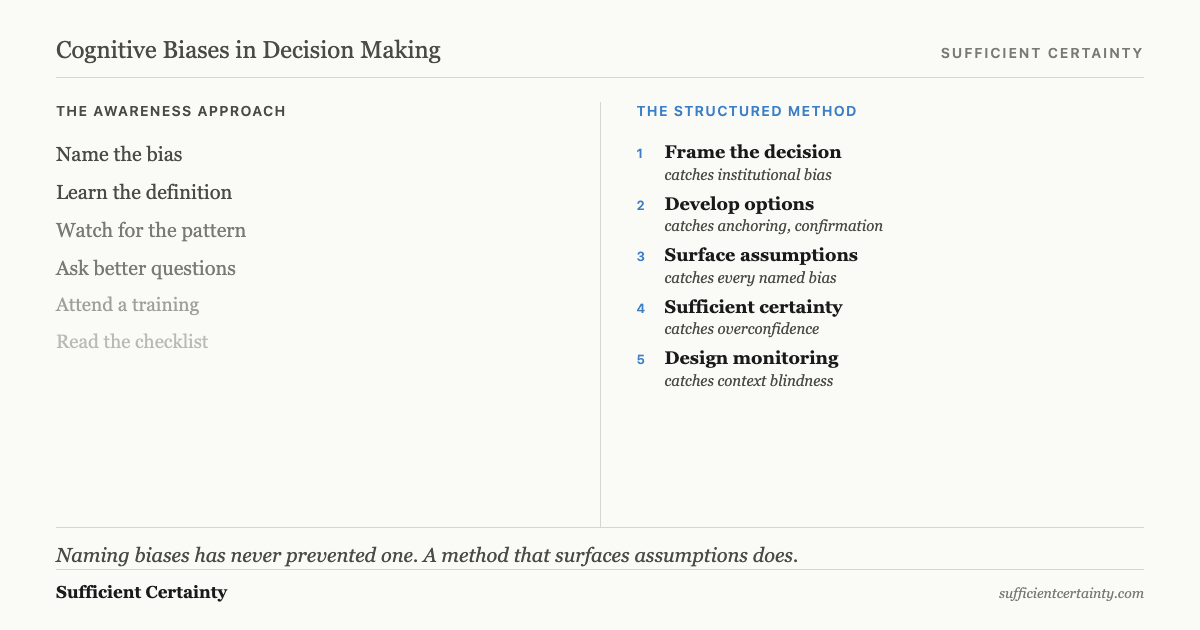 July 2026
 Representativeness Bias Mistakes Correlation for Causation
It worked before, so it must work again. That logic has emptied more accounts than bad luck ever did.
Collaborative Decision Making
Collaborative decision making needs one owner and a structured way to test what the group is assuming. A five-step method for sound group decisions.
Read the full guide →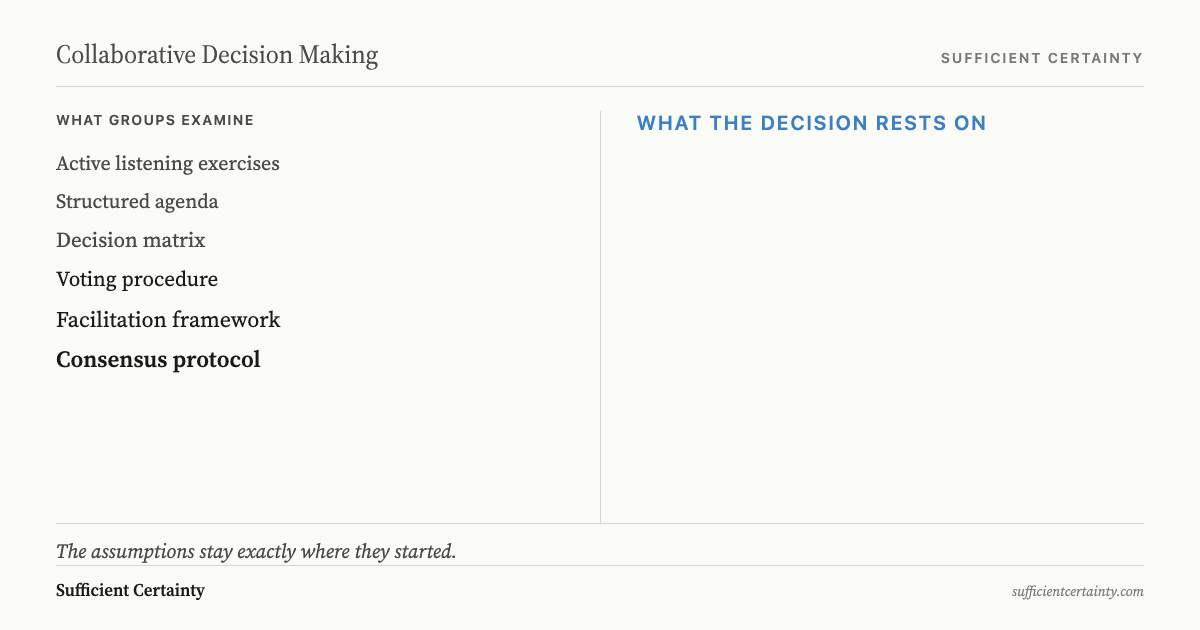 July 2026
 Consensus Group Decision Making Fails Before the Real Test
Consensus group decision making fails when a room trades pieces of the answer for peace. The hardest objection is the one that should decide it.
Data-Driven Decision Making
Your team collects more data than ever and still can't decide. Data-driven decision making works when data tests assumptions, not when it replaces judgment.
Read the full guide →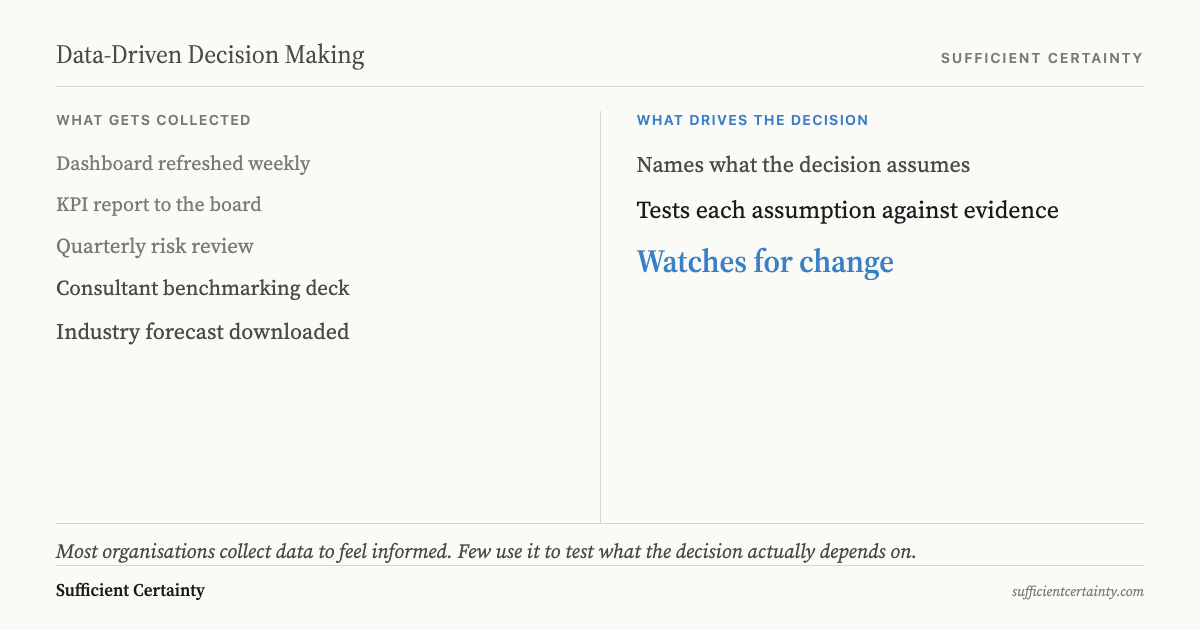 October 2026
 What to Do After Capital Budgeting
A funded shortlist can exceed the shared budget when projects depend on one another. Check the funding sequence after capital budgeting before committing money.
Decision Coaching
Coaching for one consequential decision, backed by decades of boardroom practice. Tested assumptions and a Decision Record you can defend.
Read the full guide →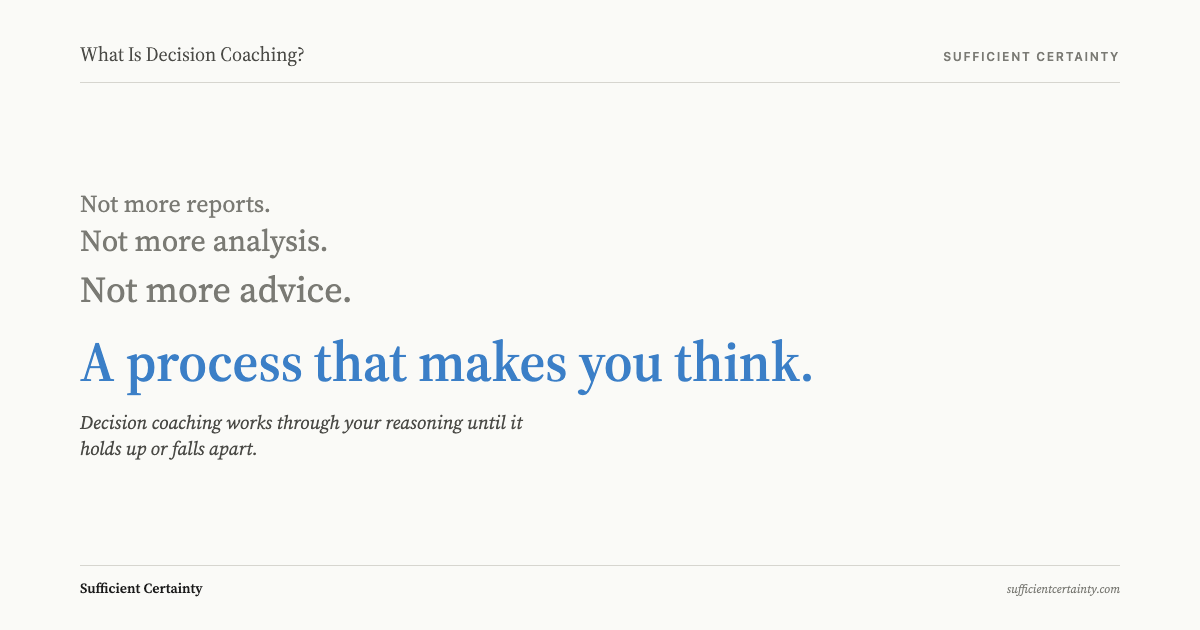 June 2026
 Decision Making Coach: Simple Questions, Not Frameworks
Decision coaching is not a framework handed over. A good decision making coach finds the one question your team keeps avoiding and makes you answer it.
Decision Making for Leaders
Decision making for leaders means surfacing what a decision rests on, judging whether enough is known, and building monitoring before it leaves the room.
Read the full guide →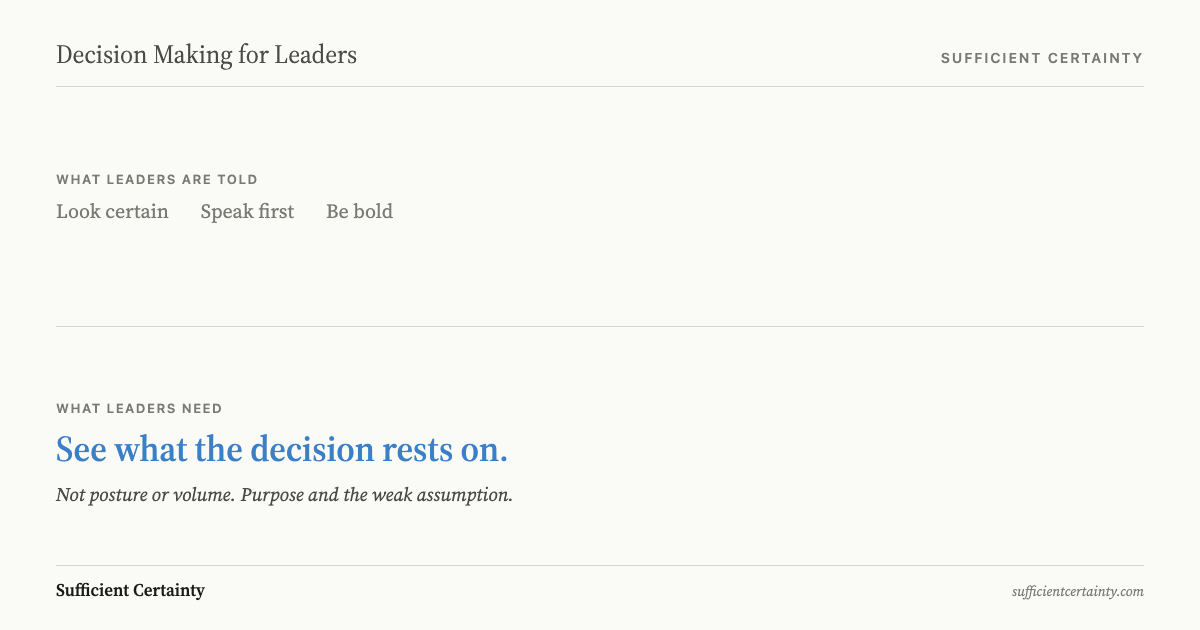 July 2026
 Making Difficult Decisions as a Leader: Test the Assumption
A difficult call feels personal when the assumption is hidden. A five-step method shows what must be true before you commit.
Decision Making Frameworks
Most decision-making frameworks help you analyze but never help you decide. They skip the one step that matters: testing your assumptions.
Read the full guide →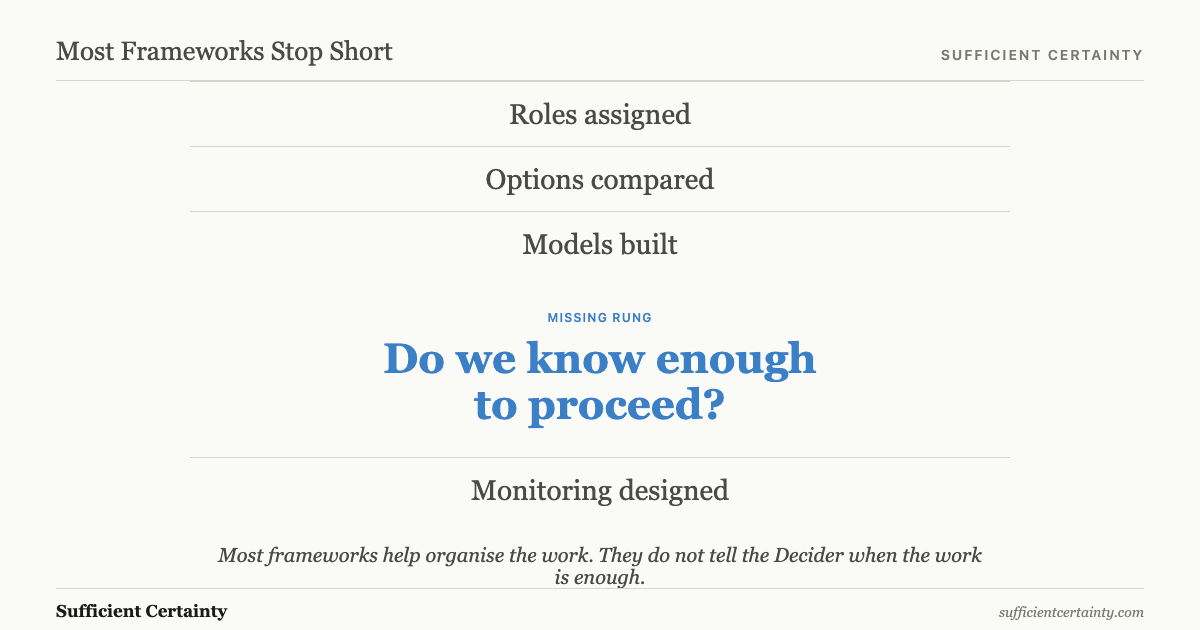 July 2026
 RAPID Decision Making Framework: Roles and Limits
RAPID clarifies who decides. It doesn't test whether the decision is sound. Here's what it does well, and the step it skips.
Decision Making Tool
Every popular decision making tool evaluates options you have already listed. None tests the assumptions those options rest on. That is the step where decisions break.
Read the full guide → September 2026
 Strategic Decision Making Tool That Actually Decides
Your team already has the SWOT and the matrix. One five-step method surfaces the assumption underneath and produces a document you can defend.
Decision Making Under Uncertainty
Decision-making under uncertainty is not about waiting for all the facts. It is about assumptions, sufficient certainty, and monitoring for change.
Read the full guide →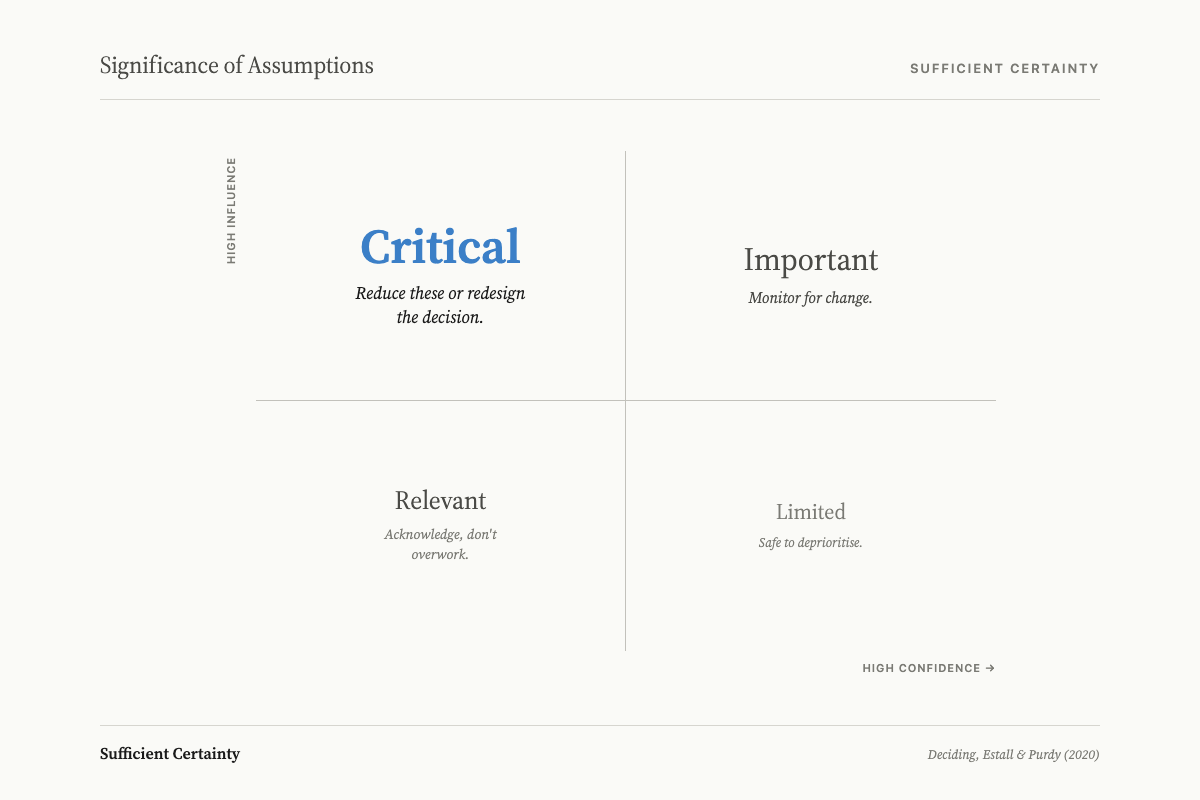 July 2026
 Decision Making Under Uncertainty Example Cases
Apollo 13 had 87 hours and brought the crew home. Blockbuster had ten years and lost 9,000 stores. The cause of failure was never time pressure.
Decision Quality
Decision quality fails when the apparatus replaces judgment. A practitioner method for surfacing what your decision rests on.
Read the full guide →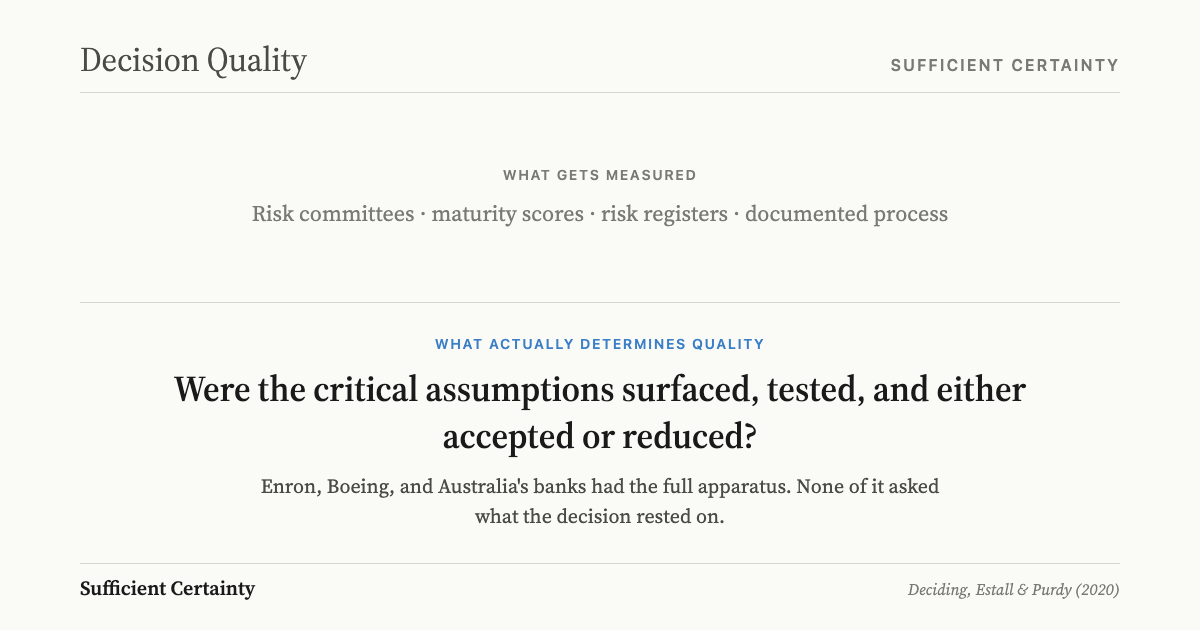 July 2026
 Enough Information to Make a Decision Is Not About 'How Much'
Your team has enough information already. One question reveals whether the decision is ready to make, or whether you are stalling for one more report.
Decision Science
Decision science is simpler than it sounds. It is the habit of asking what has to be true before you act.
Read the full guide →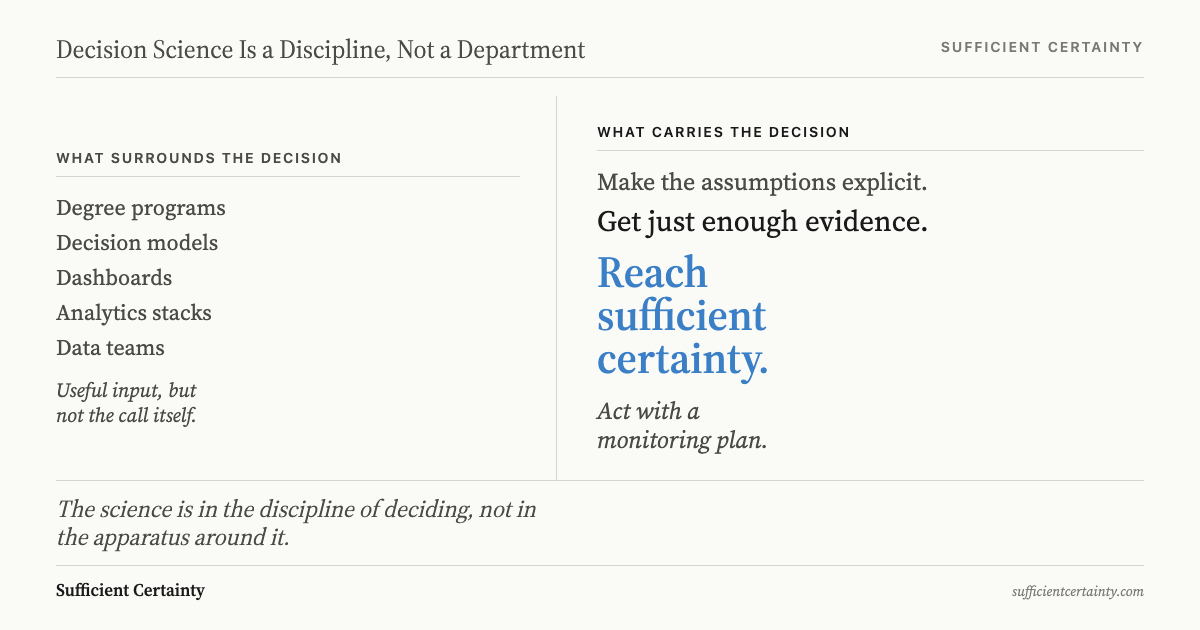 July 2026
 Decision Science vs Data Science: It's Not a Career Choice
One side builds the model. The other decides when it's good enough to act. Most people can't tell you which one they're missing.
Leadership Under Pressure
Leadership under pressure needs a written account for board and legal review, showing what was known, assumed, sufficient, and kept under review.
Read the full guide →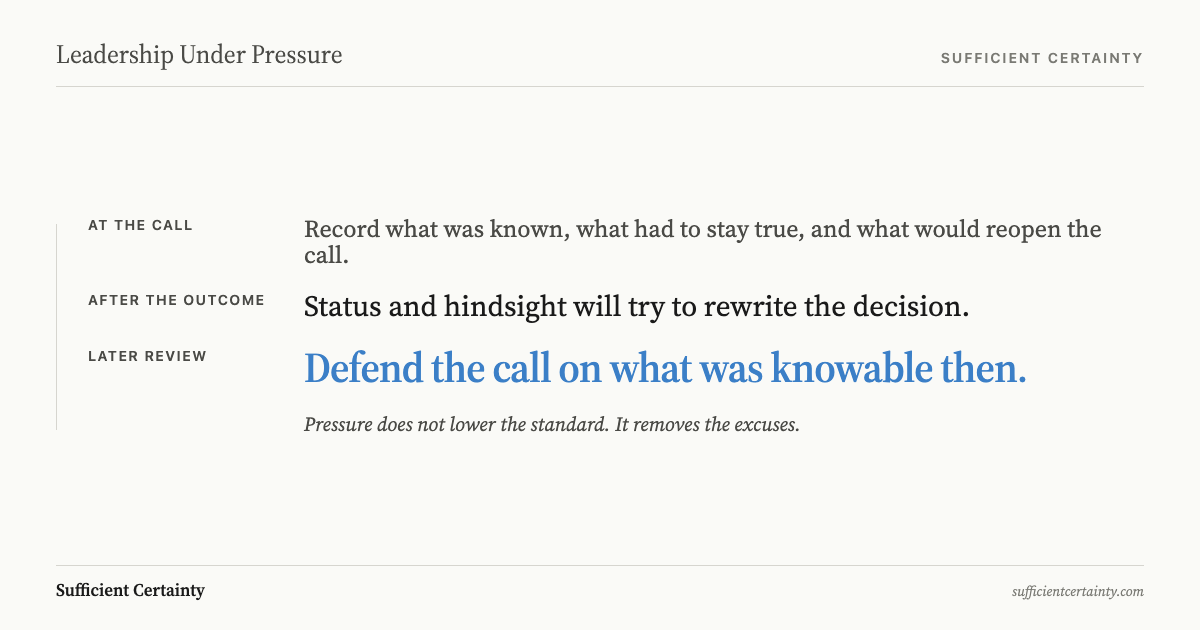 October 2026
 What to Do After a Cyber Tabletop Exercise
The cyber tabletop action list is closed, but the alert route has changed. Record the change that requires a new handoff test before the next incident occurs.
Organisational Governance
Organisational Governance Is About Decisions, Not Compliance
Read the full guide →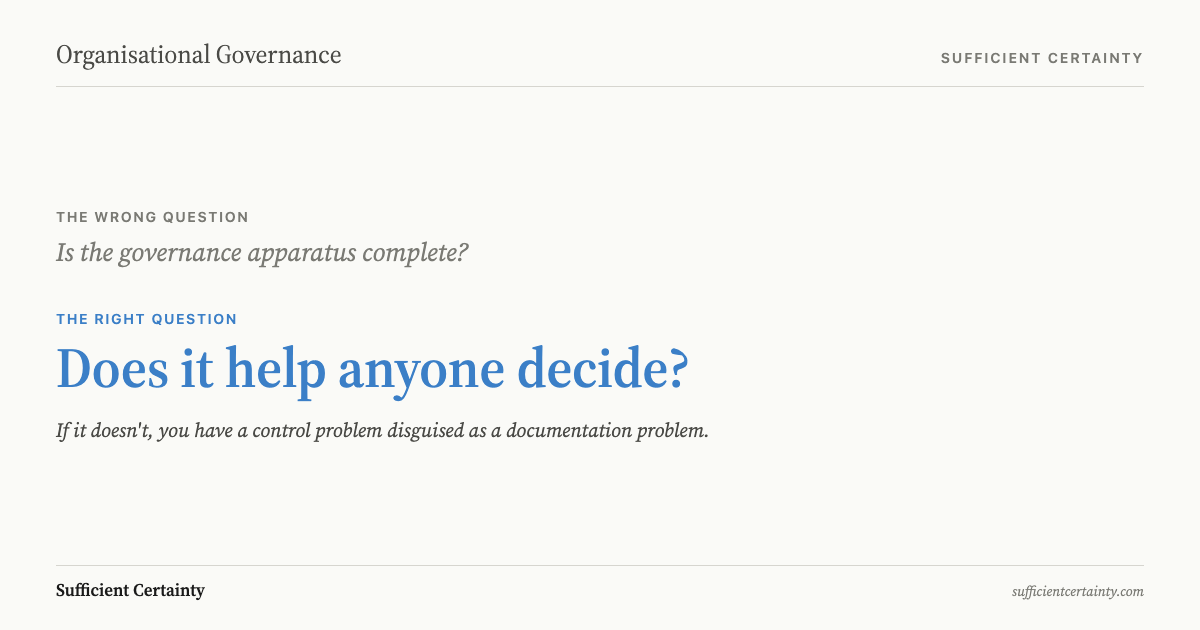 July 2020
 Why the IIA Three Lines Model Fails
The IIA Three Lines Model draws lines on a chart and calls it governance. None of those lines ask whether the decisions are any good.
PESTEL Analysis
PESTEL analysis lists six categories of external factors. One tested method turns those factors into testable assumptions and a decision your team can defend.
Read the full guide →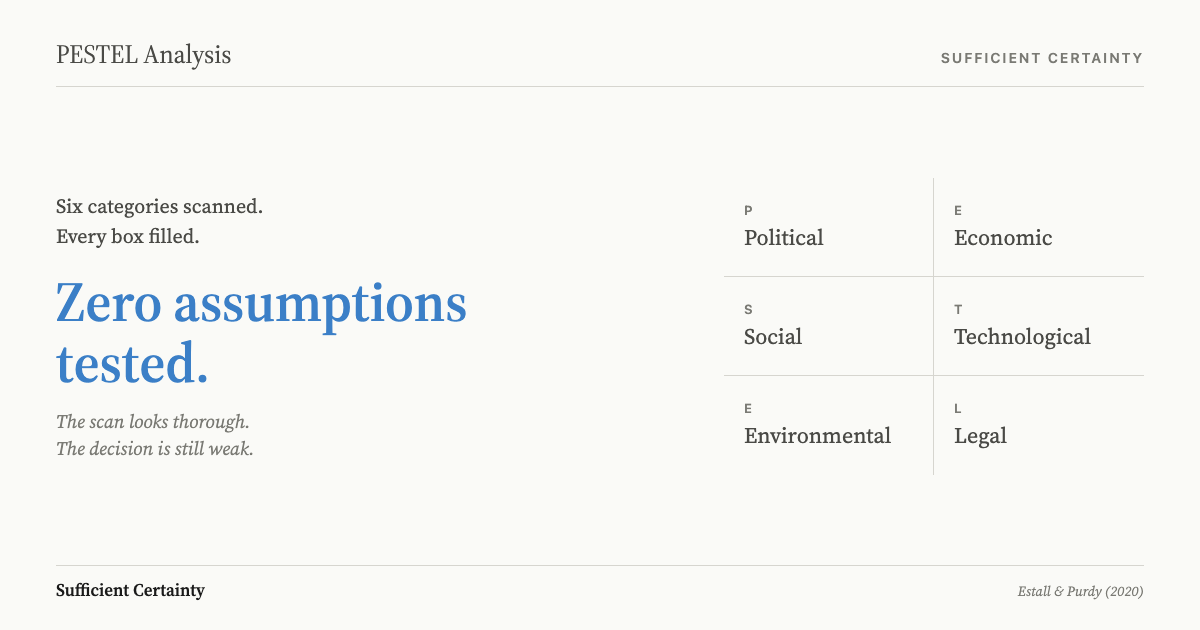 September 2026
 What to Do After a PESTLE Analysis
Your PESTLE scan categorised six external factors. None of them have been tested. One step converts observations into assumptions you can verify before the strategy meeting.
Porter's Five Forces
Porter's Five Forces maps industry pressure. The decision work is naming the assumptions each force hides and monitoring what changes.
Read the full guide →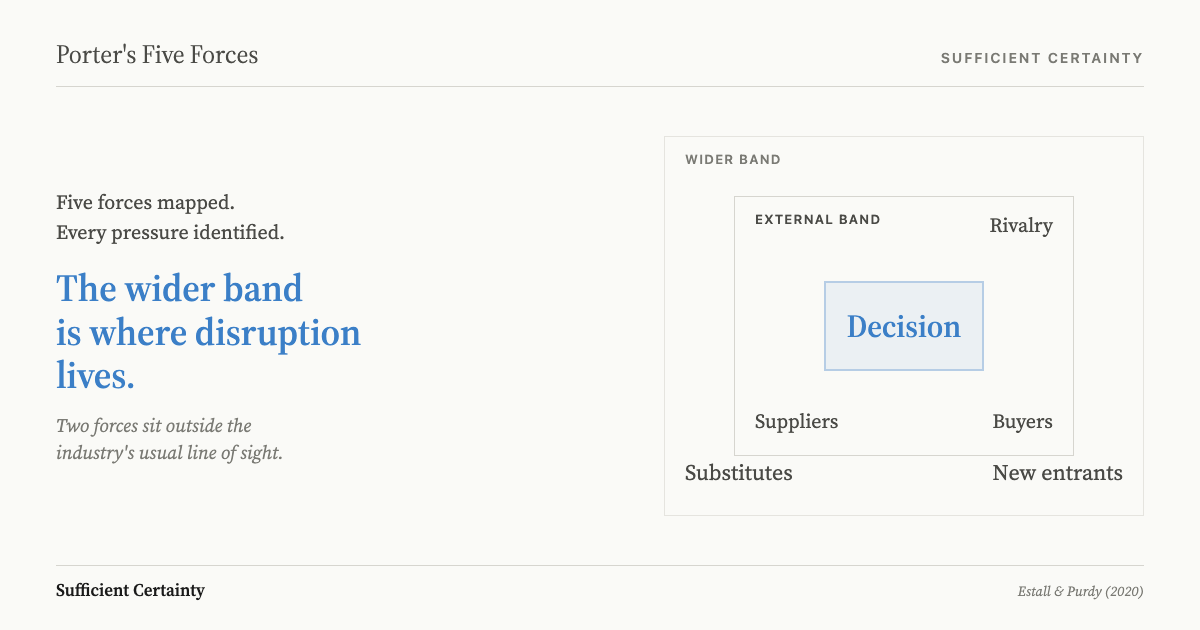 September 2026
 What to Do After a Competitor Analysis
After a competitor analysis, teams rank threats and build response strategies. But what if the competitive positions the analysis mapped rest on assumptions nobody checked? Test them before the response locks them in.
Prioritization Matrix
For operations and programme leaders comparing live options, this page explains what a prioritisation matrix can clarify, hide, and record.
Read the full guide →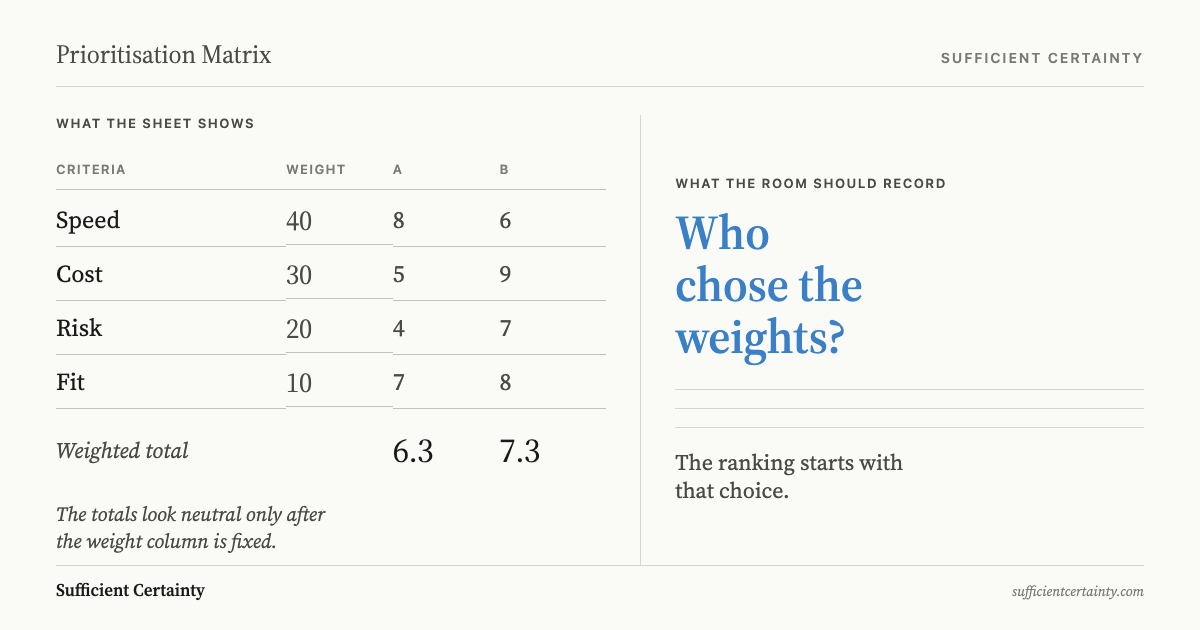 September 2026
 Waiting Makes Every Option Worse. Price It per Week.
Your team knows delay is expensive but has never priced it. A method for calculating the decay rate of each option before the next steering committee.
Problem Framing
Choosing badly costs a quarter. Solving the wrong problem costs years. Problem framing is the one step that catches it, and most methods leave it out.
Read the full guide →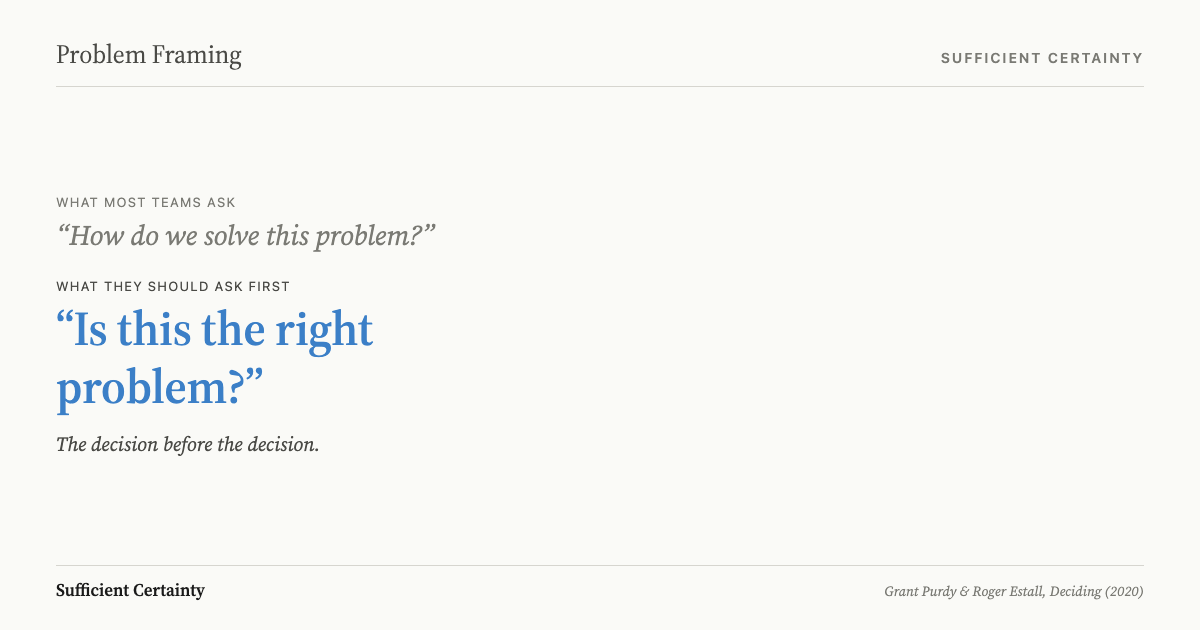 July 2026
 Problem Definition vs Problem Solving Starts Too Late
Most teams start solving before anyone names the choice. The first sentence already picked the winner.
Risk
Risk is uncertainty about the future. Most organizations file it in a register. A five-step method replaces the apparatus with decisions you can defend.
Read the full guide →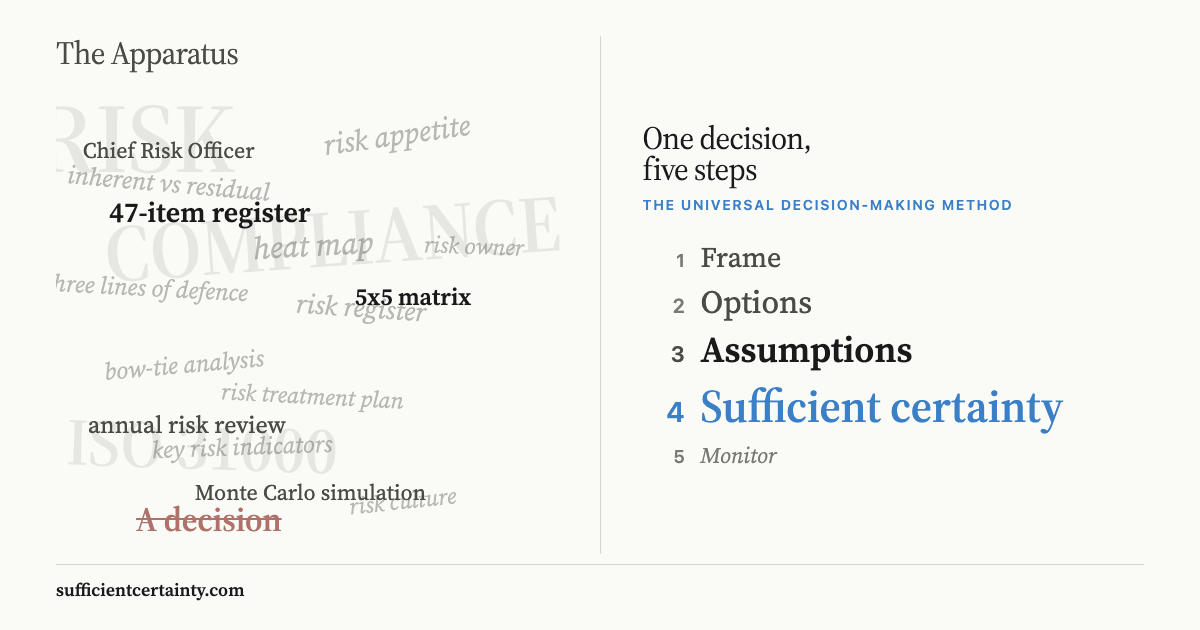 September 2020
 Conversations with Mark Siwik
From BHP Billiton to the ISO working groups that produced ISO 31000, and why the standard he helped write cannot help anyone actually decide.
Risk Assessment
A risk assessment on its own is useless. The step most organisations skip after the assessment is the one that creates value.
Read the full guide →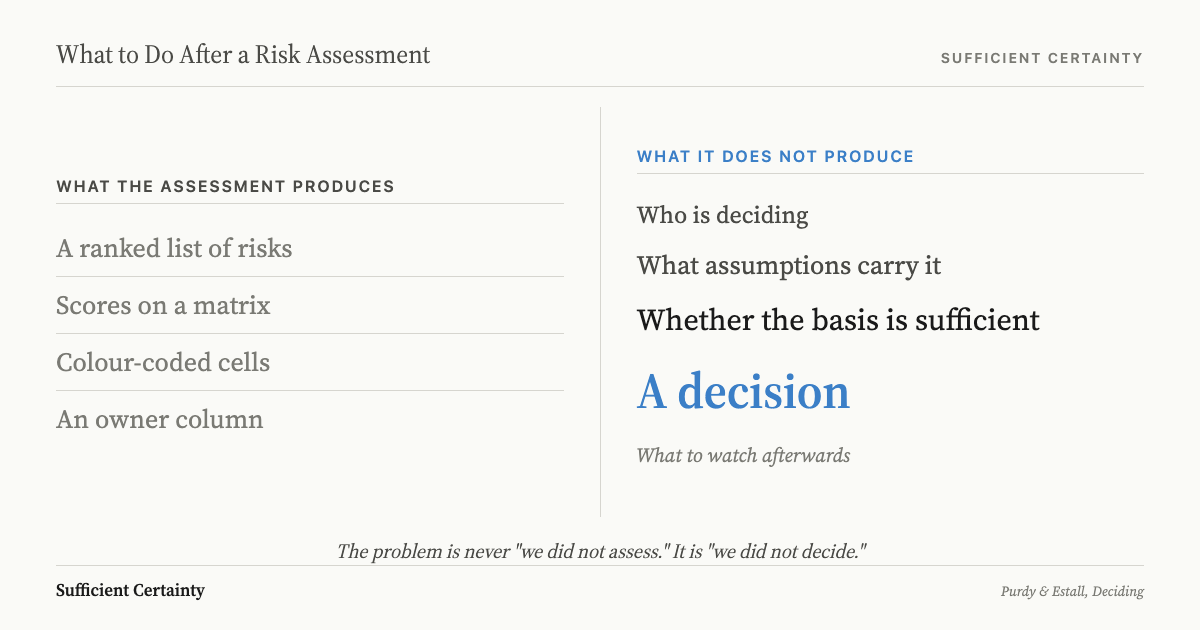 October 2026
 What to Do After a HIPAA Security Risk Assessment
After a HIPAA Security Risk Assessment, verify safeguards at ePHI locations, set acceptance evidence, and record interim controls before closing findings.
Scenario Planning
Most scenario planning produces elegant futures and no decisions. The missing discipline: surface assumptions, judge which matter, stop when certain enough.
Read the full guide →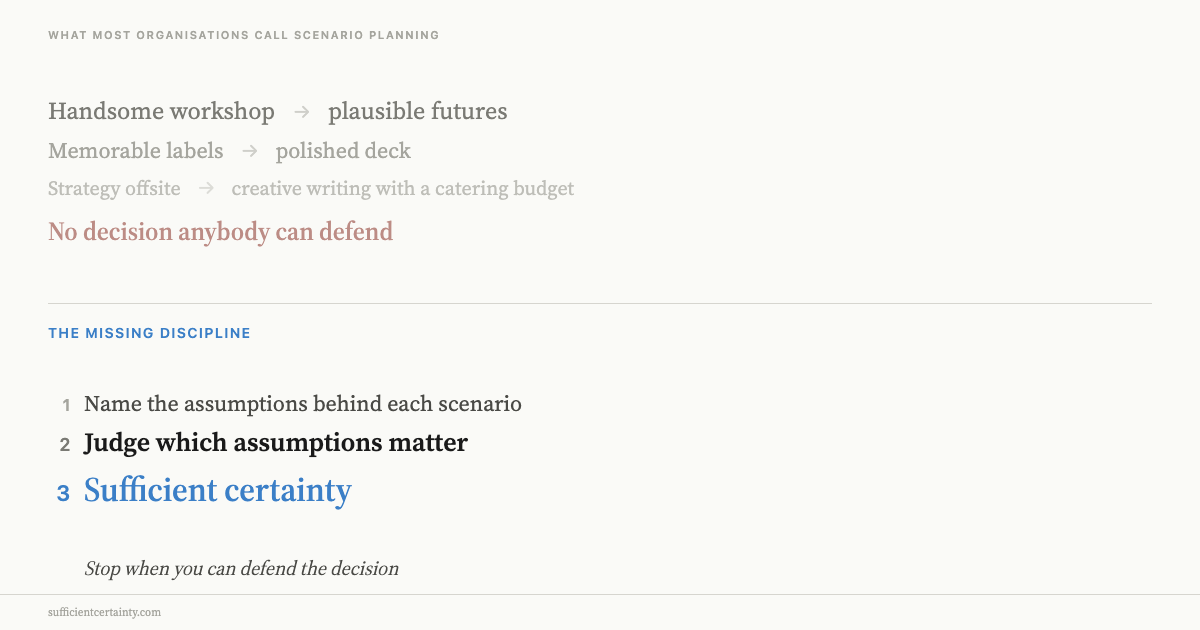 July 2026
 Scenario Planning Tools Miss the Only Question That Matters
Scenario planning tools model futures and display outputs. None of them force the team to name the assumption that would cancel the investment.
Situation Analysis
Most teams stop at SWOT or PESTEL and call it done. The step they skip turns observations into testable assumptions, and it changes the decision.
Read the full guide →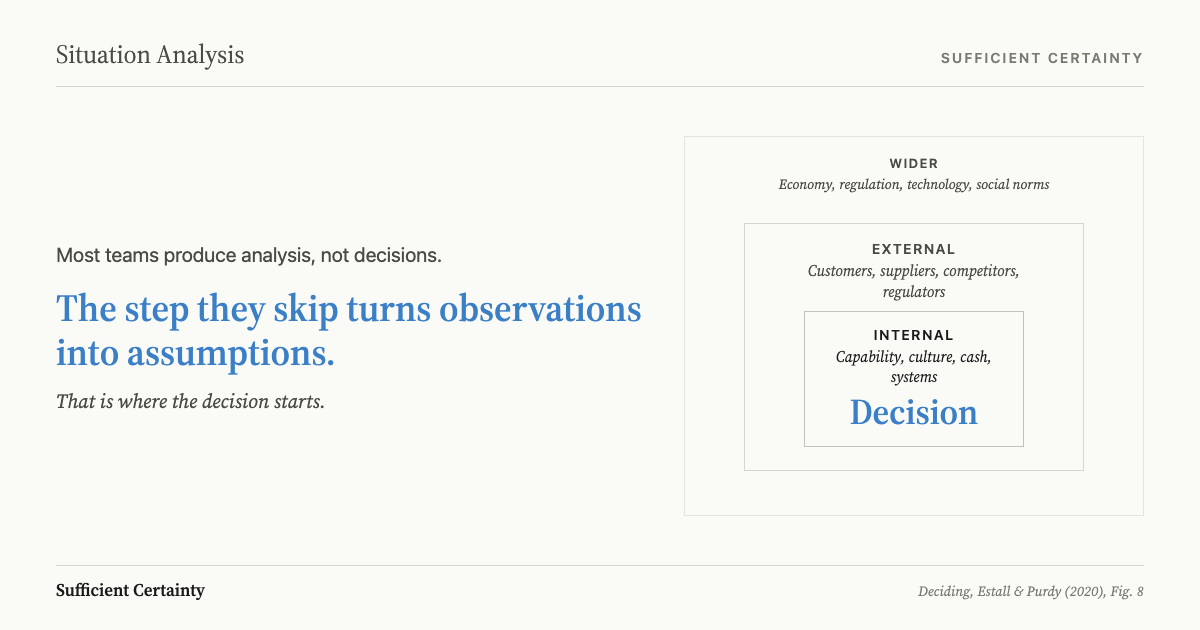 October 2026
 What to Do After an Environmental Site Assessment
An environmental site assessment can identify contamination without releasing the next site activity. Define what must happen before demolition or development.
Sound Judgment
Most organizations treat judgment as a hire-for trait. Five steps turn it into a repeatable method your team can practice and assess.
Read the full guide →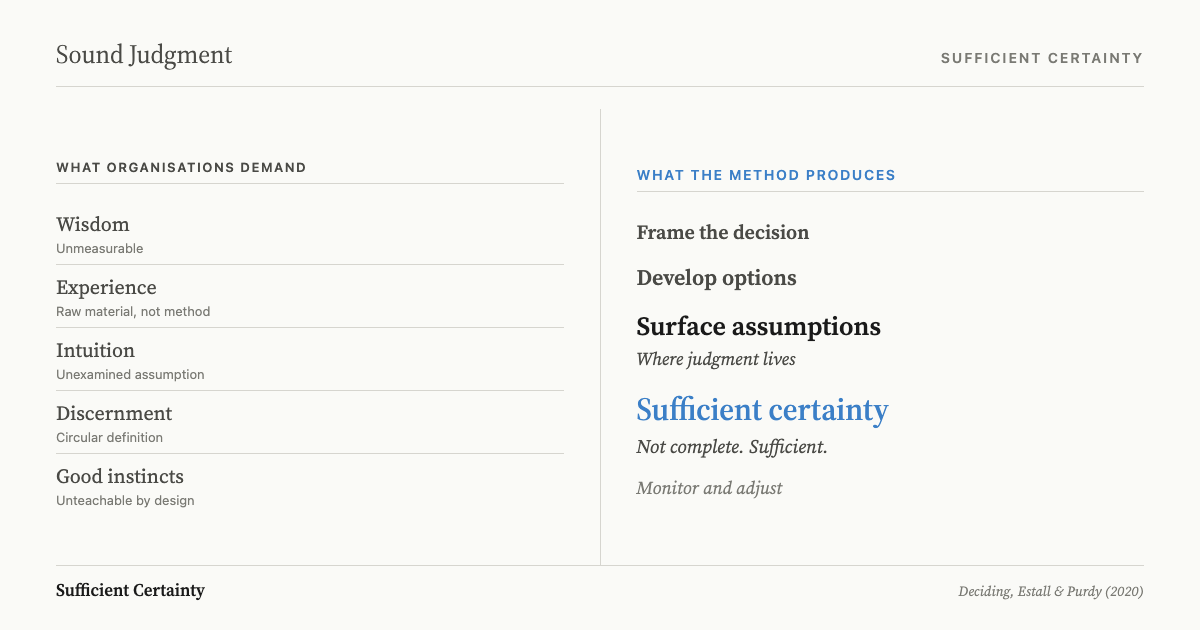 July 2026
 What Is Sound Judgment? One Question, Not a Trait
Your performance review says "sound judgment." Nobody who writes that can define it. Here is a definition that works: test the assumption before you commit.
Stakeholder Alignment
Stakeholder alignment is the state in which everyone who must act on a decision understands what was decided, what it assumes, and what to watch. It is not agreement.
Read the full guide →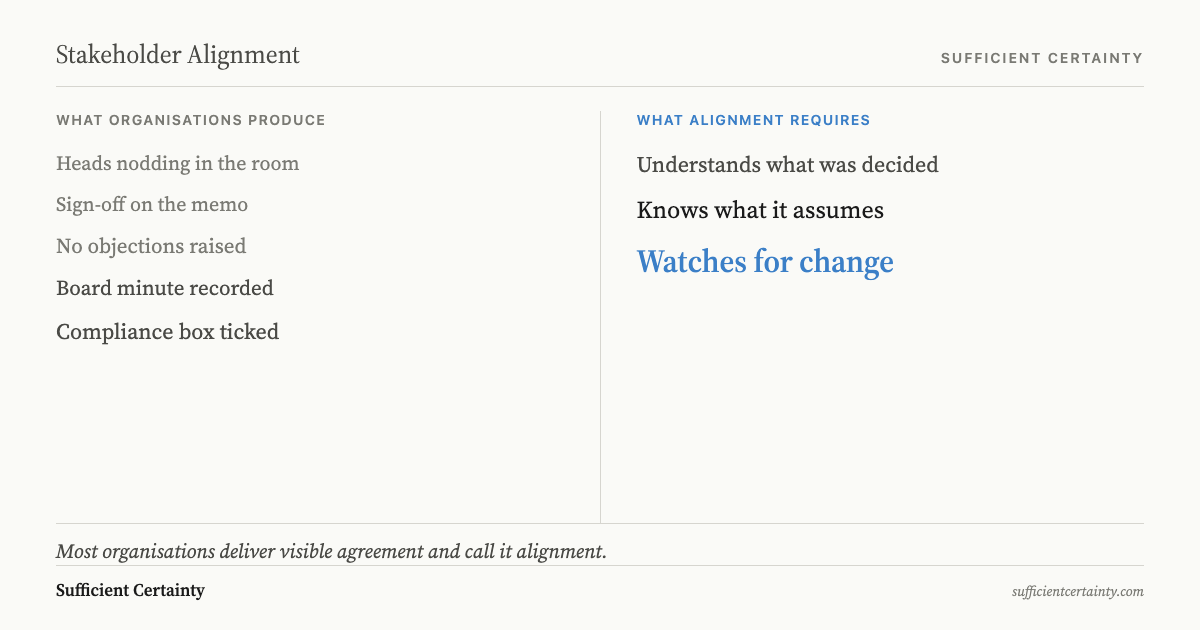 October 2026
 What to Do After an Employee Satisfaction Survey
The survey results land, the action plan is signed, and nobody reads the numbers again for a year. Set the score that reopens the plan before it is filed.
Strategic Problem Solving
Strategic problem solving fails when the problem itself was never tested. Frameworks run, plans look thorough, and the answer is still wrong.
Read the full guide →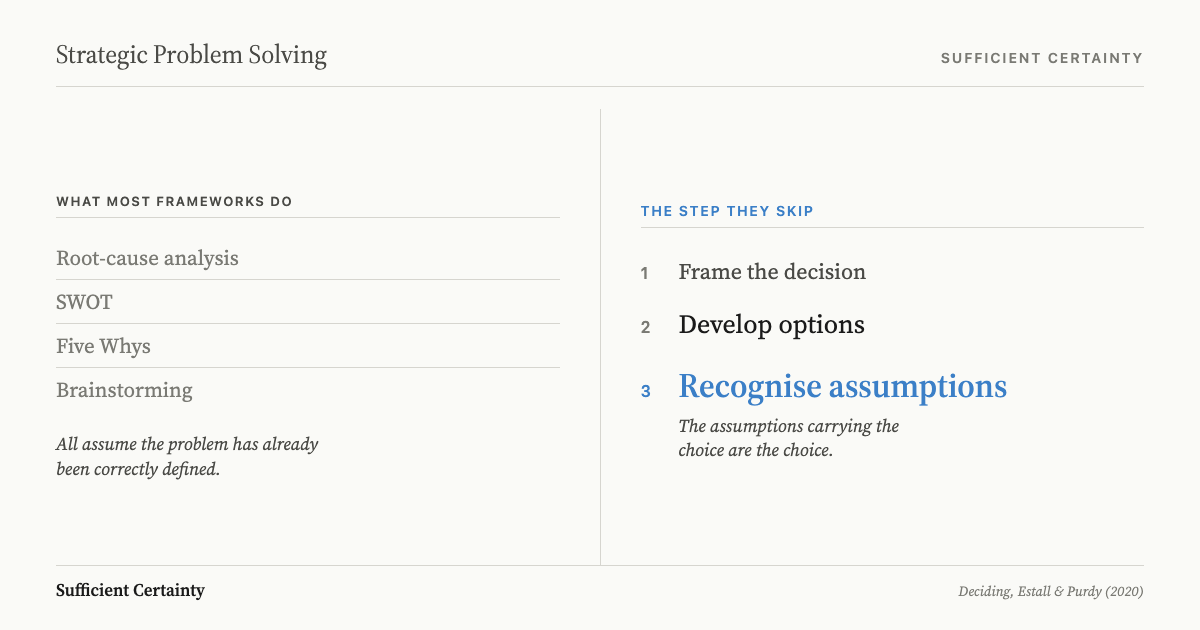 July 2026
 Business Problem Solving Starts Before the Business Case
A business case can have perfect numbers and still solve the wrong problem. Nobody checks the question until the money is spent.
Strategic Thinking
Strategic thinking is the work of setting direction before committing resources: clarifying purpose, identifying what is possible, and naming the assumptions behind each path.
Read the full guide →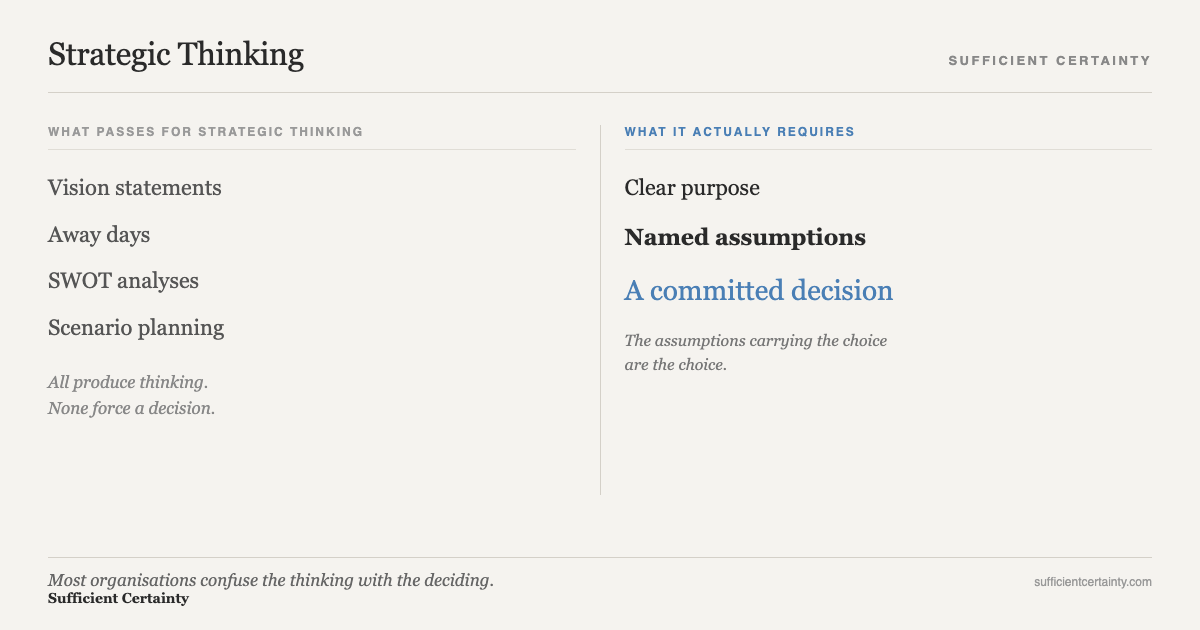 October 2026
 What to Do After a Value-Chain Analysis
After a value-chain analysis, confirm what the next activity needs from a proposed change. Record the signal that requires another review before approving it.
Sunk Cost Fallacy
The sunk cost fallacy is not a thinking error. It is a process gap. A decision method that separates past investment from future uncertainty fixes it.
Read the full guide →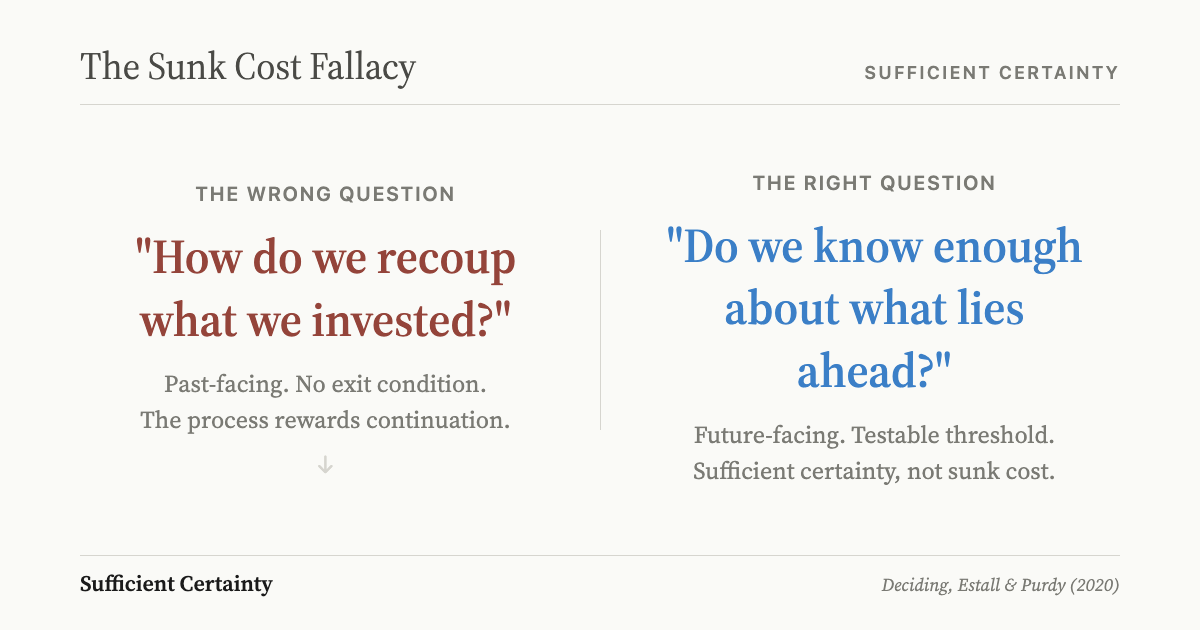 July 2026
 The Sunk Cost Fallacy Is Not a Fallacy If This Is True
The sunk cost fallacy is not a real fallacy. Whoever called it one skipped the harder question.
SWOT Analysis
SWOT analysis sorts what a room already thinks. It does not test what the room is assuming. A structured alternative that closes the gap.
Read the full guide →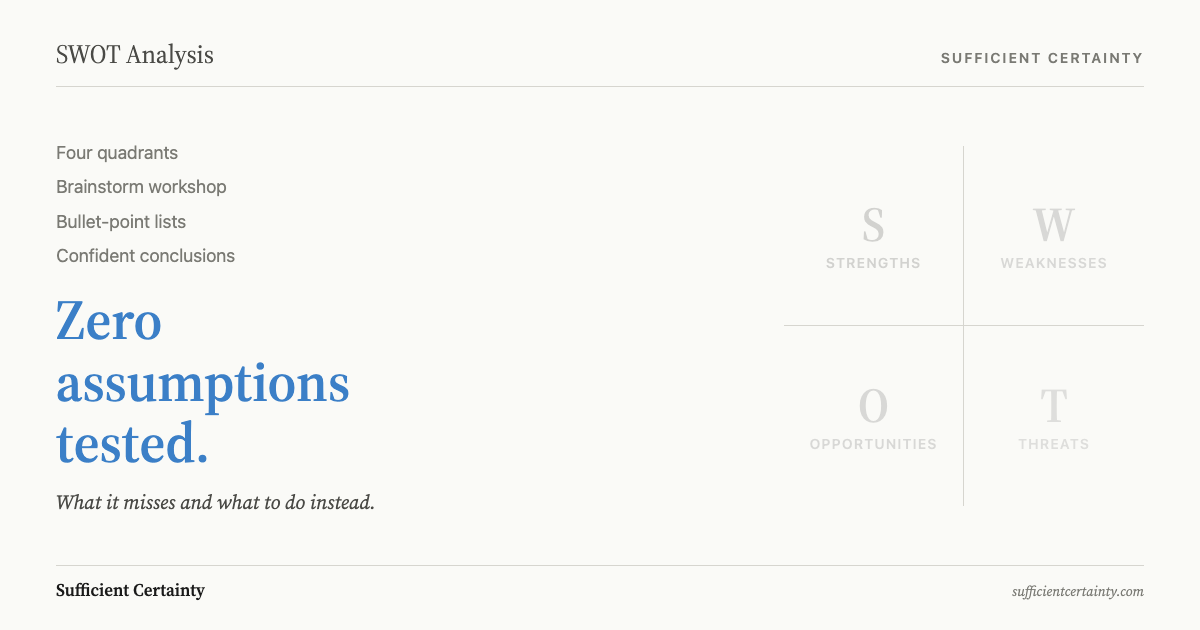 September 2026
 What to Do After a SWOT-to-Strategy
Your SWOT-to-strategy session produced prioritised initiatives with owners, budgets, and timelines. None of the assumptions those initiatives depend on have been tested. One step converts strategic confidence into evidence before resources move.