
Predictive analytics decision making works when the forecast tests a named assumption and someone owns the trigger that would change the call. Without that ownership, the model becomes the decider, and nobody in the room can explain what happens when the input conditions shift next quarter.
In a Monday demand-planning meeting, the replenishment team was ready to add 12 per cent to September inventory because the model projected two strong weeks of back-to-school demand. The dashboard showed a green band, the vendor deck said the forecast had been validated, and the room was ready to approve the buy.
Then one awkward question landed: what assumption is the forecast testing? Nobody could say who owned the call if the stock sat in the warehouse, or what signal would stop the next order. That is predictive analytics decision making at its most dangerous.
I do not object to prediction. I object to the small act of cowardice that often follows it. A model produces an estimate, then adults who are paid to decide start treating the estimate as if it has relieved them of judgement. The spreadsheet gets promoted. The Decider goes missing.
The wider problem in data-driven decision making is not lack of evidence. It is the failure to say what the evidence is meant to prove, a pattern visible in three organisations that had accurate data and still got the call wrong. A prediction is useful only when it is attached to the assumption carrying the call.
Predictive analytics decision making is the use of forecasts, scores, or predictive models to inform a choice while a human decision-maker still owns the judgement and consequences.
Predictive Analytics Decision Making Starts With Ownership
The cleanest test is simple: if the model is wrong, whose decision was it? If the answer is "the model's", the organisation has already failed. Machines do not attend board meetings, approve credit, confront customers or send people to prison. People do those things, often after borrowing a little dignity from a score.
The Bank of England's Prudential Regulation Authority says this in committee language. Its SS1/23 model-risk principles cover the path from identifying a model to validating and limiting its use. That is not paperwork for its own sake. It is a warning that models used to inform business decisions need a named owner and a limit that can be challenged before the output starts wearing authority it has not earned.
I would translate that into plainer language. What is the model standing in for? What assumption does it test? How wrong can it be before the decision becomes unsafe? Who is allowed to override it? These questions are not technical niceties. They are the decision.
They matter even more when the model comes from a vendor. The people in the room may not know the training data, the update cycle or the weaknesses hidden in the documentation. That ignorance is not a defence. If the organisation chooses to act on the output, the organisation owns the choice. Outsourcing the calculation does not outsource the judgement, however much comfort procurement takes from the contract file.
Predictive Analytics Decision Making Can Hide the Error
COMPAS risk scores show the problem in a harsher setting. ProPublica's Machine Bias investigation reported that the scores were used in criminal-justice settings to predict future crime risk. The troubling part was not merely that a score existed. The troubling part was that its error pattern carried consequences for people who did not build the model and could not audit it from the dock.
According to ProPublica, Black defendants who did not reoffend were labelled high risk at a much higher rate than white defendants, while white defendants who did reoffend were more often labelled low risk. That is not an abstract model-quality concern. It is an assumption about future behaviour entering a human decision with a false air of neutrality.
The decision question should have been visible. What error rate is tolerable when liberty is at stake? Is a false positive more acceptable than a false negative? Who chose that trade-off? If nobody can answer, the score is not supporting judgement. It is laundering it.
I have seen safer-looking versions of the same pattern in commercial work. A risk score moves a customer into a harsher workflow. A demand model shifts purchasing authority to people who never saw the local exception. A credit model narrows a person's options before anyone can explain why. The setting changes. The discipline does not. A score that affects a person needs a visible action rule, not a private shrug from the analytics team.
This is why I am wary of the phrase "data-driven" when the decision itself remains unnamed. In the Universal Decision-Making Method, the model would be forced back into the assumption it is supposed to test. Once the assumption is visible, people can challenge whether the evidence is strong enough for the action being proposed. Before that, everyone is admiring the machinery.
Record the forecast behind your decision with the owner, the likely error, and the trigger that proves it wrong. Start the Walk →
A Forecast Is Not Permission to Act
Forecasts are only one branch of predictive analytics decision making. The same custody problem appears when the output is a propensity score, fraud score, or other scored model output that tells staff what they may do next.
Rite Aid offers a more everyday scored-output version of the same defect. The Federal Trade Commission said the retailer deployed facial-recognition technology without reasonable safeguards, falsely tagging consumers as shoplifters, particularly women and people of colour. The settlement banned Rite Aid from using facial recognition for surveillance purposes for five years.
The lesson is not that facial recognition is uniquely wicked. The lesson is that a classificatory signal became an instruction to act. A system said "possible shoplifter", and people with uniforms and store authority turned that suspicion into an encounter. That is where predictive analytics stops being a dashboard and becomes a decision process, whether the operator admits it or not.
The useful question is not, "What does the system predict?" It is, "What are we allowed to do because of this prediction?" I want that written before the first customer, applicant, patient or employee is touched by the output. If the action threshold is vague, the organisation has delegated ethics to software and hoped nobody notices. Someone always notices, usually after the harm has become expensive.
The same point applies in less dramatic settings. A churn score is not permission to discount every account. A demand forecast is not permission to build inventory. A fraud score is not permission to accuse. Predictive analytics decision making becomes useful only when the forecast is tied to a specific action and a named person accepts the leftover uncertainty.
What I Record Before I Trust a Prediction
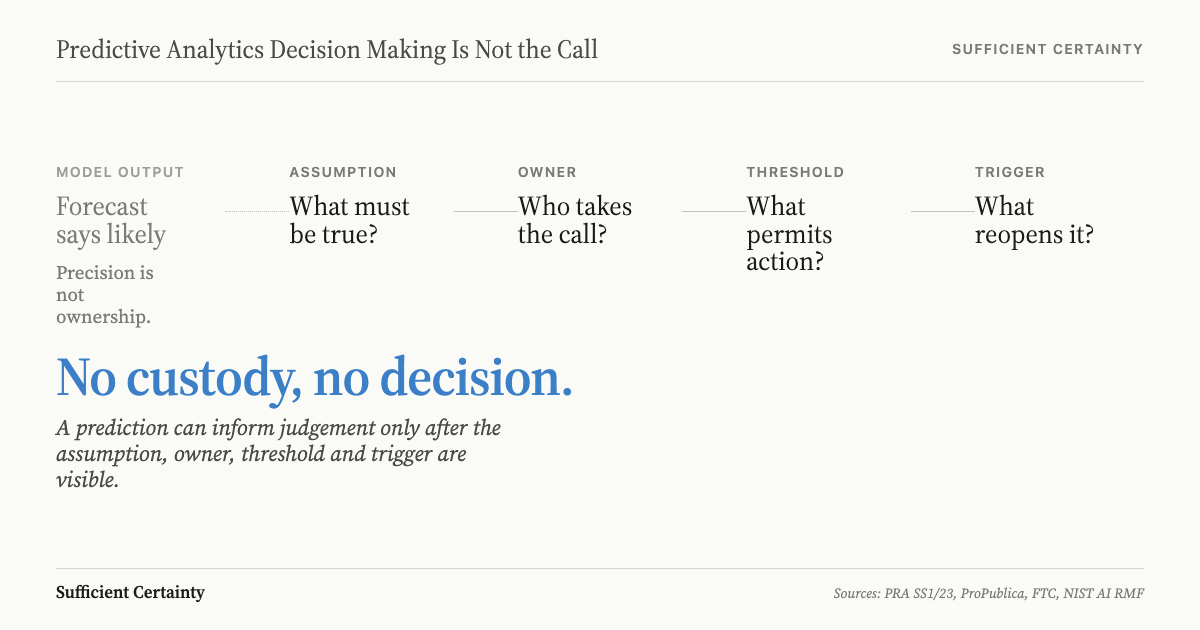
NIST's AI Risk Management Framework uses a lifecycle discipline: govern, map, measure, manage. That is useful, but it still needs a decision sentence underneath it. I want a record that says: this prediction tests this assumption; this person owns the call; this threshold permits action; this signal reopens the decision.
In plain operating terms, a demand-forecast record might read like this: "We are adding 12 per cent to September inventory because the forecast is testing the assumption that back-to-school demand will stay above 18,000 units a week. The supply director owns the call. We buy only if the model stays above that threshold for two weekly runs. If sell-through drops below plan for ten days, we freeze the next order and reopen the decision." That is not elegant. It is usable.
That record also keeps predictive work from collapsing into big data decision making theatre. The more impressive the model looks, the more tempting it becomes to skip the dull sentence that carries the real burden. I have watched teams spend months improving a forecast while nobody asked whether the forecast still answered the decision in front of them. Vendors enjoy that version. It keeps the invoice clean and the accountability foggy.
A better data driven decision making framework begins before the model output. It names the decision, exposes the assumption and states what would count as sufficient evidence. It then treats monitoring as part of the commitment, not a dashboard added later for comfort.
I have no patience for prediction used as camouflage. If the model is good, it will survive being translated into plain English. If it cannot survive that, it was never ready to carry the decision. A forecast can improve judgement. It cannot replace the person who must finally say, "We will do this, for these reasons, and we will reopen it if this signal changes."
You could let a forecast make the call and discover too late what it never tested.
Work through your decisionNo sign-up. Just pick your decision and start.
Grant Purdy is the co-author, with Roger Estall, of Deciding (2020), and the architect of the Universal Decision-Making Method.