
Risk-based decision making is a decision, not a matrix. The team that scores likelihood and consequence has produced a register. It has not yet asked a question, tested an assumption, or committed to anything. Scoring feels like progress because it fills a template. The actual decision still sits unexamined.
Risk-based decision making is a decision, not a matrix. The team that scores likelihood and consequence has produced a register. It has not yet asked a question, tested an assumption, or committed to anything. Scoring feels like progress because it fills a template. The actual decision still waits in the corridor.
I have sat with directors who had a 47-item register and six weeks left before a board call on closing a plant. They had paperwork. They did not yet have risk-based decision making.
That phrase gets abused. It is usually treated as a way to bolt risk language onto a decision that has already gone soft. I use it differently. If uncertainty matters because it may upset what you are trying to achieve, the job is to make the decision with your eyes open, not to build more apparatus around it.
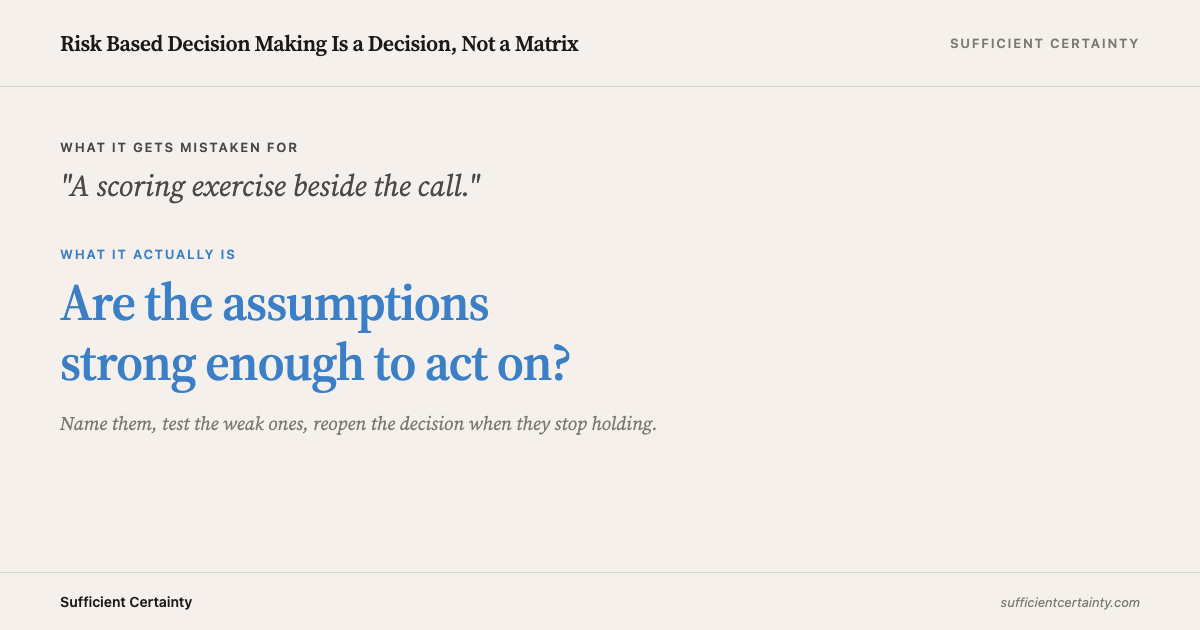
Risk-based decision making is the practice of making a decision by testing the assumptions beneath the options and acting when the evidence is strong enough.
It Starts With the Call You Have to Make
It starts with the decision itself. That sounds obvious, yet most organisations begin somewhere else: the register or the committee paper. The decision gets treated as the last small box on the form.
The field cannot even agree what the phrase means. A scoping review in Risk Analysis confirmed it: fifty years of use, no settled definition. That saves us from pretending the label is the method. Ask the plain question first: what are we deciding, and what could stop it from working?
You are no longer trying to score every possible bad thing. You are trying to test the few assumptions the decision actually rests on. That is the same move I make in the Universal Decision-Making Method, and it is why a concise decision record is usually worth more than a swollen risk appendix.
Most guidance on this subject assumes there is a risk function somewhere nearby, ready to translate the decision into a process. Most of the decisions I see do not work like that. There is a divisional head or a board committee with a date on the calendar and a call to make. They do not need another profession built around them. They need a way to say which assumptions matter and what evidence would change the answer.
Why Risk-Based Decision Making Turns Into Theatre
This usually turns into performance when people confuse precision with judgement. A matrix looks rigorous because it seems precise. It still cannot tell you whether the assumption underneath the decision is sound.
I have watched rooms spend an hour arguing about whether a consequence score should be four or five, then spend thirty seconds on the assumption that demand will still exist in eighteen months. The scoring lets adults dodge the one sentence that would expose the bet: if this assumption fails, our decision fails with it.
This is why so many registers are useless to the person who has to decide. I wrote a longer piece on why risk registers do not help you decide. The apparatus expands and the decision-maker is left with less clarity than before. The broader picture of risk covers how that happened.
Even the U.S. Government Accountability Office stops short of pretending one score can do the deciding. It says risk-informed decisions draw on risk information alongside cost, law, and context. That is already more honest than most of the apparatus industry, and it is still not enough, because it leaves the actual decision to the reader.
Strip one risk matrix back to the call itself and write down what would make you reopen it. Start the Walk →
Risk-Based Decision Making Reopens the Call When Assumptions Fail
When the assumptions weaken, you reopen the decision. You do not carry on because the program is late or the paperwork is complete.
NASA's Starliner investigation is a good example. After the June 5, 2024 crewed flight test ran into helium leaks and thruster anomalies, the mission stretched to 93 days and the spacecraft came back without the crew. NASA later said program objectives had influenced operational decisions. That is the sentence that matters. It tells you the live judgement about sufficiency had been bent by pressure from elsewhere.
The FAA response to the 737-9 MAX door-plug blowout shows the opposite instinct. The fleet was grounded, 171 aircraft were inspected, Boeing's production expansion was capped, and the agency set up weekly reviews plus monthly progress meetings. In other words, the decision was staged and reopened as evidence arrived. That is what serious practice looks like when the stakes are public.
The same lesson appears in the World Health Organization's 2026 guidance on modelling. The model is there to serve the policy decision. It is not the decision. Officials are told to examine data gaps, assumptions, and uncertainty before leaning on model outputs. A model can inform a choice. It cannot relieve you of making one.
What I Do Instead of the Standard Apparatus
I do not start by asking a team for its risk appetite. I ask what decision must be made and what outcome must be protected. That is Framing, and it is the part most teams skip. Once they skip it, every step that follows is solving the wrong problem.
Next I get the room to develop the real options and name the assumptions each one rests on. Not every assumption. The ones that could break the call. In a plant-closure decision that might be one assumption about demand and one about regulatory timing. The team already knows which ones matter. They have just never been asked to say so out loud.
Then I ask whether the evidence beneath those assumptions is strong enough to act. That is sufficient certainty. It is not consensus and it is not waiting until every unknown is retired. It is the point where acting is defensible and the remaining uncertainty can be watched rather than resolved.
That sequence is practical because it keeps uncertainty tied to a live choice. It also stops analysis from pretending to be authority. If a consultant brings a model, or a specialist brings a register, fine. Put it on the table. Then ask which assumption it tests and whether that assumption is central enough to move the decision. If the answer is vague, the artefact is noise.
Monitoring matters because some evidence only arrives after you move. A factory expansion or a product withdrawal reveals itself in stages. The discipline is to decide in advance what you will watch and what would cause you to reopen the choice. If the decision rests on a supplier delivering by March, you watch the supplier's weekly progress, not a risk register update in June. If the assumption is that demand will hold, you watch early order data, not a quarterly forecast. Most organisations leave that work until later, which is why bad assumptions stay hidden long enough to become expensive.
Roger Estall and I made the same point in Deciding: test the assumption before the room commits, then watch the ones that can still break the call. The method structures that conversation. If you need the wider logic, read making decisions with uncertainty. Then give the decision-maker a clear record of what was assumed and what will be watched.
Done properly, risk-based decision making is not a profession sitting beside the decision. It is the decision, with uncertainty handled in plain language.
You could close this tab and carry that decision into another week.
Work through your decisionNo sign-up. Just pick your decision and start.
Grant Purdy is the co-author, with Roger Estall, of Deciding (2020), and the architect of the Universal Decision-Making Method.