
After a near-miss investigation, the step before allowing the same work is to arrange one observed rehearsal of the proposed control. At Kirtlebridge in November 2019, three Network Rail workers cleared a 125 mph train less than one second before it passed. Nobody was injured. The Rail Accident Investigation Branch safety digest describes equipment that worked during testing, followed by a failure in how people understood the start of protection.
A near-miss investigation examines an event that could have caused harm, identifies why it happened, and supports changes to prevent a repeat.
At Kirtlebridge, a tested warning system left workers exposed
Track inspectors near Kirtlebridge relied on a Lookout Operated Warning System. Lookouts activated warning lights and a siren through radio-linked transmitters.
After a successful equipment test, the controller expected warnings from the northern lookout. The lookout expected another call. He sent no warning when the train passed him. The work was cancelled after the escape.
The team used informal language instead of the formal protocol. RAIB found that the conversation had not produced a shared understanding. An older, more complicated written protocol was present, but RAIB said it was not a factor in this incident.
Network Rail stated an intention to address the documentation issue and help staff use the simpler protocol. The digest does not establish that this follow-up was completed. It is a safety digest, rather than a full investigation report.
That distinction matters when using the case after another investigation. The manager must examine evidence for the correction before authorising work. A proposed corrective action still needs evidence before someone can rely on it.
The practical question for a manager reading these findings is what evidence should support the next permission to work. This is an application of the case, not a claim about Network Rail's later practice. A revised instruction could address the communication failure. Its existence alone would not establish that the people using it share the same understanding.
For a communication control, arrange a protected rehearsal with the people who will give and receive the instruction. Observe the complete exchange. Ask each person to state what they understand they must do next. Check their answers against the required procedure. Record any disagreement before the work can expose anyone to the hazard.
A rehearsal must not create the hazardous conditions it is meant to prevent. Keep required protection in place and use a safe simulation where necessary. The supervisor should specify who can stop the rehearsal and how a failed check will be handled. This makes the observation usable without treating workers as test subjects.
Separate the evidence for each part of the control. An equipment test supports a conclusion about equipment operation. An observed exchange supports a conclusion about communication. Neither should be used to claim the other was verified. The same discipline applies after a safety audit, when a document finding leads to a change in work.
Before the rehearsal, state what a pass requires. For a start instruction, this could mean that every participant correctly identifies when their duty begins. A qualified person must decide whether that observation covers the actual task. The evidence must match the control that the work will depend on.
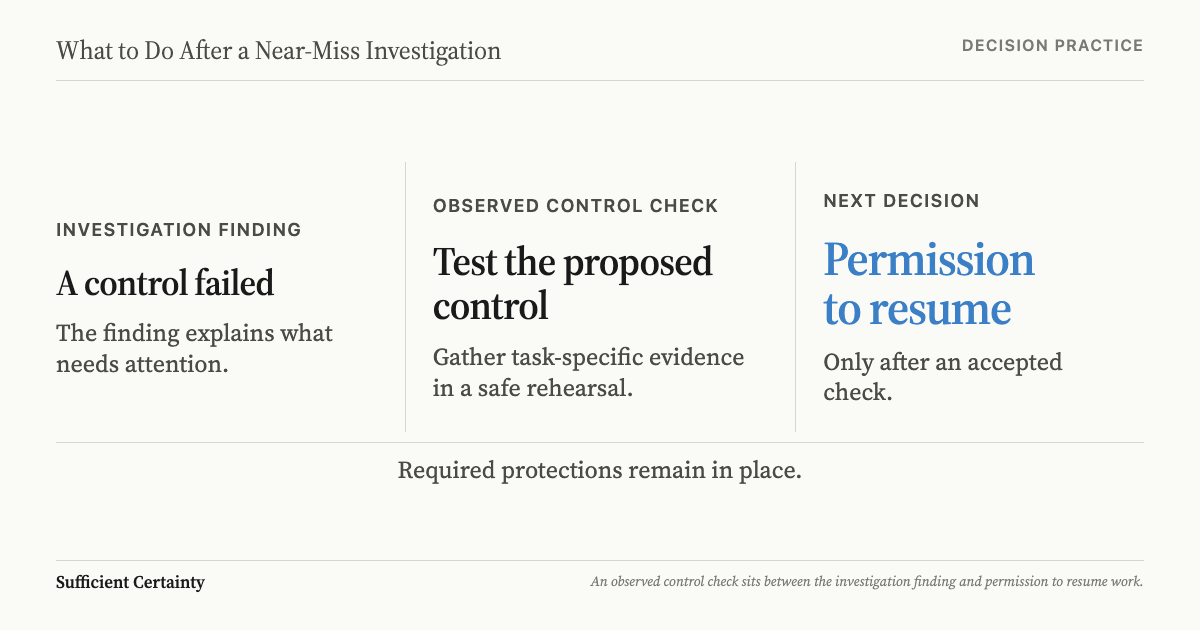
Closing the finding and authorising the work require different evidence. Keep the observation with the investigation action record so the person approving the work can examine both.
A near-miss report leaves a practical decision: whether the proposed correction has enough evidence to support the next start. Start the Walk →
What does a near-miss investigation establish?
A sound investigation establishes what happened and which conditions contributed. It gives the organisation a reason to change a control before someone is harmed. The OSHA incident investigation guidance calls for attention to underlying causes and worker involvement, rather than stopping at fault or failure to follow a rule.
This gives the action plan a useful starting point. Investigators can connect the proposed change to a finding. Workers can explain whether the change fits the task. Managers can provide the resources and authority needed to implement it. Keeping that connection visible reduces the chance that a convenient action replaces the action the finding actually requires.
The HSE investigation workbook treats an action plan and its implementation as part of the investigation process. Its action record asks for a control measure, completion date and responsible person. These fields make follow-up concrete. A report without an owner or date leaves the reader unable to tell who must act next.
Add a field for the evidence needed to accept the action. An owner can send a new procedure and meet the deadline while its use remains unobserved. A completion entry should therefore say what was changed. The acceptance entry should say what was checked and what the check showed.
An investigation explains the need for a correction; a control check supports the decision to rely on it. This is the point where the risk assessment must reflect the changed task, rather than merely refer to a completed report.
The instruction is rewritten and the action marked complete. The record contains no observation of the people using it.
The required exchange is rehearsed safely. The record shows what each participant understood and whether the agreed check passed.
Neither a quiet period nor the absence of injury fills this evidence gap. A near miss can show that the existing arrangement needs attention without showing how often it will fail. Choose the evidence needed for the next task, rather than inventing a recurrence rate from one event.
The same boundary matters after root cause analysis. Explaining a past failure helps select a correction. Checking the correction requires a separate observation. If the investigation leaves an important cause unresolved, keep that uncertainty visible in the action record instead of declaring it settled.
Use the workplace risk assessment follow-up to examine whether other tasks depend on the same control. Extend the review where the finding applies. Do not claim every task is affected without checking its conditions.
Observe the control before authorising the same work
Prepare a short control acceptance record before the next start briefing. Name the task, the investigation finding and the proposed change. State who must carry out the check and who can authorise work. Attach the current procedure so the observer checks the required arrangement.
Write the pass condition before collecting evidence. It should describe observable performance, such as a correct instruction followed by the required response. Include the relevant operating conditions. If noise, visibility or a handover affects the control, the qualified reviewer should decide how those conditions must be covered safely.
Sufficient certainty means having proportionate, task-specific evidence to support the decision. It does not mean accepting less protection because the investigation is complete. Required safety controls remain required. A change that needs technical validation, specialist assessment or formal approval must receive it.
One observed rehearsal is a concrete first action. It is not an automatic permission to resume. If the control has several failure modes, or the possible harm is severe, further checks may be necessary. The responsible person must explain why the collected evidence is enough for this task and where its limits remain.
Record a failed check even if the correction passes on a later attempt. The earlier failure may identify conditions that the final approval needs to exclude.
The Universal Decision-Making Method asks whether the available information supports acting with sufficient certainty. Applied here, the decision is specific: whether to permit this work under the proposed control. Keep the investigation conclusion separate from that permission.
Use the record at the point of authorisation, before workers depend on the changed control. If the agreed condition fails, keep the affected work paused or use another approved safe arrangement. Assign the next check to a named person. A failed observation should change what happens next, rather than produce another reminder.
Permission to resume must depend on the check result, not the action's due date. This also provides a useful boundary after an incident post-mortem: completion of the review does not by itself authorise the activity it examined.
Set a trigger for reviewing the evidence again. A different crew, changed equipment or a changed procedure may invalidate part of the earlier check. OSHA program evaluation guidance calls for verifying that controls remain effective and considering changes in equipment, personnel and work practices.
Put those triggers in the acceptance record and name who will respond. Check the record during the next relevant briefing and after a trigger occurs. The next work decision needs evidence about the conditions that exist now.
What evidence would justify resuming the work under the corrected control?
Work through your decisionNo sign-up. Just pick your decision and start.
Grant Purdy is the co-author, with Roger Estall, of Deciding (2020), and the architect of the Universal Decision-Making Method.