
After a project risk assessment, write down the change that would make the approved reserve too small. In December 2014, GAO reported that the James Webb Space Telescope's cost risk analyses omitted risks identified since 2011. The project still reported that it was on budget and schedule.
The next decision is about the work still to come. A reserve judged adequate at approval needs a stated condition for review. That condition should cause someone to check the remaining money and time. The check must address the next commitment.
A project risk assessment examines uncertainties that could affect project objectives and informs choices about responses and resources. These choices affect delivery commitments.
The assessment informs reserves and project commitments
Use the completed assessment to prepare a specific decision. The sponsor may need to release funds for the next phase. That choice needs evidence about the work it will authorise. A list of project concerns is only part of that evidence.
Identify the reserve that supports the proposed commitment. It could be money available for extra work or time available before a delivery deadline. State what the reserve is intended to cover. Check whether the estimate includes the proposed responses and their likely effect on remaining work.
Name the commitment the reserve supports. A budget for completing design supports a different choice from a budget for delivering the finished system. An assessment of the earlier phase cannot automatically justify the later one. The distinction also matters after a stage-gate review.
Record who can approve use of the reserve and who can change the commitment. Those may be different people. A project manager could have authority to authorise extra testing while the sponsor controls the promised delivery date. Make the route between those decisions explicit.
Make the review rule part of the approval record. A note in an analyst's working file may never reach the sponsor. Put it beside the approved amount and date, where the next request for funds will be checked. This also makes it possible to explain why the decision remains supported.
Finally, record the assessment date and the work remaining at that date. This gives later reviewers something concrete to compare with new information. The broader risk assessment discussion concerns how analysis informs a choice. Here, the focus is how a project keeps that choice under review as work changes.
What can a project reserve support?
A reserve allows a project to absorb some change without seeking a new approval for every issue. Extra testing may fit within the resources already authorised. That flexibility is useful when the project knows what the allowance covers.
Keep the reserve tied to remaining work. The important comparison is between what is left and what could still consume it. A reserve that remains untouched tells little about its adequacy if the difficult work has not started. Nor does reserve consumption alone prove that the project needs to stop.
Review the reserve alongside the delivery plan. Ask whether a delay would keep people employed longer or postpone revenue. Check any extra supplier costs separately. Time and money may move together. A response that protects the deadline could spend the cost reserve faster.
This is a narrower question than whether the project can be built. Technical feasibility concerns whether the proposed system can work. A reserve review concerns whether the remaining resources still support the delivery commitment under the conditions now known.
Which change would make the remaining project reserve too small for the work still to come? Start the Walk →
New risks can invalidate an earlier reserve
A project changes as the team moves from design to delivery. Testing can reveal extra work. Suppliers can revise dates. A planned response may fail to reduce the uncertainty it addressed. The assessment can remain neatly documented while the facts behind its estimate change.
A changed fact needs a decision response. Updating a register records the issue. It does not establish whether the approved reserve still covers the remaining exposure. That is the practical limit of a risk register when it is separate from the commitment.
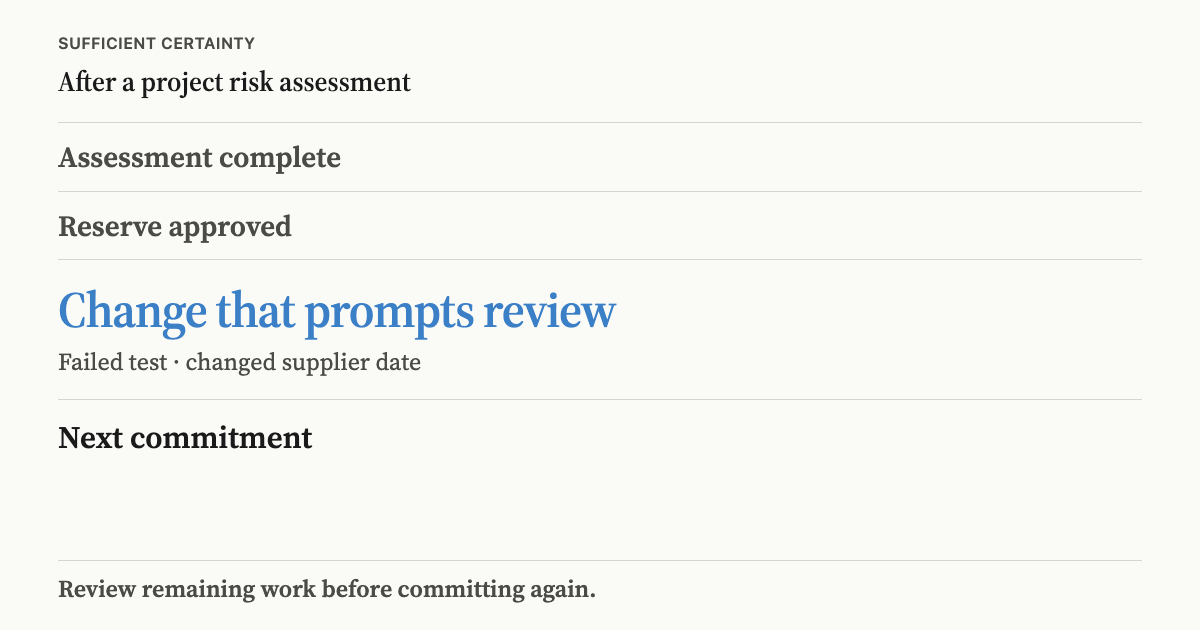
Set review conditions around facts that could materially change the estimate. A failed acceptance test could prompt a reserve review before dependent work starts. This is a proposed condition for readers, not a description of NASA's procedures.
Choose conditions early enough to preserve a useful response. If the trigger waits until the money has gone, it may only confirm a problem. A missed test milestone can prompt a review before dependent work starts. The review can then consider more testing or a revised sequence. It could also support changing the date.
Check the evidence used to monitor the reserve. In its December 2015 Webb report, GAO found that a completed cost risk analysis substantially met best practices. It also found that officials did not plan periodic updates. A simplified analysis used instead relied on contractor performance data that GAO found unreliable.
The reader's lesson is to check both the changing work and the information used to describe it. Risk analysis may improve an estimate. It cannot keep that estimate current unless new evidence reaches the people who can revise the decision.
Webb needed risk analysis that changed with the work
The Webb record shows a specific gap between completing analysis and maintaining it. GAO's current status entry for its 2014 recommendation records that the project completed a cost risk analysis. It also records that the project did not plan to update it as significant risks emerged. The recommendation was closed without implementation after events overtook it.
That status entry describes later developments, not just what was known in December 2014. It records that NASA revised the cost and schedule baseline in June 2018. The distinction matters: an analysis completed after a recommendation does not show that its results were kept current throughout the work.
Review the promise when the remaining work changes. In February 2018, GAO reported that the launch readiness date had slipped by at least five months in 2017. Spacecraft integration took longer than planned. Technical issues consumed the remaining schedule reserve, and the revised launch window provided more time.
GAO also reported pressure on cost reserves. Planned workforce reductions had not occurred as expected because technical challenges kept work going. A revised date therefore affected the resources needed to complete the project, as well as the calendar.
This record does not prove that updating the analysis would have prevented those delays. It supports a more limited conclusion: changed project facts required renewed scrutiny of reserves and commitments. Webb launched on 25 December 2021. These earlier reports concern delivery management, not a claim that the mission failed.
Name the change that reopens the project decision
Attach a short review rule to the approval. State the commitment and the reserve supporting it. Name the change that prompts review. Assign the person responsible for that review. Identify what happens before further money or work is committed. Assign someone who can change the decision. Reporting an issue is insufficient if nobody can authorise a response.
The Universal Decision-Making Method places monitoring within the decision. Apply its five steps to the project commitment:
- Frame: State the result the next project commitment must achieve and the constraints it must respect.
- Tentative Elements: Set out the proposed work and resources. State the reserve and delivery date. Identify feasible alternatives.
- Assumptions: Identify what must hold for the remaining reserve to cover the remaining work.
- Sufficient Certainty: Decide whether the evidence is adequate to make this commitment, given the consequences of being wrong.
- Implement+Monitor: Assign checks and review conditions, with authority to revise the commitment when those conditions occur.
Keep routine progress checks and decision reviews connected. A weekly update can record a missed milestone without requiring a sponsor meeting. But if that milestone meets the agreed review condition, the update should identify the decision that now needs attention and the next commitment that depends on it.
For example, a sponsor could require a reserve review if an acceptance test creates work outside the approved estimate. The project manager would bring a revised estimate before authorising dependent work. This is a proposed arrangement. The actual condition must fit the project's contracts and work sequence. Assign review authority within the project's approval rules.
Connect the trigger to the next commitment. A review might support continuing or increasing the reserve. It could also support reducing scope or changing the date. Agree which choices remain available. The purpose of monitoring is to inform those choices while the project can still act.
Before the next project commitment, name the new fact that would require a reserve review.
Work through your decisionNo sign-up. Just pick your decision and start.
Grant Purdy is the co-author, with Roger Estall, of Deciding (2020), and the architect of the Universal Decision-Making Method.