
After action review captures what happened but rarely captures why the call looked safe. The real failure is earlier: the assumption behind the original approval was never stated, never tested, and never assigned to anyone who would reopen it when conditions shifted.
In one after action review I joined, the meeting room wall carried a delivery timeline beside four stock questions copied from the standard script. The meeting ran for ninety minutes. Everyone could describe what happened on Tuesday. Nobody could tell me which belief had made the original approval look safe a month earlier.
That meeting was not unusual. I have joined dozens across mining, infrastructure, and government projects. The wall decorations change. Sometimes there are post-it notes, sometimes slides with red-amber-green dots and a timeline that reads like a prosecution brief. The ritual does not change: the room tells itself a careful story about what went wrong in execution, and nobody asks whether the decision that started the whole thing was any good.
The after action review has become one of those corporate fixtures that nobody questions, partly because questioning it would mean questioning the people who approved the original call. The meeting reviews what happened. It almost never reviews what was decided, and the gap between those two questions is where the real learning sits.
An after action review is a structured debrief that traces a result back to the belief behind the original decision and the signal that should have challenged it.
Why the standard after action review looks backward
The Army built this format for drills against a known standard. In that world, FM 7-0 Appendix K makes sense: compare what was supposed to happen with what did happen, then tighten performance next time. Business copied the ritual into uncertain decisions, where the missing standard is the whole problem.
Harvard Business Review and Wharton still sell the meeting as a sensible corporate habit, and I understand why it travels so well. Approvers get a review without reopening their judgement. Governance staff get a neat pack for the board. Vendors and consultants get one more ritual they can package, and managers get the warm feeling of closure before blame finds them. The format did not drift in from the weather. It survives because it protects people.
The stock four questions and the chronology fetish point at how people behaved after the call. They usually end with little performance grades that leave the approval itself untouched. In my experience, the original judgement is treated almost as sacred text, which is convenient for the people who signed it (they are often still chairing the meeting). You end up with a performance review of the participants instead of a review of the decision.
Once the meeting starts grading whether people followed the plan, it quietly assumes the plan deserved obedience, which is the sly part. The format treats compliance as virtue and judgement as settled, even when the judgement was only a hopeful guess with committee stationery on it.
Rework the last approval that went wrong and identify the belief your review is still protecting. Start the Walk →
What an after action review should test
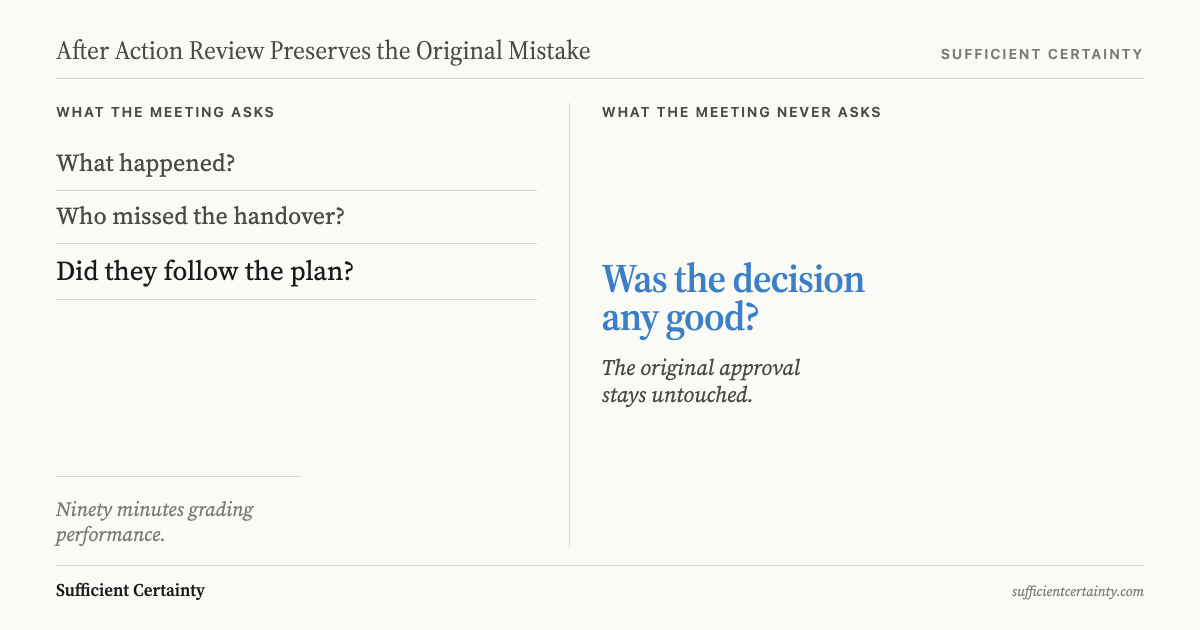
Roger Estall and I came at this differently in Deciding. I do not want a clever retelling of the project. I want the decision stated plainly. Then I want the belief that made that option look safe, plus the first signal that should have made the room stop and look again. That is built into the Universal Decision-Making Method, because a decision with no stated assumptions is only a preference dressed up as analysis.
The usual business after action review does the opposite. Asana's template pushes teams toward timelines and what went well. Atlassian's guide pushes facts and outcomes. It is neat and reusable, which is exactly why it spreads. It is almost useless when the approval itself was wrong. A timeline can show you when the train left the tracks. It cannot tell you why sensible adults waved it through the station.
Software vendors like that format because timelines and action logs fit neatly into a template, while judgement does not. The harder question is whether the decision rested on a belief that should never have survived contact with reality. Once you dodge that question, the meeting becomes a clean-up operation for execution noise and a protection racket for the original approval.
I have sat in rooms where everyone could point to the red status and the missed handover, yet nobody would ask the plain question: should this decision have been approved on the assumptions we had? That silence is not accidental. It keeps the meeting safe.
Why late after action review meetings become safe theatre
By the time most companies hold the meeting, everyone has already worked out which mistakes are safe to admit. Harvard Business School's Working Knowledge made the same point more politely when it noted that the Army reviews while the exercise is still underway, while corporate reviews often happen after the emails and the quiet revision of memory.
Late meetings also reward the best storyteller, not the best observer. By the time the room sits down, the rough edges have been sanded off and the awkward fact has usually been renamed as an "emerging issue". That is how folklore gets written.
A useful after action review needs the warning sign that should have been watched from the start. If nobody named that signal when the decision was made, the debrief turns into adults reconstructing yesterday's innocence. That is why I treat monitoring as part of the decision, not the housekeeping that follows it.
The same rot appears in post-mortem analysis when the room stares at the wreckage or the lucky escape and never reopens the belief underneath the choice. If the call was sound, fix execution. If the belief underneath it was rotten, stop blaming the operators.
How I run an after action review that fixes the next call
When I chair one of these reviews, I start with a sentence blunt enough to make people uncomfortable: what exactly did we decide, and what belief made that decision look safe at the time? A poor result does not automatically mean a poor decision, as I wrote in good decisions with bad outcomes, but you cannot separate luck from judgement until that original belief is on the table. If the room cannot answer quickly, nobody recorded the decision in a form that could later be tested.
Then I want the earliest signal, not the fullest chronology. I am not there to hear the whole story again. I want the first fact that should have reopened the call, because that is where the learning sits. This also exposes one of the common frauds in corporate review culture: people say they learned something late when the information was sitting in front of them early, ignored because it threatened the approved story.
I do not finish with owners and dates. I finish by correcting the decision record so the trigger for reconsideration is named and the same lie has less room next time. That is the discipline behind the decision quality argument. I have written separately about what to do after the review closes, because the meeting is only as good as what the room actually changes.
You could leave the next after action review protecting the same bad approval.
Work through your decisionNo sign-up. Just pick your decision and start.
Grant Purdy is the co-author, with Roger Estall, of Deciding (2020), and the architect of the Universal Decision-Making Method.