
Good decisions bad outcomes is a phrase people reach for after the result arrives. Hindsight rewrites the story. The only honest test of a decision is whether the assumptions it rested on were visible, checked, and reasonable at the time the commitment was made.
I sat through a board review in 2016 where five directors praised a supply-chain restructure because the quarter closed twelve percent above forecast. Fourteen months later the same restructure was called reckless after a single supplier collapsed. That is how shallow most scoring systems are. Good decisions bad outcomes are common, and bad decisions can look clever for years while the machinery keeps paying the bonuses.
A bad result does not prove the call was bad. The bigger failure is judging the ending instead of the basis on which the choice was made.
I do not need certainty about the outcome. Nobody gets that. I need enough certainty about the assumptions carrying the decision, enough to act even though uncertainty remains. That is all sufficient certainty ever meant, despite the expensive fog sprayed around ordinary decision-making by oversight people and the advisers who invoice them for the privilege.
Good decisions bad outcomes are sound calls, made on honest reasoning, that still went wrong because conditions shifted or luck moved against them.
Why Good Decisions Bad Outcomes Keep Fooling People
This confusion has been measured for years. In a 1988 paper, Jonathan Baron and John Hershey gave people the same decision facts and changed only the ending. Once the ending improved, observers called the decision better. Once the ending worsened, they called the same decision worse. That is not judgment. It is hindsight in a tie.
A 2023 replication with 692 participants found the same effect with a more realistic design. Even people who said outcomes should not matter still let the outcome sway their verdict. I am not surprised. Most organisations keep scorecards for results. They do not keep decision records showing what the call rested on when it was made.
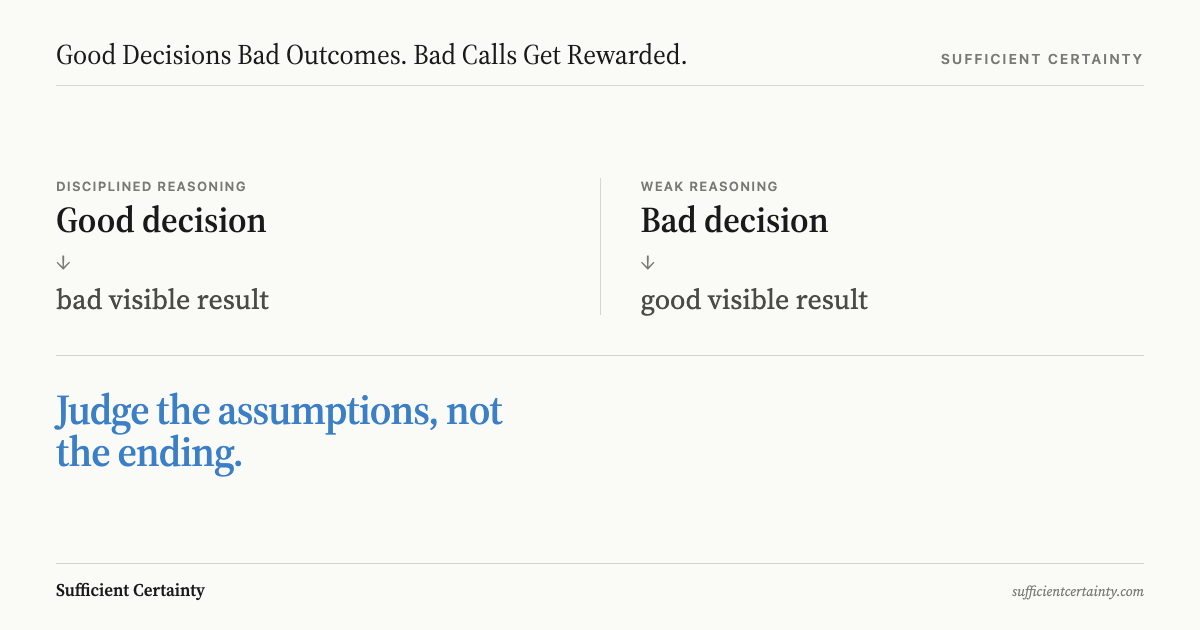
That is why I want a written record before action, and why the Universal Decision-Making Method puts the strain on assumptions in decision making. If the key assumptions were surfaced and dealt with honestly, you may still get a bad result. Roger Estall and I made exactly that point in Deciding: luck can reward sloppy reasoning and punish disciplined reasoning long after the real quality call was made.
Poker is the simplest analogy here. I do not need Annie Duke to lend it to me, though she makes the same point well enough. A strong bet loses hands. A foolish one wins them. The cards do not certify the reasoning, and neither do quarterly numbers.
Judge one painful result by separating the original call from the visible outcome. Start the Walk →
Starliner Was A Good Decision With A Bad Visible Result
NASA's August 2024 Starliner decision did not need much scene-setting. Boeing had spent years and billions. Two astronauts were in orbit. The program was already a public embarrassment. Then thruster problems and helium leaks raised doubts about safe return. NASA decided to bring Starliner back without its crew.
That looked, in public, like another expensive humiliation for Boeing. This is the part people miss when they see good decisions bad outcomes in full view. The ugly outcome was evidence of discipline, not proof of a bad call. The unresolved assumptions about safe re-entry were not bullied into submission for program pride or public optics. Plenty of people feed on that sort of theatre. The Decider should not.
That is decision quality. If you need the full argument, it sits in the guide to decision quality. The organisations that get into real trouble are usually the ones that cannot tolerate looking foolish for a week. They would rather protect appearances now and buy a larger failure later. I have seen that instinct in executives and boards trying to save face, and in regulators who prefer visible compliance to honest judgment.
Ceremonial assurance language is useful to people paid to certify the appearance of control. It is useful to consultants selling frameworks and to oversight bodies that want a neat file to point at. It is useless to the Decider who still has to live with reality.
SVB Was A Bad Decision With Good Outcomes, Until It Wasn't
Silicon Valley Bank shows the reverse. For a while the bank looked smart enough because the conditions were flattering it. The Federal Reserve's review says assets grew from $71 billion in 2019 to more than $211 billion in 2021, while management removed interest-rate hedges and left the bank badly exposed. That was not wisdom. It was a weak decision enjoying good weather.
When the weather turned, it turned fast. SVB sold $21 billion of securities at a $1.8 billion after-tax loss. Depositors pulled more than $40 billion in a day, and another $100 billion was expected to leave the next day. None of that suddenly made the earlier decision bad. The earlier decision was bad already. It had merely been flattered by conditions that had not yet started asking rude questions.
This is why I prefer a decision autopsy that goes back to the basis of the call rather than a committee performance after the corpse is on the table. Once the collapse is public, everyone rewrites history. The assumptions look obvious only because they have already failed.
What to Do When Good Reasoning Produces a Bad Result
The practical test is not complicated. Ask what has to stay true for this call not to make a fool of you. Not what the report says or what the most senior person in the room prefers, but what has to be true in the world for the decision to work? If nobody can answer that cleanly, the decision is not ready.
Then decide what signs would tell you that one of those assumptions is failing. If you only work out what to watch after the decision has been signed off, you did not finish the decision. Conditions change and implementation drifts, even when the original reasoning was sound. Monitoring is part of the call because reality does not care what your approval paper said. The same test applies to a team deciding what to do after an MVP launch: if early metrics pass for proof, the assumptions underneath need testing before scaling begins.
That is also why broken outcome-scoring systems survive. They suit executives and boards because they excuse bad reasoning in good times and turn judgment into a tidy scoreboard. They suit regulators and consultants because visible metrics are easier to defend, and easier to sell, than thought. Good decisions bad outcomes ruin that convenience. They force you to inspect the reasoning before you admire or denounce the result. The same dodge runs through innovation decisions, where the existing model gets scored by its track record while the new idea gets scored by its assumptions.
You could praise this quarter and reward the same bad logic again.
Work through your decisionNo sign-up. Just pick your decision and start.
Grant Purdy is the co-author, with Roger Estall, of Deciding (2020), and the architect of the Universal Decision-Making Method.