
Business decision analytics under uncertainty shows you the options. It does not make the choice. A model can compare scenarios, weight likelihoods, and rank alternatives, but a person still has to own the assumptions the model cannot see and the consequences the spreadsheet will never carry.
A chief executive once slid a 62-page board paper across the table and asked me which number he was meant to trust. Beside it sat a pricing dashboard that refreshed every morning and a twelve-tab model built by people clever enough to believe their own spreadsheet. His operations lead still had to walk into the boardroom and carry the recommendation. That is business decision analytics under uncertainty.
Business decision analytics under uncertainty is the use of models, scenarios, and evidence to compare options when important outcomes cannot be known in advance.
Why business decision analytics under uncertainty fails at board level
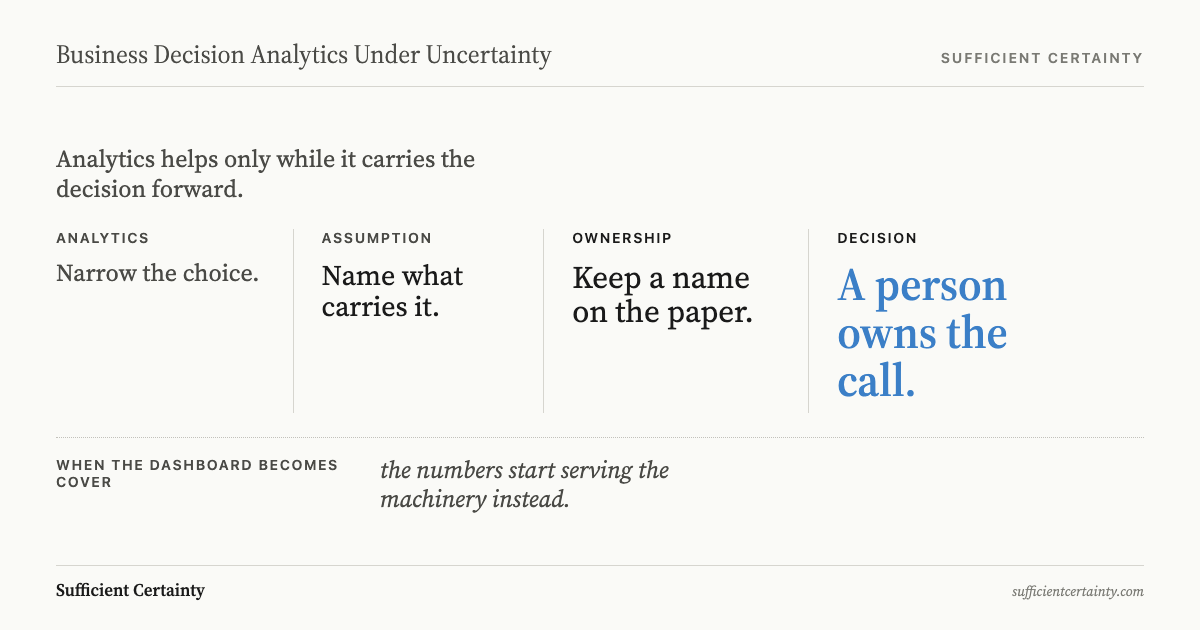
At board level the question is never just forecast accuracy. It is how much margin pain or inventory exposure the firm can absorb before delay becomes the real decision. The person who feels this first is usually not the chair. It is the operator carrying the recommendation, expected to defend a forecast whose load-bearing assumptions nobody has bothered to say out loud.
This is the commercial mess inside decision making under uncertainty. Uncertainty sits in the assumptions, and time attacks them faster than most board packs admit. Once the room starts admiring the decimals instead of naming what had to be true, the machinery is already protecting itself.
Zillow shows where the model stops helping
Zillow's 2021 retreat from iBuying is the cleanest commercial example I know. In its 2 November 2021 results release, Zillow reported a Homes segment loss before tax of about $422 million and an inventory write-down of about $304 million. It also told the market to expect more fourth-quarter losses and cut about 25 per cent of its workforce. Rich Barton said the unpredictability in forecasting home prices far exceeded what the company had anticipated.
Zillow needed somebody to say plainly that carrying houses at scale rested on assumptions about price movement and renovation throughput that were too jumpy to trust. Management could keep the growth story alive by pointing at the algorithm, and the board could borrow comfort from that story instead of owning the balance-sheet bet (always a popular move when the quarter is wobbling). That is where decision analysis under uncertainty turns grubby, because the model stops testing the decision and starts protecting it.
Roger and I used a pricing case in Deciding for the same reason. Cost looks factual only for a moment. Stretch the launch across quarters and cost becomes an assumption about supplier behaviour and what the market will still pay. A prettier dashboard merely gives anxious people a cleaner place to hide.
Carry your next model-backed choice through the five steps and decide which pain the numbers cannot choose. Start the Walk →
UPS shows when analytics really can carry the load
UPS is the boundary case that proves the point. In its 2017 Corporate Sustainability Progress Report, UPS said ORION had reached 100 per cent of targeted US routes in 2016. It then said the system cut 100 million miles in 2017 and kept the company on track for savings running to about $400 million. UPS also said success depended on drivers using their best judgment.
UPS can lean harder on analytics because the feedback is fast and the operation is built to monitor what reality says next. A bad route confesses by tomorrow morning. Drivers and the system learn quickly, so the assumptions do not get years to ferment into doctrine. In my experience, boards adore this sort of case because it lets them pretend every capital bet will confess its mistakes by breakfast, which it will not. A routing decision for tomorrow is a different animal from freezing capital in property or plant.
Target shows that the hard part is choosing the pain
Target's 2022 inventory reset shows the real commercial work. In its 17 August 2022 earnings release, Target said comparable sales were still growing. Even so, operating margin had fallen to 1.2 per cent from 9.8 per cent a year earlier, and the company had cut discretionary-category receipts by more than $1.5 billion.
The dashboards exposed the pain early enough. Management still had to choose how much profit to surrender in order to clear stock before the holiday season. No model could volunteer for that wound. That is why this sits so close to how to make a difficult business decision. The data can expose the trade, but somebody still has to own it with their name on the paper.
What business decision analytics under uncertainty still needs from a Decider
When someone tells me the analytics are convincing, I ask a rude question: what had to be true for this recommendation to survive contact with time? Usually one assumption is carrying most of the weight. Once that assumption is named, the fog thins, the operator can finally defend a real argument, and the adviser who lives off one more refinement suddenly has less room to perform.
At that point the Decider has to say what level of certainty is sufficient for this commercial call, in this firm, with this amount of damage at stake. I described the mechanics of that threshold in data driven decision making framework. That is judgment, and the machinery dislikes judgment because nobody can bill for it or hide behind it for very long.
Before approval, I want Deciders to Design monitoring around the fragile assumption. If inventory ageing moves outside the band the firm said it could tolerate, the decision comes back before more capital is frozen. In my experience, this is where respectable board process suddenly becomes less popular, because a live trigger leaves much less room for theatre later.
The strongest business decision analytics under uncertainty narrow the field and speed the conversation, but the decision still belongs to a person. Once the dashboard is treated as the decision, executives get cover and advisers get more work, while the person carrying the recommendation is left defending a forecast nobody truly trusted.
You could trust the spreadsheet and still walk into the boardroom carrying guesswork.
Work through your decisionNo sign-up. Just pick your decision and start.
Grant Purdy is the co-author, with Roger Estall, of Deciding (2020), and the architect of the Universal Decision-Making Method.