Decision making under uncertainty is the normal condition of every consequential choice. You never have all the facts. You never will. The question is not how to remove uncertainty but which assumptions carry the decision and whether you know enough about them to act.
In January 2011, the operators of Wivenhoe Dam outside Brisbane had more information than most Deciders ever get. They had live inflow data, Bureau of Meteorology forecasts, and a rulebook telling them when and how much water to release. The city still flooded. Decision-making under uncertainty is the practice of deciding while uncertainty remains by naming the assumptions carrying the decision, judging their significance, and deciding whether what remains is sufficient for the Purpose at stake. Wivenhoe failed not because uncertainty existed, but because the assumptions inside the rulebook had stopped matching the world.
That is the wrong-question problem at the centre of this subject. People ask how to decide when they do not have all the facts. You never have all the facts. You never will. Every live decision rests on assumptions about markets, weather, regulators, suppliers, politics, timing, and human follow-through. The real question is different: which assumptions matter, how much confidence do you have in them, and what would count as enough certainty to act?
I have spent nearly fifty years watching organisations answer that question badly. They commission more analysis, ask for more modelling, and wait for uncertainty to retreat. It does not. What changes, if the process is any good, is the quality of the Decider's judgment about the assumptions doing the real work. That is what the Universal Decision-Making Method is for, and it is the practical question Roger Estall and I kept returning to across boards, regulators, and public bodies.
Decision-making under uncertainty is the discipline of choosing while some things remain unknown by testing what the choice depends on and judging whether you know enough to act.
What decision-making under uncertainty actually means
Decision-making under uncertainty is not a specialist corner of strategy or economics. It is the normal condition of deciding. A pilot, a board, a founder, or a family all face the same structure: some facts, some assumptions, and a future that refuses to keep the same shape for long. The question is never whether uncertainty exists. It is whether the assumptions carrying the decision are fit for purpose.
Frank Knight drew the useful distinction more than a century ago in Risk, Uncertainty, and Profit: risk is measurable, uncertainty is not. Most organisations still pretend the answer is to model harder and longer. Sometimes that helps. Often it produces a tidier spreadsheet and a longer agenda, and no more certainty than before.
The real question is whether the assumptions carrying the decision are good enough to act on. Certainty is local and temporary; as soon as time passes, today's fact becomes tomorrow's assumption. For the distinction between risk and the wider problem, see decision analysis under uncertainty.
That is why this is not a call to be more mystical. It is a call to be more exact about what must remain true and for how long. Once the assumption list is visible, you can judge which items are carrying the choice and which are just noise with an impressive title. The minute that is explicit, the decision stops being vague theatre and starts being work. That holds whether the window is 208 seconds or six months, because the method does not change with the clock.
Why waiting for all the facts makes it worse
Wivenhoe is the clean example because it strips away the excuse that more data would have solved it. The operators had inflow data, forecasts, and rules. The Queensland Floods Commission of Inquiry later showed the problem was not missing information but assumptions inside the operating manual that had stopped matching the world.
The same thing happens more slowly in boardrooms. A committee asks for one more forecast, then one more review, then one more deck. Spyros Makridakis, Robin Hogarth, and Anil Gaba make the point in Forecasting and uncertainty in the economic and business world: forecasting matters, but accurate forecasting is usually unavailable exactly where the decision matters most. At some point delay stops being prudence and starts being ritual with a budget.
The standard is not completeness. It is whether the assumptions driving the choice have been surfaced, tested where they can be tested, and judged honestly where they cannot. When decision analysis under uncertainty becomes a defence of a preferred answer, it is no longer analysis. It is camouflage with charts.
That is why the usual advice to wait until you are comfortable is empty. Comfort is private. Decisions are public. The standard is not how settled you feel, it is whether the choice can stand up to the assumptions it depends on.
Assumptions are the real object of the decision
The most useful question in the room is still the plain one: what are we assuming here? Ask it properly and the fog starts to clear. Options that looked equivalent separate. Confidence stops masquerading as evidence. Disagreement becomes useful because people can argue about one assumption instead of waving at the whole swamp.
Not every assumption matters equally. That is why Roger Estall and I use a significance matrix with two axes: how much influence the assumption has on the outcome, and how confident the Decider is that it will hold. High influence with low confidence is Critical. High influence with high confidence is Important. Low influence with low confidence is Relevant. Low influence with high confidence is Limited. It is plain English, which is rare enough to be suspicious. The point is to stop arguing about the whole decision and start working the few assumptions that actually move the outcome.
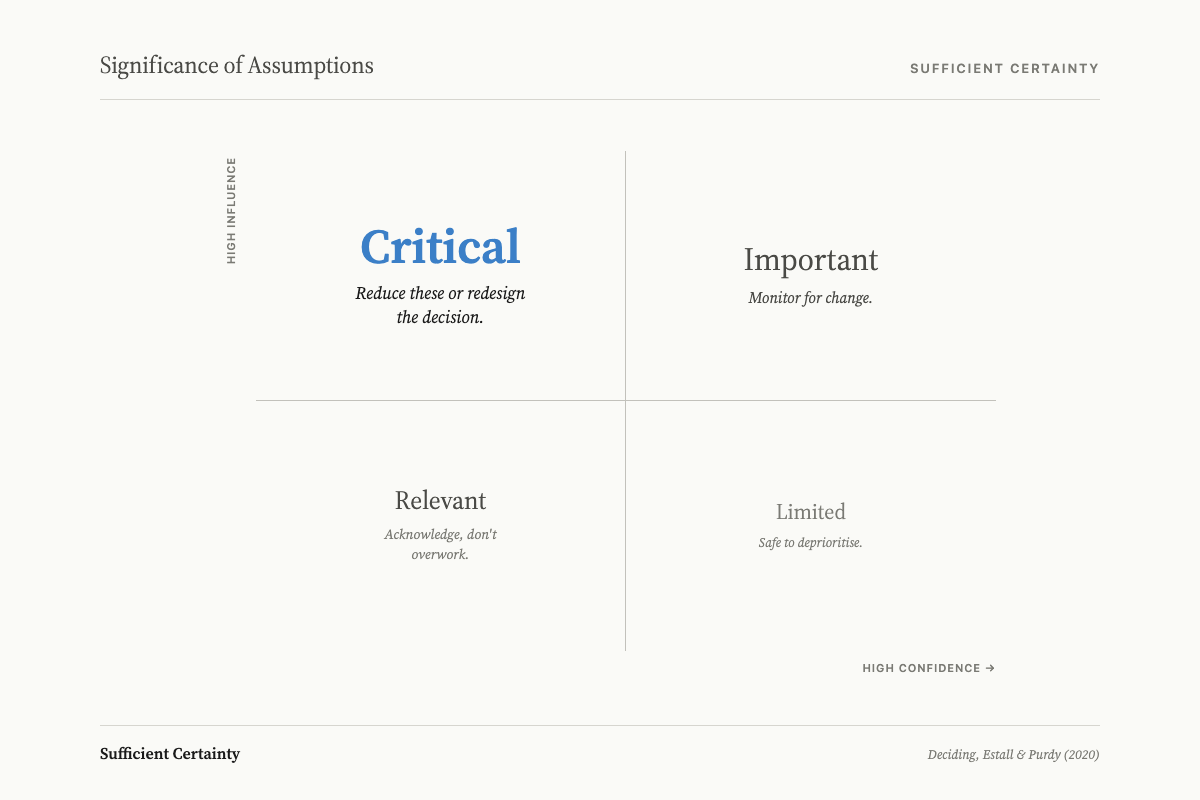
The matrix does not make the decision for you. It tells you where the next hour belongs. A Critical assumption needs better information, a different design, or a different option. If you want the live-business version, see how to make a difficult business decision; if you want the place where the numbers stop and judgment starts, see business decision analytics under uncertainty.
That matters because a Critical assumption is rarely solved by more debate. More discussion usually just produces more adjectives. Either you test it, redesign around it, or stop pretending the option is still live.
Identify the assumptions your decision rests on and judge which ones are significant enough to block action. Start the Walk →
Sufficient certainty, not maximum certainty
The phrase that matters most here is sufficient certainty, which is not maximum certainty and not perfect information, but enough to proceed. That is the stopping rule most governance processes lack, because they were built to ask for more data rather than to define what "enough" looks like in the first place.
The blood-imports case in Deciding shows why this matters. In trying to reduce the chance of contaminated blood reaching patients, some countries suspended all imports from suspect sources. The result was a blood shortage and increased mortality. Greater certainty on one narrow question damaged the broader Purpose the decision was supposed to serve, which is a neat way of making the wrong answer more expensive.
Sufficient certainty is the discipline that prevents this. The Decider asks whether the remaining uncertainty is acceptable given what is at stake, given the significance of the assumptions involved, and given the cost of chasing more certainty. That judgment cannot be outsourced to a formula. When organisations refuse to work this way, the pattern usually turns into analysis paralysis.
The point is not heroics. It is restraint. If the Purpose is to keep the broader system healthy, then buying a clean answer to one narrow question at the expense of everything else defeats the Purpose it was meant to serve.
Deep uncertainty, vulnerability, and context drift
Some decisions are harder because the uncertainty is not just large but structurally unstable. The wider context itself may be changing faster than the organisation can observe. That is where deep uncertainty enters, not as an exotic theory term but as a practical condition in which historical probabilities help less and context monitoring matters more.
Postal services are the tidy example. Letter volumes fell as email took over; parcel volumes rose with e-commerce. The organisations that kept treating themselves as letter businesses saw change as an external shock. The smarter ones noticed they were actually in a different business and adjusted before the stamp collection became a strategy.
That is why the uncertainty cluster has to touch disruption and monitoring directly. Uncertainty is not only what exists before the decision. It is what keeps moving after the decision has been made. When the probabilities themselves are too weak or contested to carry a choice, decision making under deep uncertainty becomes practical, not academic.
Vulnerability is often self-inflicted. Organisations decide what they will monitor, then act surprised when the thing they chose not to watch becomes the thing that bites them. Deep uncertainty makes that mistake expensive and obvious.
What this looks like in business decisions
In business, uncertainty often arrives disguised as abundance. Forecasts, consultant packs, committee notes, scenario models, and confident opinions create the illusion that the decision is being worked properly. It usually means everyone has opinions and nobody has stated the decision's real dependencies. If you want the toolset without the fog machine, decision-making frameworks separates the apparatus from the method. A framework is not a decision and never has been.
Take a company deciding whether to expand fulfilment capacity into a second site. The question is short enough to name: will demand hold, can management absorb the complexity, and are labour and transport stable enough to make the move sensible? That is the whole game. If you cannot say that plainly, you do not yet have a decision, only a pile of confidence with an invoice attached. And if one of those assumptions breaks, the whole case breaks with it.
Sometimes a Decider can do this work alone. Sometimes they need a more disciplined conversation, which is where decision coaching belongs. The coach does not remove uncertainty or take the choice away; the coach makes the reasoning visible enough that the Decider can say whether the assumptions are good enough to proceed. A good coach also notices when due diligence is just hesitation wearing a suit.
If the distinction still feels abstract, read the decision making under uncertainty example cases. Apollo 13, Blockbuster and Grenfell Tower each show a different failure mode when assumptions stay hidden.
The five steps that make this workable
The method itself is simple: Frame the decision. Develop options. Recognise assumptions. Sufficient certainty. Design monitoring. That is the Universal Decision-Making Method, and the full sequence is also laid out in the decision-making process under uncertainty. The point is not ritual. It is a sequence that can be explained, repeated, and audited.
What matters is what the steps do to uncertainty. Framing stops the Decider from solving the wrong problem. Options stop the process collapsing onto the first plausible story. Recognising assumptions turns hidden uncertainty into visible statements, whether the assumption arrived through availability bias or from a tidy spreadsheet that nobody questioned. This is also where complex problem solving, strategic problem solving, and strategic thinking all stop being slogans and start being work. Without that, the team just circles the same questions until somebody with authority gets tired.
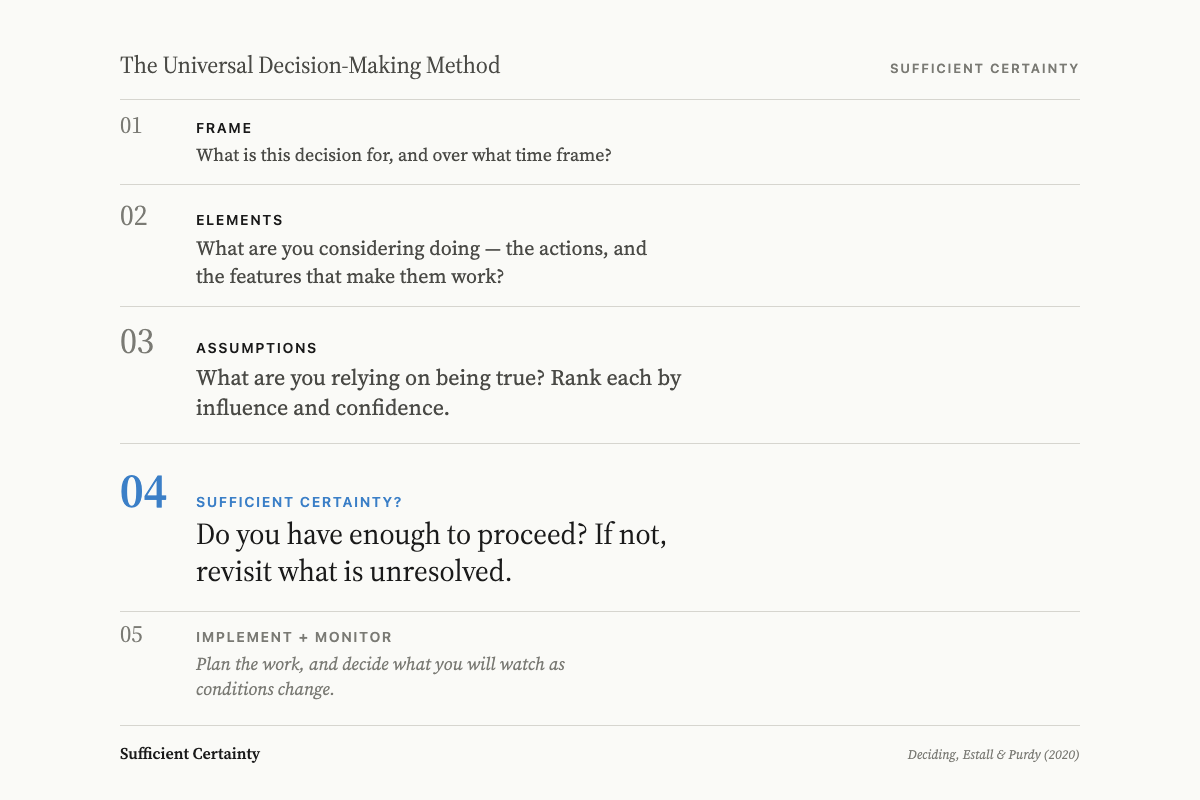
The method is not rigid. Sully used the same structure in seconds. A board may use it across weeks. The difference is not the method. It is the time available and the speed with which the context is changing. When the clock is genuinely short, the same sequence still applies, it just has to be built before the pressure arrives. That is the argument in decision making under pressure. Pressure does not delete assumptions. It just makes them louder.
What to monitor after you decide
A decision under uncertainty is only as good as its monitoring design. If an Important assumption stops holding three months later and nobody is watching for that, the original quality of the decision becomes almost irrelevant. The outcome will drift and the organisation will discover it late. That is how good decisions become bad stories, and why monitoring is not an admin task.
Good monitoring asks simple questions in advance. What must still be true for this decision to keep making sense? How likely is each thing to change? How quickly would that change matter? How easy would it be to detect? The answers tell the Decider where attention belongs after the decision leaves the room, which is more useful than another dashboard no one can read without a pilot's licence. It is how you notice drift before it becomes a report.
That is also why the decision autopsy matters. It is not an exercise in blame. It is a way of reconstructing what was assumed, what later changed, and whether the change should have been visible sooner. Organisations that do this well get better at uncertainty over time because they stop treating each bad outcome as a mystery. They also stop pretending that hindsight is a quality control process.
Sufficient certainty is the target at the moment of decision. Monitoring is what stops that certainty from fossilising into wishful thinking afterwards. If you do it properly, you are not surprised by change; you have been expecting it and watching for it.
You could wait for cleaner signals, while the deadline gets louder every day.
Work through your decisionNo sign-up. Just pick your decision and start.
Grant Purdy is the co-author, with Roger Estall, of Deciding (2020), and the architect of the Universal Decision-Making Method.