
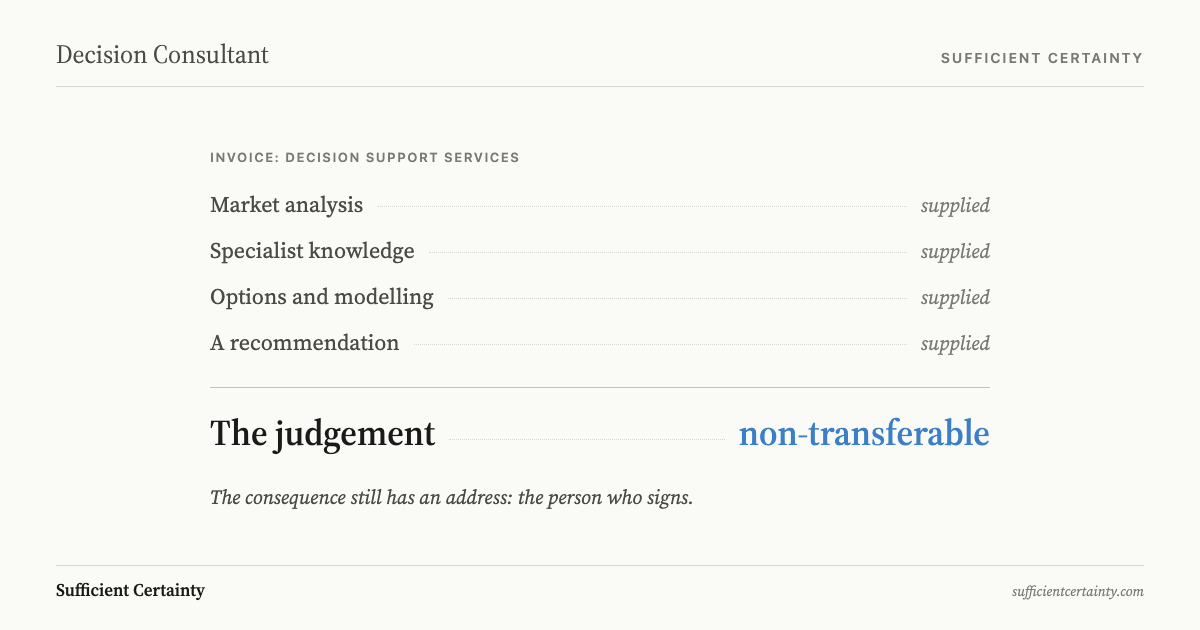
A decision consultant sounds like someone who can carry the hard call for you. The analysis can be bought. The judgment cannot. A 96-page report tells you what the adviser found. It does not tell you what you are betting on, and that is the part the invoice cannot cover.
A managing director once slid two proposals across the table. One promised strategy work on growth and pricing. The other offered a monthly retainer for "decision support" plus workshop day-rates. He wanted to shut one product line and move the money elsewhere before quarter-end. He said he thought he needed a decision consultant.
I have spent much of my working life watching clever organisations blur that boundary. Consultants and internal governance teams prefer the label soft, as do the people who sell workshops, because ambiguity bills well and rarely gets refunded. Roger Estall and I wrote Deciding because support is one thing and ownership is another. If you are facing a difficult business decision, outside expertise may be worth buying. The trouble starts when the buyer hopes the judgement will travel with the invoice.
A decision consultant provides analysis, research, or specialist knowledge to support a live choice, but the judgment and accountability stay with the person deciding.
What a decision consultant usually sells
In my experience, people who search this phrase are not hunting for philosophy. They are trying to buy capacity. Consultport's strategy-consultant pages present the offer plainly: bring in outside people for growth or expansion decisions. Clutch's 2026 buying guide says three in five small-business decision makers expect to rely on outsourcing in 2026 and lays out the usual menu, short hourly work or longer retainers. At least that part is honest. The sale is extra brains and extra labour around a hard problem.
If the gap is technical detail or market detail, buy the knowledge. I have done that myself. What irritates me is the quieter promise tucked inside the label. It suggests a decision consultant can carry the judgement for you, when only the expertise is external and the consequence stays put. That fiction suits the seller because the softer the boundary, the longer the engagement. It does nothing for the buyer who still has to sign the paper.
I have seen the commercial version of this trick in retainers sold as ongoing decision support. The consultant is kept close enough to share the mood of the room, far enough away to avoid owning the call, and useful enough to be invited back next month. Everyone gets some comfort from that arrangement, but responsibility is not transferred. That arrangement may suit the seller beautifully. It should never be mistaken for a substitute for judgement.
Put the decision you want a consultant to carry through the five steps and see what judgement stays yours. Start the Walk →
Why a decision consultant still cannot carry the decision
One person owns the outcome. That is the bit glossy support offers keep trying to smudge. The UK Government's GovS 002 standard says it bluntly in project language: there is a single senior responsible owner. I like that sentence because it strips away the theatre. You can surround a major choice with advisers and spreadsheets, yet the consequence still has an address.
I have sat with boards that had a project office, external advisers, and a pack thick enough to stun a burglar. When the chair finally called the resolution, one director still had to vote. He could not write in the minutes that the consultant seemed comfortable with it and go home absolved. The Institute of Directors makes the same point about advisory boards: challenge and experience are useful, but the legal duties do not migrate across the table.
Internal risk teams, governance functions, and PMOs play the same trick with softer voices and better stationery. They arrive with templates and an implied answer. The room relaxes because a function appears to have taken charge, which is usually the moment judgement starts to thin out (the stationery looks authoritative). In my experience, support becomes dangerous when management uses it as camouflage. Then the paperwork improves and ownership quietly weakens.
When a decision consultant starts sounding like a decision mentor
A decision mentor is usually someone you return to because he has seen more than you have. He tells you what he would watch next and where he has seen similar choices go wrong. EMCC Global describes mentoring as a learning relationship built on shared knowledge and experience over time, which is near enough. It is still a different job from working through one decision that has to be owned now.
If you want someone to stay with the live choice and test your reasoning, you are getting closer to a decision making coach. I am not interested in a broad relationship dressed up with soft language. I want to know whether you genuinely know enough to commit, and a decision mentor may help you get there without becoming the person who decides.
What useful decision support looks like
Useful support makes the owner more exposed, not less. The Teal Book is sensible on one narrow point: support offices may do planning and analysis across many projects, and Roger Estall and I made the same allowance in Deciding. What we rejected was the old habit of rebadging support machinery as something grander, then pretending the new label had solved the judgement problem.
The Universal Decision-Making Method matters here because it keeps dragging the live call back to the Decider. If Sufficient certainty is weak, go get something real. If it is strong enough, decide and Design monitoring around what would reopen the call. That is support doing its job, sharpening the reasoning without pretending to absorb the consequence.
Good support is often unimpressive. It keeps dragging the conversation back to the live choice and the assumption underneath it. That annoys people who hoped a handsome report or a committee process would spare them the discomfort. In my experience, that irritation is a good sign. It means the decorative parts of the machinery are losing their grip.
The wider argument sits under decision coaching, but the narrower point here is the one buyers keep dodging. This kind of support can bring expertise and evidence, yet the invoice still does not carry the consequences, and once the label hints otherwise the sale has drifted into relief theatre.
You could buy decision support and still be alone when the product line closes.
Work through your decisionNo sign-up. Just pick your decision and start.
Grant Purdy is the co-author, with Roger Estall, of Deciding (2020), and the architect of the Universal Decision-Making Method.