Decision coaching is the use of a structured method to help a Decider reach sufficient certainty on one live choice without handing the decision to someone else. The point is not to advise. The point is to ensure the Decider knows what they are betting on before they commit.
Decision coaching is the use of the Universal Decision-Making Method to help a Decider reach sufficient certainty on one live choice without handing the decision to somebody else. In the health-decision literature, Dawn Stacey and colleagues defined it more generally as support that helps a person prepare to make a decision without taking the decision away from them. That is close enough to what Roger Estall and I spent decades doing with executives, boards, regulators, and public bodies. The point is not to advise from the sidelines. The point is to help the Decider work out whether they know enough to commit.
The 2025 International Coaching Federation study counted 122,974 practitioners worldwide and put annual coaching revenue at $5.34 billion. Most of that work is about leadership, careers, performance, or general development. Very little of it is about one consequential decision sitting on someone's desk, with a board paper due in six weeks and no place left to hide.
That narrower task is what this page is about. It is not motivation, not therapy, and not a consultant's report disguised as wisdom, but a disciplined way of helping the person who must own the consequences do the actual thinking.
Decision coaching is the practice of helping someone test what a choice depends on so they can decide for themselves.
What decision coaching is, and what it is not
Most people have already paid for the substitutes. A consultant interviews everyone in sight, produces a deck, and hands the problem back with bullet points. A risk team builds a forty-seven-item register and calls that diligence. A leadership coach asks how the decision makes you feel and whether you have honoured your inner compass. Charming, no doubt. All of those things may have some value, but they generate artefacts, not commitment. Artefacts are easy to circulate, annotate, and postpone behind. A decision is not. A decision ends with one person, or one accountable group, saying that this is the path and these are the assumptions on which we are willing to stand. That is why organisations fall in love with process: process looks like rigour, and rigour is much easier to display than responsibility.
Decision coaching starts from a stricter premise: the choice stays with the Decider. The coach's role is not to provide taste, optimism, or borrowed certainty. It is to keep asking the annoying questions that bureaucracy prefers to dodge. What is the decision, exactly? What options are genuinely open? What has to be true for this option to work? Which assumptions matter enough to break the choice if they fail? What evidence actually bears on those assumptions, as opposed to making everyone feel industrious? That is why I treat the work as structured challenge rather than supportive conversation. The coach is there to sharpen judgement, not to become the judgement. If the coach has become the source of the answer, something has gone wrong. If you want the full definition and boundaries, I set those out in Decision Coaching: What It Is, because this page is the hub, not the encyclopaedia.
That distinction matters because expertise is not the same thing as judgement. A decision consultant may know the industry, the numbers, and the precedents better than anyone in the room. Buy the expertise if it is useful. Use modellers, lawyers, scientists, market researchers, and whoever else can reduce ignorance about something material. The decision still belongs to the person whose name goes on the paper and whose reputation goes with it. The sharper contrast is with consulting: consulting improves inputs, while coaching improves the Decider's reasoning about those inputs. One acquisition committee can spend six figures on due diligence and still arrive at the meeting unable to say, in one plain sentence, what has to be true for the deal to make sense. If that sounds familiar, it is because plenty of expensive work is really just uncertainty with better stationery.
So what is this work not? It is not a substitute for subject-matter expertise, legal advice, or financial analysis. It is not a polite ceremony for ratifying the preferred answer of the most senior person in the room. It is not a motivational conversation about confidence. Confidence is cheap; people manufacture it every day from tone of voice and slide design, then mistake that feeling for preparedness. Decision coaching is the harder trade: making the reasoning visible enough that weak assumptions can no longer hide behind respectable process. The point is not to make the Decider feel better. The point is to make the basis of the choice clear enough that agreement, disagreement, and commitment are all attached to something real. If that sounds unfashionable, good. Good decisions are rarely fashionable while they are being made.
How the process works in practice
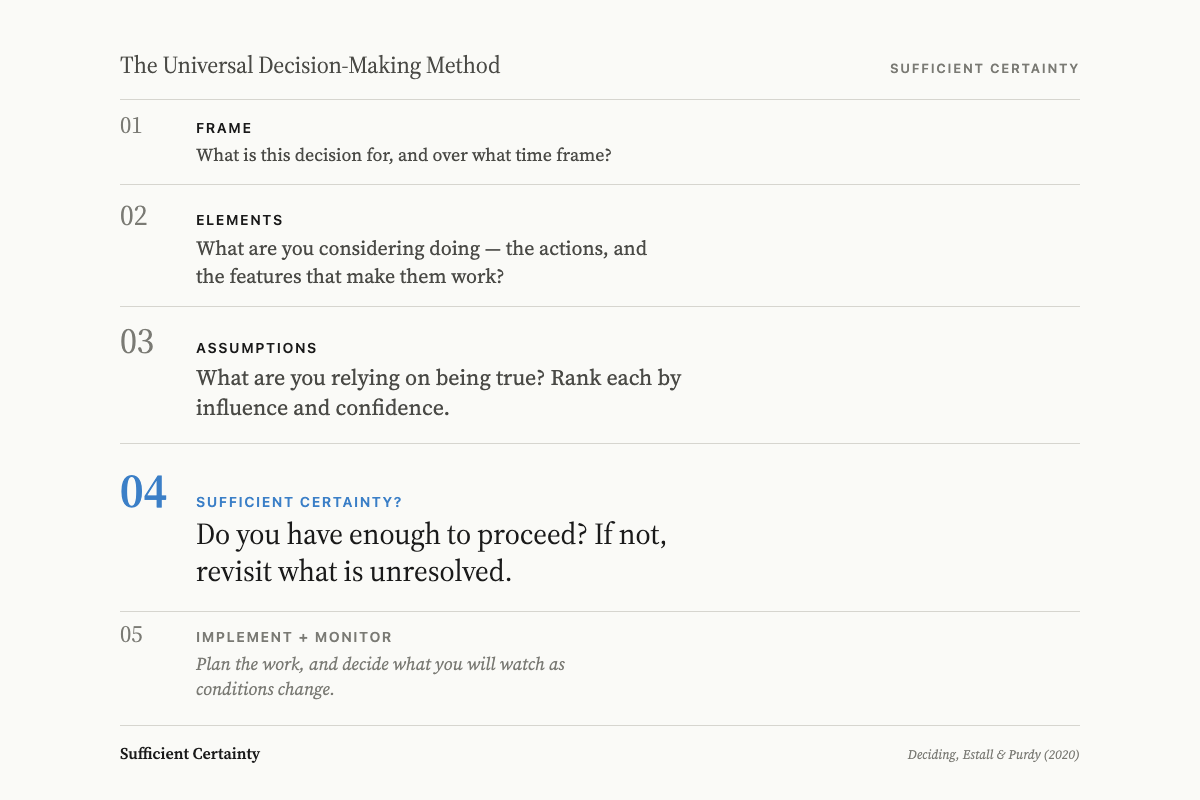
Roger Estall and I did not start with a theory and then roam about looking for somewhere to bolt it on. We started with a practical observation: people who decide well do not magically remove uncertainty, but they do move through it in a disciplined way. That pattern became the Universal Decision-Making Method. It gives the conversation shape by forcing attention onto purpose, options, assumptions, sufficiency, and monitoring. Those five labels matter less than the moves underneath them: make the choice explicit, identify what it depends on, test whether that dependence is acceptable, and decide what to watch after commitment. More importantly, the method gives the conversation a stopping condition. Most organisations have plenty of process and almost no stopping condition at all. They keep collecting material because collecting material feels active, even when no one can explain what further collection would actually change.
That is why the method is useful as a coaching tool rather than just a diagram to admire. It stops the meeting from dissolving into whatever topic currently has the loudest sponsor. We frame the actual decision instead of the surrounding fog. We separate real options from decorative variations of the same option. We identify the assumptions carrying the weight rather than treating every possibility as equally important. And when certainty is inadequate, we do not perform another ritual round of "more analysis" by default, because random accumulation is not the same as targeted learning. We either gather information that bears directly on a material assumption, redesign the option so it depends less on that assumption, or admit that the case is not ready and stop pretending otherwise. The fuller walkthrough belongs on the spoke about the decision coaching process, not here.
The practical output is a Decision Record, which is far more useful than the usual sludge of minutes, mark-ups, and half-remembered verbal caveats. A good record captures what was decided, what the decision was for, which assumptions carried the conclusion, what was done to improve certainty, and what would trigger a review later. It preserves the logic, not just the verdict, which matters because people regularly inherit decisions without inheriting the reasoning that once made them seem sensible. It also makes later challenge cleaner: instead of arguing from mood, people can point to the assumption or threshold that needs revisiting. Boards like to imagine they have institutional memory. Most have institutional archaeology instead: fragments, legends, and one overworked person who vaguely remembers why a conclusion seemed acceptable eighteen months ago.
The work itself usually happens over short, focused sessions around one live choice, not a cathartic away-day with sticky notes and sandwiches. That matters because live decisions have deadlines, politics, missing information, and people who would rather discuss everything except the assumption doing the actual work. A capital approval I was involved in went from three weeks of circular challenge to one page of useful argument once the room agreed there were only two assumptions worth fighting about. If you want the detailed mechanics, use the spokes; the hub point is simpler. Good process does not make deciding effortless, and it certainly does not make it comfortable. It makes the real work impossible to avoid, which is precisely why so many organisations resist it until the clock becomes unfriendly. Then they call the resulting urgency "clarity," which is a favourite organisational fairy tale.
Bring a live decision and work through it with a method that surfaces what you actually need to know. Start the Walk →
When decision coaching helps most
This is not for trivial choices. If the cost of structure exceeds the cost of being wrong, decide quickly and move on. You do not need a formal method to choose lunch, approve a harmless experiment, or rearrange a diary. Decision coaching becomes worthwhile when the consequences are material, the uncertainty is genuine, the choice is hard to reverse, or the surrounding apparatus has become so elaborate that nobody can tell whether the organisation is thinking or merely moving paper around. Delay also matters. Some decisions rot while they wait. If postponement is itself a consequential choice, then "we will think about it a bit more" is not prudence. It is simply another option, and often a poor one. The expensive mistake is not always action; sometimes it is the polished delay that lets the market, the regulator, or the deadline decide for you.
It is especially useful when a decision has become socially difficult. Once many stakeholders are involved, the pressure to sound comprehensive often outruns the pressure to be clear. People start adding scenarios, caveats, sub-options, and committee language until the centre of the decision disappears under its own health-and-safety equipment. Nobody wants to look careless, so everyone contributes another layer of respectable caution. In that environment, structure is not bureaucracy; structure is rescue. It gives the Decider a way to say, "These are the assumptions that matter. These are the ones that do not. This is what we still need to know. This is what we will never know before acting." That is a very different thing from pretending that equal airtime must be given to every anxiety that wanders into the room. It also stops the faux-neutral habit of treating indecision as though it were wisdom.
A common case is the senior executive facing a board timetable with too much analysis and too little judgement. Think of the VP of operations with a plant-closure decision, an $80,000 consultant report, three scenario models, and a risk register dense enough to stun wildlife. She does not need another adjective in the executive summary. She needs a disciplined way to separate assumptions that actually determine the result from background noise that merely looks conscientious. I have seen executive decision coaching cut through that clutter by forcing the pack back to one question: what has to be true for this recommendation to make sense, and how sure are we about those points? That question is awkward, which is why it is useful.
The same logic applies far beyond boards. Founders choosing where to commit scarce resources, public officials weighing difficult trade-offs, family-business owners untangling succession, and individuals considering relocation or career moves all face the same underlying problem. They are not defeated by uncertainty itself, and they are rarely defeated by lack of intelligence. They are defeated by uncertainty with no test for "enough." That is why this page sits beside the broader question of decision-making under uncertainty. The job is not to become certain in some grand metaphysical sense. The job is to decide whether the assumptions that matter are sufficiently supported for this choice, at this time, with these consequences, while accepting that some ambiguity will survive the decision because adulthood is inconvenient like that. The rest is just people trying to negotiate with reality using spreadsheets and optimism.
What the evidence supports
The strongest formal evidence comes from health care, mostly because health researchers had the decency to run trials instead of simply declaring themselves insightful. The broad finding is consistent: structured decision support helps people understand options better, feel less uninformed, and choose more in line with what matters to them. The 2024 Cochrane review of patient decision aids looked across 209 randomised studies involving 107,698 participants and found the same general pattern. That does not prove that every boardroom, founder, or regulator should behave like a clinic. It does show that disciplined support is not a sentimental add-on. When people are helped to clarify options, trade-offs, and relevant facts in a structured way, the quality of the decision conversation improves. They are less likely to drift, less likely to confuse volume with understanding, and more likely to name what actually matters to them.
The limitation in that literature is also the interesting part. Many studies examine aids, summaries, worksheets, or digital tools; far fewer examine the live act of challenging a Decider's assumptions in real time. Stacey and colleagues noted years ago that only a small minority of the relevant trials included coaching at all. Tools are useful, and I am not above a decent worksheet. But a tool cannot look a chief executive in the eye and ask whether the entire case rests on an assumption everyone is politely pretending has been tested. Nor can it detect when a room has started using more paperwork as a substitute for responsibility. A spreadsheet can look wonderfully serious while the central judgement sits unexamined in cell B42, which is how intelligent organisations slide into analysis paralysis. The literature supports the method. It does not replace the conversation.
Frequently asked questions
What is decision coaching?
Decision coaching is structured help for thinking through an important decision without handing the decision to someone else.
How is decision coaching different from consulting?
Consulting usually gives recommendations, while decision coaching helps you test your own reasoning so you can make the decision yourself.
What does a decision coach do?
A decision coach keeps returning the decision to the person who owns it, asking what has to be true for this option to work and whether you know enough to proceed.
When do you need a decision coach?
You need a decision coach when a decision is high-stakes, uncertain, hard to reverse, or stuck in too much analysis.
You could read the example, then return to your own call still half-settled.
Work through your decisionNo sign-up. Just pick your decision and start.
Grant Purdy is the co-author, with Roger Estall, of Deciding (2020), and the architect of the Universal Decision-Making Method.