
Decision making under uncertainty examples reveal one pattern. The cause of failure is never the uncertainty itself. Apollo 13 had 87 hours and brought the crew home. Blockbuster had a decade and lost 9,000 stores. What separated them was whether the process tested its own assumptions before time ran out.
Sully had about 90 seconds to decide where to put US Airways Flight 1549. At Wivenhoe Dam, operators had a thick manual and still collected 177 recommendations after the 2011 flood inquiry. That is a decision making under uncertainty example in two forms: one man deciding fast, one organisation hiding inside procedure. Manuals are excellent at producing paperwork after the event; they are useless at deciding for you before the water arrives.
I have seen this repeatedly. People dress it up as decision analysis under uncertainty, then ask for more information because they do not want their assumptions written down where somebody can attack them. A live decision making under uncertainty example is a decision taken before the facts settle, where assumptions do the real work and sufficient certainty has not been reached. A consultant's report helps them because it looks like due diligence and gives everybody a place to hide when nobody wants the decision pinned to a name.
Decision making under uncertainty examples are cases that show how choices are made before key facts settle and outcomes can be verified.
How fast pressure forces a call before the facts arrive
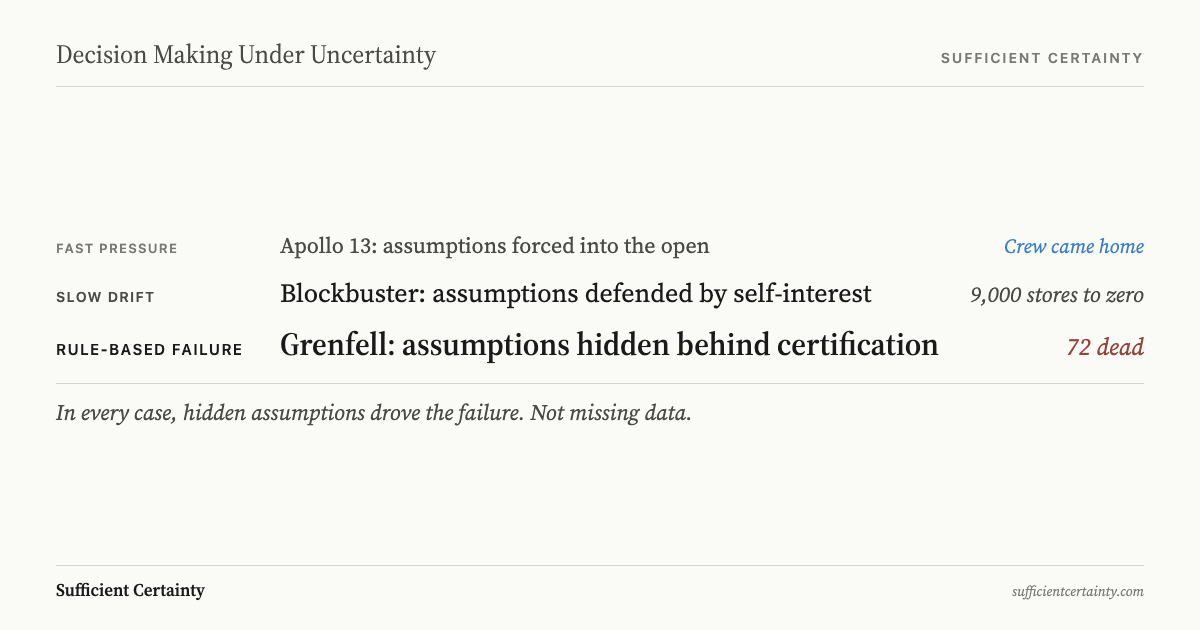
Apollo 13 is the cleanest decision making under uncertainty example I know. In April 1970 an oxygen tank exploded when the spacecraft was about 200,000 miles from Earth. Gene Kranz and Mission Control had three astronauts, a crippled spacecraft and no route to perfect information. They could not inspect the heat shield or confirm every power assumption before re-entry. They had 87 hours to get home, so the only sensible standard was sufficient certainty tied to one clear Purpose: bring the crew back alive.
They cut power from 55 amps to 12, built a carbon dioxide scrubber from what was on hand and kept checking each judgement against telemetry and physical limits until splashdown landed within 1.5 nautical miles of target, as the NASA Cortright Report records. That is what competent Deciders do under pressure. They force assumptions into the open and make them answer to reality. Nobody in Houston mistook the model for the decision, and that modest piece of honesty is rarer in boardrooms than most people realise.
Trace the uncertain call in front of you through the five steps and see whether pressure, drift, or rules are driving it. Start the Walk →
Decision making under uncertainty example, slow drift
Blockbuster failed in the opposite way. In 2000 it passed on buying Netflix for $50 million. John Antioco later tried an online response and cut late fees worth about $200 million a year. The board removed him, James Keyes restored the old story and by 2010 the company was bankrupt after peaking at about 9,000 stores. The signals were visible in broadband growth and in customers learning that convenience mattered more than a Friday-night drive to the shop. Each local decision looked sensible enough in isolation, which is why slow drift fools respectable boards.
Self-interest kept the failure going far more than ignorance did. The board defended late fees because the cash was immediate. It defended store economics because the estate on the ground justified the story it had already sold to itself. The people who benefited inside the room were the ones who got to keep a familiar story and avoid admitting that the model had changed. Roger Estall and I saw the same habit in large media businesses when classified advertising was treated as a permanent river of gold.
I watched managers call this prudence when what they really meant was delay. By then the market and the internal story no longer matched. Once that gap opens, management starts defending its narrative instead of deciding in Context. That is why monitoring matters. If assumptions are not watched, they quietly turn into delusions.
When rules replace judgement
Grenfell Tower is the case I want every board to remember when somebody waves a certificate. Reynobond 55 PE panels sat inside an approved-looking system and then burned catastrophically in June 2017. Seventy-two people died. Britain has since committed £5.1 billion to remediation. Boards love this sort of machinery because the evidence arrives with stamps and letterheads, which count for nothing once the building is on fire.
The Grenfell Tower Inquiry Phase 2 Report and the Hackitt Review lay out the machinery plainly enough. Arconic sold panels it knew were combustible. Certifiers helped claims travel further than the evidence deserved, and regulators kept the scheme respectable by treating paperwork as proof. Arconic had sales to protect, while certifiers had fees and standing to protect. Regulators had every incentive to preserve a regime that made them look watchful without asking harder questions. The assembled building was never honestly tested against the real fire it might face.
That is why I say official-looking risk management is a belief system sold as governance. Insurers and regulators keep it going because the language expands what they can demand and police. Academics and consultants keep it going because the machinery gives them something to teach and something to sell. The tools of decision analysis under uncertainty become actively harmful when they create the illusion of due diligence, because a report can be filed while the real decision slips out the side door.
People reserve this complaint for decision-making under deep uncertainty as if only rare disasters worked this way, but ordinary organisations do it every day. They inherit a rule, a score or a report, then stop asking what had to be true for it to deserve trust. That is how a manual at Wivenhoe and a compliance route at Grenfell both ended up looking authoritative right until reality arrived.
What these cases say about decision making under uncertainty example practice
If my name is attached to this argument, it is because I keep making the same unfashionable point: total certainty is a fantasy, and a lot of people are paid well to pretend otherwise. Roger and I spent years watching people ask for total certainty because it sounded responsible. Usually it meant they wanted distance from the consequences. One more report and one more sign-off always look safer than an exposed assumption with a person's name beside it. The report spreads responsibility in a way a real decision never will.
A sound decision starts with Purpose, then records the assumptions the Decider is relying on and keeps watching them as Context changes. Everything else is support. When a model, a manual or a certification scheme starts claiming it has made the decision for you, it has already become dangerous. That is the fantasy I object to, because it keeps fees and authority flowing long after the decision itself has stopped making sense.
You could reach for the manual when your next uncertainty gives you ninety seconds.
Work through your decisionNo sign-up. Just pick your decision and start.
Grant Purdy is the co-author, with Roger Estall, of Deciding (2020), and the architect of the Universal Decision-Making Method.