
An ethical decision making tool is not a code of conduct and it is not a compliance checklist. An ethical decision breaks the same way any decision breaks: on an assumption about the people affected that nobody tested before the room committed. The method is the same. The stakes are not.
I have sat in enough boardrooms to know that an ethical decision making tool is not a code of conduct on the wall and it is not a compliance checklist in a drawer. An ethical decision breaks the same way any decision breaks: on an assumption that nobody tested.
The code of conduct tells people what the organisation values. It does not tell the room what they are assuming about stakeholders, about consequences, about the context that makes this particular decision sound or reckless. I built the Walk to force that question before the room moves on.
Every result you will find when you search for such a tool is a framework: a set of steps for ethical reasoning, usually from a social work textbook, a medical-practice guide, or a compliance toolkit. Those teach students how to think about ethics; they do not help a governance lead test a live decision before the board date.
The frameworks are not wrong. They teach reasoning in the abstract and leave the assumption underneath the real decision untouched.
An ethical decision making tool is a structured method that surfaces the assumptions underneath a decision and tests whether they hold before the room commits.
Why ethics frameworks do not prevent ethical failures
Enron had a code of ethics. It had an ethics committee, external auditors, and a board that met regularly. The apparatus was in place.
The senior executives were running a fraud to boost their own compensation, and the auditors were not independent. Neither the code of ethics nor the compliance programme detected it, because nobody tested the assumptions underneath: that leaders were honest, that oversight was real, that the off-books entities served a legitimate Purpose. The code existed without anyone owning those assumptions.
The Australian Royal Commission into Misconduct in Banking found the same pattern at scale. The four largest banks had risk committees, reporting frameworks, and published codes of conduct. Commissioner Hayne found that primary responsibility for misconduct lay with boards and senior management.
Banks charged fees for no service, sold insurance to people who could never claim on it, and processed deceased estates for profit. The ethics apparatus was elaborate and the assumption that leaders would act on it was never tested.
The Ethics Centre described what happened as organisations sleepwalking into an "ethical death pit" through failures of culture and governance. I would put it more plainly: the tool was a framework that nobody applied to a live decision.
It existed as a reporting structure, not as a test of what the room was assuming about the people affected by the decision. The Walk does not teach ethics. It surfaces the assumption that makes the decision ethical or not, and it forces somebody in the room to own it.
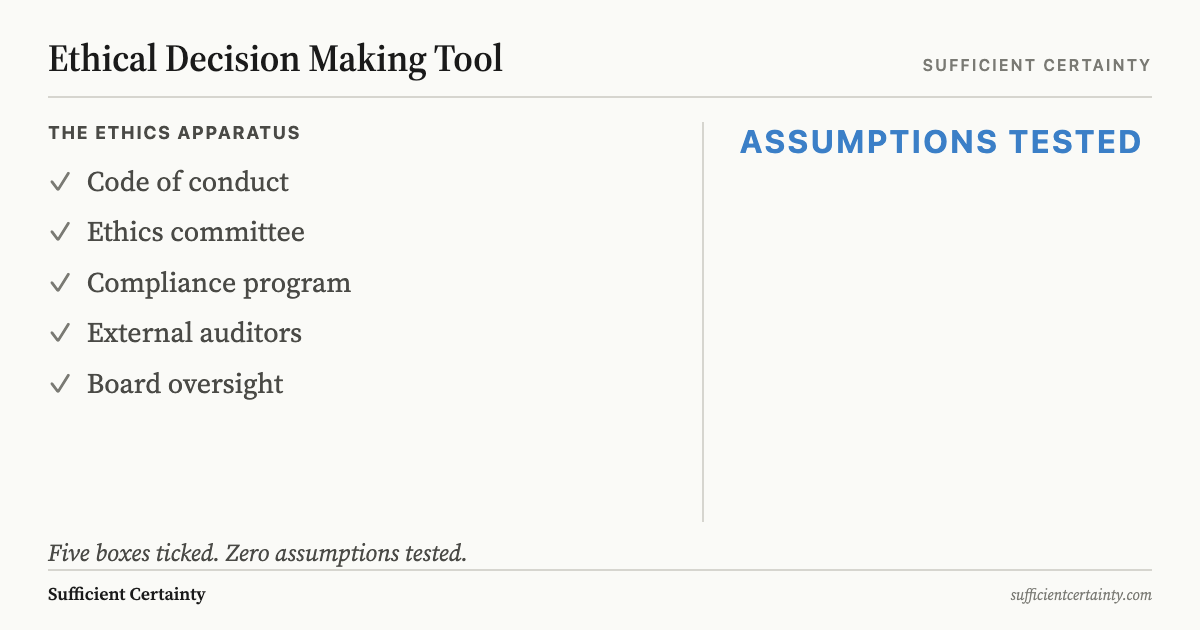
The assumption underneath every ethical decision
When I chair this part of the conversation, I ask one plain question: what are the assumptions we are making here? In an ethical decision, the answer usually involves people.
The room is assuming that the redundancy will not destroy livelihoods beyond what the severance covers, or that the product recall threshold protects customers rather than the warranty budget. Those assumptions are not written down anywhere. They sit in the heads of the people making the call, and they stay there until the consequences arrive.
I watched a hiring panel score three candidates for an accounts payable role on skills, experience, and interview manner. The scores looked clean. Nobody wrote down the assumption that mattered: that the successful candidate would be honest and that the control environment around the role would catch it if they were not. The same person can clear an invoice backlog or enable a major fraud.
A scoring matrix can rank the candidates; it cannot test the assumption about integrity and environment that makes the ethical dimension of the decision visible. That assumption belonged on paper before the offer letter went out, with a named signal for what would trigger a review of the controls around the role. No risk register would have caught it because no register asks what the hiring panel assumed about the person they chose.
MIT Sloan reviewed why compliance programmes structured for appropriate oversight still failed to prevent misconduct at Wells Fargo and General Motors. The finding is consistent with what I have seen: the structure existed; the assumptions underneath it were not tested; and monitoring, where it existed, was a reporting obligation rather than a genuine test of whether the original decision still held.
At Wells Fargo, the incentive structure assumed that employees would sell products customers actually needed. Nobody tested that assumption. Employees opened millions of accounts that customers had never requested, because the targets rewarded volume and the controls counted accounts opened, not consent obtained. The Walk asks the room to name the assumption, judge whether the evidence supports it, and write the signal that would reopen the decision. That sequence is what most ethical decision making tools skip.
Write down the assumption your committee is making about the people this decision affects, and name who owns it. Start the Walk →
When an ethics framework is enough
A code of conduct, a compliance checklist, and a facilitated ethics discussion are enough when the choice is bounded and the downside is containable. Routine procurement decisions, standard HR processes, day-to-day operational calls where an existing policy already covers the ethical dimension and the people affected are identifiable and protected by that policy. In those situations the framework does what it was designed to do: it reminds the room of the standard and the room applies it.
The framework stops being enough when the decision carries a material commitment and the assumption underneath it reaches people who have no seat at the table. Restructuring that will eliminate roles across a region. A product threshold that trades customer safety against warranty cost. A partnership with an organisation whose labour practices rest on an assurance nobody has verified. In those decisions, the ethical question is not whether the room knows the code of conduct. The ethical question is whether the room has tested what it is assuming about the people the decision will affect.
The Walk forces that test. It does not replace the ethics framework; it picks up where the framework stops. The framework sets the standard. The Walk surfaces the assumption that determines whether this specific decision meets it, and it writes the monitoring signal that brings the decision back if the assumption fails. When the downside is containable, the framework is enough. When a wrong assumption could harm people who cannot push back, the room needs the full method.
What an ethical decision making tool must produce
I want a record. Not a compliance report and not a set of meeting minutes, but a short document that says what was decided, why it serves the organisation's Purpose, and which assumption would hurt people if it turned out to be wrong.
That document should name who will know first when the assumption starts to fail, and what they will do about it. At that point, the ethical decision making tool is the Decision Document itself.
Most decision making tools end at selection: the matrix produces a score, the framework produces a recommendation, and the room disperses. In my experience, the ethical dimension of a decision lives in what happens after the choice: whether the monitoring catches the signal, whether the person responsible acts on it, and whether the organisation learns from it or files it.
The Universal Decision-Making Method puts Recognise assumptions before Sufficient certainty for this reason. I do not need the room to be more ethical. I need them to test what they are assuming before the commitment hardens and the people affected start living with the consequences.
The Walk produces that Decision Document in one pass: it names the assumption, weighs the evidence, and writes the monitoring signal. No facilitator between the decision and the record.
If the assumption is that the supplier's labour practices are sound, I want the audit date, the scope, and the signal that triggers a re-check rather than a vague assurance that "we looked at it." If the assumption is that the redundancy process treats people fairly, I want the threshold written down and the person who will monitor the outcome named before the announcement.
Roger Estall and I wrote Deciding because we sat through too many meetings where the ethical question was treated as a sentiment rather than a test. The room would agree that the decision should be ethical, and then nobody would say what they were assuming about the people it affected. The Walk exists because most rooms will not ask that question without structure. A spoken agreement about ethics lasts days; a Decision Document lasts until someone reopens it.
You could pass the next ethics audit and still leave the assumption underneath untested.
Work through your decisionNo sign-up. Just pick your decision and start.
Grant Purdy is the co-author, with Roger Estall, of Deciding (2020), and the architect of the Universal Decision-Making Method.