A decision making tool earns the name when it tests the assumption a choice depends on before the room commits. Most tools organise preferences. The Walk tests assumptions. That is the difference between a tool that records a decision and one that improves it.
I have spent fifty years advising executives, boards, and governments on decisions where the answer was not obvious and the consequences were real. That work distilled into a five-step method that tests what every other tool leaves unexamined: the assumption the choice depends on.
The Walk takes you through those five steps for one live decision. You open it without creating an account, name what you are deciding and why, surface the assumptions carrying it, and leave with a Decision Record that states the basis of your choice and the condition that would trigger review.
"I knew the answer. I just couldn't see what was blocking me."
A decision making tool earns its name when it tests what the choice depends on and records what would make you reconsider it.
What a decision making tool should actually test
A scoring sheet tests the numbers entered into its cells. A decision matrix tests how options rank against selected criteria. Neither test asks whether the criteria describe the real Purpose or whether an assumption outside the spreadsheet is doing the work. If the chosen option depends on a supplier meeting a delivery date or a control catching an error, the total score cannot tell you whether that condition is credible.
I saw this in the decisions that followed the 2007 financial crisis. The Financial Crisis Inquiry Commission report describes models, ratings, and oversight that continued to support lending while the housing conditions beneath them changed. The output looked orderly; the material assumptions had not been made answerable. A precise result can therefore make a weak basis harder to challenge. A decision support tool that does everything else right still fails at that point.
The process starts earlier. It asks what is being decided and who owns the outcome. It then asks what the decision is for, which options are genuinely open, and which conditions each option needs. Those questions are not an introduction to the real work. They are the work. It keeps returning to them until the Decider can explain why acting now is justified and what would cause a review.
Evidence still matters, but evidence is not a substitute for judgement. Evidence-based decision making separates a fact about the present from a prediction about the future, then makes the prediction visible. You can accept uncertainty when its influence is small or when you have designed a response that limits it. You cannot claim sufficient certainty while leaving the central condition unnamed.
A risk register can name a hazard without naming the decision it could change. The risk hub explains that distinction; the product keeps the question attached to the choice you own.
That is why the method may leave a matrix in place. A comparison can be useful after the choice has been framed and the material assumptions have been examined. The matrix becomes one input, not the decision-maker. The product is built to prevent the familiar reversal in which the calculation quietly becomes the authority.
A decision making tool should make the Decider's judgement more visible, not make a spreadsheet look more official. It earns its place by connecting each answer to the condition it is meant to test.
Every consequential decision I saw fail had the same signature: a belief about what would happen next that nobody had named, let alone tested.
How the Walk works
To show the experience, take a documented decision from the Boeing 737 MAX programme. Boeing changed the position of larger engines to match competitor efficiency. The new position could make the aircraft pitch up and stall during initial climb, so flight-control software was added to lower the nose when duplicated angle-of-attack sensors detected an excessive angle. Later investigations found that the system and pilots could not reliably know when a sensor was faulty, and pilots were not made aware of how the software would respond.
I built the product around those questions, not around a promise that any method can remove human failure. It keeps the work bounded: one choice with one owner, not a permanent process for every uncertainty in the organisation.
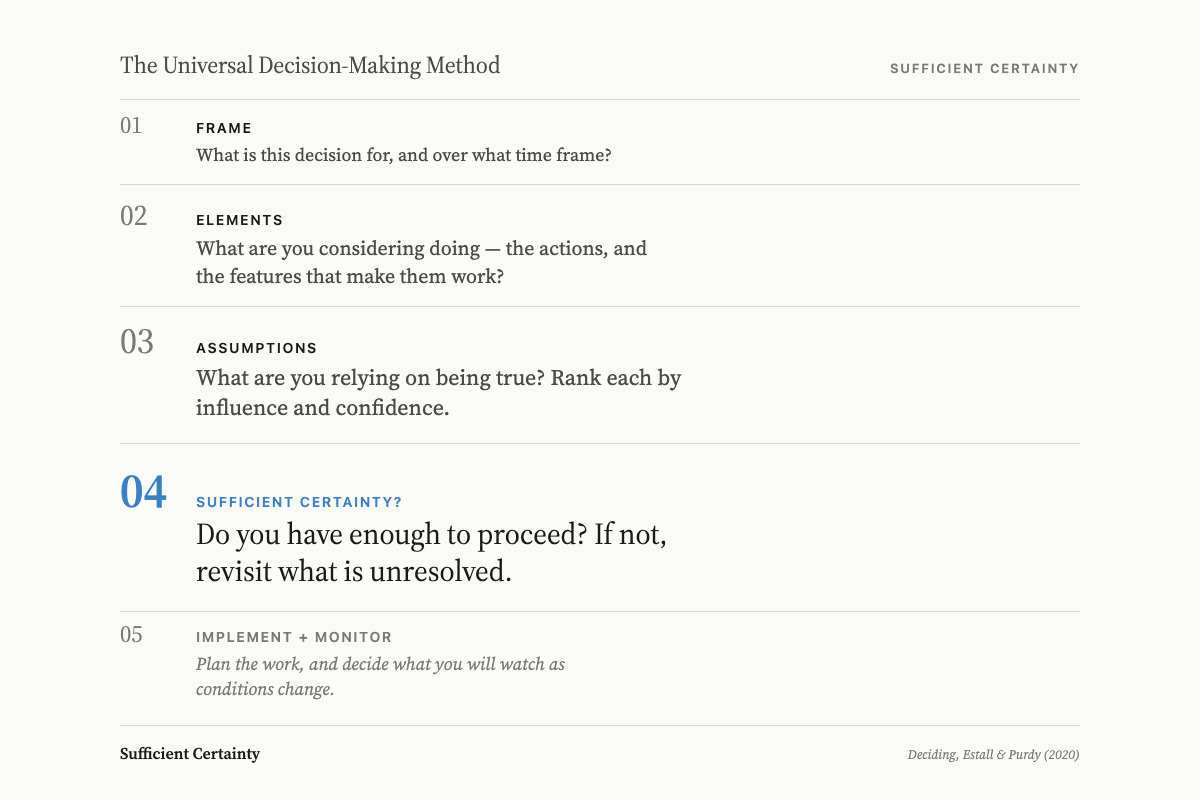
Five steps. One sitting. A defensible record at the end.
No jargon, no training programme, no consultant required. Nearly fifty years of advising at the highest level, distilled into a structured session you run yourself. You bring the decision. The method tests what it depends on.
Frame the decision. This step asks you to write the actual choice in plain language and name its Purpose. For the 737 MAX decision, the Purpose was not simply to install larger engines. It was to offer an aircraft with improved fuel efficiency while preserving safe operation, acceptable training demands, and a viable commercial timetable. A narrow frame would have made the engineering change look complete before the operating consequences were considered.
For your own decision, the frame might be whether to close a plant or approve a procurement contract. Risk-based decision making keeps the hazard attached to the choice rather than parked in a register. A new service can be a separate decision with its own Purpose. You name the Decider and the boundary of the choice. It does not let a broad problem statement expand forever. A bounded decision gives the rest of the work somewhere to land.
Develop options. This step asks you to create options that can actually be pursued. For the aircraft decision, an option was to redesign the aircraft around the larger engines. Another was to accept a different efficiency target and preserve the existing configuration. A third could have been to delay the commitment until the pilot interface and sensor behaviour were understood. The point is not to invent a long menu. It is to stop the preferred answer being treated as the only available path.
Recognise assumptions. This step asks what must be true for each serious option to work. In the 737 MAX case, the decision relied on the software receiving trustworthy sensor information and the pilots understanding its behaviour. The altered aircraft also had to remain safe in the conditions where the system might activate. Those were not details to be left to a later document. They were conditions carrying the decision. When the domain is risk specifically, a risk based decision making tool built on the same principle makes the assumption answerable before the room commits.
When the forecast comes from an AI model, an ai decision making tool built on the same discipline records what the model assumes and assigns a person to watch for the moment that basis shifts.
The same test applies when an AI forecast is part of your case. You can record the evidence the forecast uses and the behaviour it assumes will continue. It cannot certify the prediction, and it does not pretend that an automated output owns the consequence. You decide what evidence is enough and which signal would show that the basis has shifted.
Sufficient certainty. This step asks you to judge whether the remaining uncertainty is acceptable for the Purpose. That judgement is not a score from one to ten. You can improve certainty by collecting targeted evidence, changing the option so it relies less on a weak condition, or accepting the condition with a defined response. A decision is ready when the Decider can explain why the remaining uncertainty is tolerable now.
For a safety-critical choice, the threshold may be strict and the evidence may need independent challenge. For an internal process change, a short trial may provide enough learning. It does not impose one appetite on every organisation. It makes the Decider state the basis for the threshold instead of hiding it behind a label.
Design monitoring. The final step attaches a signal, an owner, and a response to the assumption that matters most. In the aircraft example, a useful monitor would have needed to reveal conflicting sensor information and the interaction between software and pilot input before flight conditions made the problem catastrophic. Monitoring is not a report sent upward after the fact. It is a pre-agreed reason to pause, change, or confirm the decision.
A printed decision making tool template usually ends at the ranking. The five questions above carry the work past that point: they name the assumption the preferred option depends on and attach a monitoring signal before the room moves on.
The full method is explained at the Universal Decision-Making Method. It is where that method becomes a decision you can act on. When a second person is needed to challenge the frame, I explain the boundary between the product and decision coaching: coaching adds a human conversation, while the product gives you a structured session you can run yourself.
Put the decision on your desk through the step most tools leave out: test what it assumes. Start the Walk →
What you get: the Decision Record
It ends with a Decision Record in PDF, not a score and not a transcript of your answers. It states the decision and its Purpose, identifies the Decider, and shows the option that was selected. It records the material assumptions and the evidence accepted. It also states the work done to improve certainty and the monitor that will trigger review. The document is short enough to use and specific enough to defend.
What the Decision Record contains
- The decision and its Purpose
- The Decider and the boundary of the choice
- The selected option and the alternatives considered
- Material assumptions and the evidence accepted for each
- Work done to improve certainty
- The monitor: a condition, an owner, and a pre-agreed response
This is what a walked decision looks like. The record below is from a manufacturing firm deciding whether to deploy AI for quality inspection. Each assumption is graded by significance and tested against the evidence accepted.
That distinction matters in governance. A board paper usually explains what management recommends at one point in time. A consultant's report explains what the consultant found. A filled-in template shows that somebody completed fields. The Decision Record shows the reasoning that connected the choice to its Purpose and states what would make the board look again. It gives a later director a basis to question without having to reconstruct the meeting from scattered files.
Aircraft operators are required to keep maintenance records so a later owner can understand what was done and when. The United States recordkeeping rule makes that continuity explicit. Organisational decisions need the same discipline when people change roles or the context moves. The Decision Record keeps the original basis visible instead of allowing hindsight to rewrite it.
Managers decide at the highest velocity and with the least structured support. A decision making tool for managers needs to test what the preferred option assumes in the time the calendar actually allows, which is usually a single meeting.
A monitor in the Decision Record must lead somewhere. If a supplier misses the agreed lead time, the owner knows whether to pause the contract or accept the change. If a project adoption measure stays below the threshold, the project lead knows which assumption needs review. It makes that response part of the decision while the reasoning is still fresh, rather than leaving it to a later committee.
The Decision Record is the part of the product that survives the session. It gives governance a clear basis for review without asking anyone to trust a score they did not create.
Who uses the Walk
Boards use it when a recommendation needs a clear Purpose and a review condition before approval. The Decider can circulate the Decision Record with the board papers and make the central assumption visible. A group can work through the same decision, but the product still requires one person to own the call.
When a group needs to test what the room is assuming before anyone commits, the Walk works as a group decision making tool that surfaces the premise the team shares but has not examined.
Cross-functional teams face a harder version of the same problem: the scoring model produces consensus but leaves the assumption underneath untested. A decision making tool for teams that produces a record instead of a score closes the question the first time.
When the collaboration product is recording preferences instead of testing them, the same method applies as a collaborative decision making tool that replaces the vote with an assumption register.
Project leads use it before a commitment changes scope, budget, or the operating context. Managers use it for a hire, supplier change, or new control where the cost of a wrong assumption will land on their team. Procurement leads can test whether a low price depends on unestablished delivery or quality.
Founders use the Walk when the next commitment will consume most of the available runway. A startup that cannot afford to be wrong about a market entry or an exclusive distribution agreement needs the assumption underneath the commitment tested before the money moves. The decision making tool keeps the session bounded to one choice, which prevents a founder from trying to resolve every open question in a single sitting. The Decision Record also gives an investor or co-founder a clear basis for understanding why the commitment was made.
A nonprofit board faces a version of the same problem with an additional constraint: the funding assumption underneath a programme commitment is rarely tested until the reserves are already drawn down. The Walk surfaces that assumption before the board approves the expansion.
For an ethical choice, the product makes the affected interest and the accepted trade-off explicit. For a strategic choice, it makes the forecast and the conditions behind it reviewable. For a clinical choice, it helps the clinician and patient keep the decision with the person who will live with the outcome, while recognising that clinical judgement and professional guidance still matter.
The same discipline applies to a strategic decision making tool: the five steps surface the assumption underneath a commitment and produce a document the room can defend after the meeting ends.
Why not a consultant, and what it costs
A consultant can be valuable when you need specialist evidence, an independent investigation, or work that your team cannot do. I have hired specialists myself. The problem starts when a consultant's opinion becomes the organisation's substitute for deciding. The report can be correct and the Decider can still be unable to say what condition carries the recommendation.
The product takes a different position. It is my method made into a self-guided product, not my judgement rented by the hour. You do the work on your decision, in your context, and keep the Decision Record. There is no recurring relationship for the product to protect and no subscription that rewards another round of analysis. You pay $49 AUD once for one session and one record.
That price is deliberately below the cost of a consulting engagement because the product is bounded. It does not promise to research your market or approve your engineering. It gives you a disciplined place to test the assumptions you already carry and a record that can be reviewed. If you need outside expertise, include it as evidence. You can start without signing up.
A consulting engagement typically begins with scoping, continues through research and interviews, and ends with a report that may take weeks to produce. The Walk takes one session. It does not replace the consultant's specialist knowledge, but it does replace the part of the engagement that consisted of a structured conversation about what the Decider believes and what the choice requires. That is the part most organisations overpay for, because the rigour comes from the method, not from the billing rate.
What went into building this
The method behind the Walk was not designed in a sprint. It came from decades of advising boards, regulators, and governments on decisions where the cost of a wrong assumption was measured in lives, public trust, or billions. It drew on the same thinking that shaped ISO 31000 and then moved past the standard's limits. The five steps are the residue of that work: everything that did not survive real use was cut. What remains is the smallest set of questions that reliably finds the belief carrying the decision.
When a matrix is enough
A matrix is enough when the criteria are stable, the options are familiar, and a wrong choice is cheap to reverse. Comparing two routine suppliers may need no more than agreed criteria and a clear owner. A small operational adjustment can be made, observed, and changed without a formal record.
Use the product when the choice is hard to reverse, depends on somebody else's behaviour, or will need to be defended after the people involved have moved on. A plant closure, a major procurement, or a project that commits budget and timeline can carry assumptions that a ranking hides. The question is not which tool looks more serious. It is what the cost of an untested assumption would be.
A decision matrix
- Ranks options against criteria you set
- Scores what you enter
- Useful when criteria are stable and a wrong choice is cheap to reverse
- Leaves no record of what the choice depended on
The Walk
- Tests what the preferred option depends on
- Names the assumption carrying the choice
- Built for commitments that are hard to reverse or will outlast the meeting
- Produces a Decision Record with a review trigger
For the lighter decision, keep the matrix. For the consequential one, use it within this process if it helps compare the surviving options. The product earns its place when it makes the basis of the choice and the review condition as clear as the ranking.
The distinction is not about the size of the organisation or the seniority of the Decider. A senior executive making a routine supplier renewal does not need a full decision making tool for that choice. A team leader committing to a new service architecture that will constrain the next three years of development does. The question is always whether an untested assumption could change the outcome after the commitment has been made.
That question applies equally to a decision matrix tool that scores options against weighted criteria, to decision making software that automates the scoring, and to a decision tree tool that maps the branches. All are useful inputs. None tests the assumption underneath the preferred path.
Published best decision making tool comparisons reinforce the pattern: they rank features and price tiers without asking whether the process behind the tool can surface the assumption the preferred option depends on.
Decision making tool or decision making framework
The decision making tool vs framework distinction comes down to what exists after the meeting: a framework describes the elements a decision process should contain, while a tool applies them to the choice in front of you and leaves an artefact. The Universal Decision-Making Method is the framework; the product is the working instrument for one live decision.
ISO 31000 can help an organisation use consistent language about risk, but a standard cannot take responsibility for a particular call. The Decider still has to say what will be done and what will be watched.
The method is set out in full at the method page, including the five canonical steps. The product turns those steps into prompts, records your answers, and produces the Decision Record. If you are comparing the wider category, see decision-making frameworks; if you are looking for a product that takes you from a live question to a defensible record, start the Walk.
Take the decision you have been circling into the Walk and leave with a record you can defend.
Start the WalkOne decision, one Decision Record. No sign-up.