
How much downside should we accept is the question most teams answer after they have already committed. By then the number is shaped by the sunk cost, not the evidence. Agreeing on the loss you can absorb before the proposal arrives is the one move that stops optimism from doing the arithmetic.
I was chairing a review of a major plant investment when a non-executive director asked the question that should have come first: "How much downside can we accept on this?" The room went quiet. The business case had projected returns, sensitivity analyses, and a colour-coded risk register. Nobody had stated the figure at which the board would stop.
That silence is more common than it should be. I have sat through dozens of investment committees where the upside case was rehearsed, the risk register was tabled, and the only question that matters went unanswered: how much loss are we prepared to absorb before we pull the plug?
The finance industry has annexed this question. Search for it and you get portfolio theory: semi-deviation, Value at Risk, Sortino ratios. Those tools belong to fund managers choosing between asset classes. They are useless to a project lead whose team is about to commit headcount, budget, and reputation to a plan that could fail. The real question is how a group agrees on the loss it is prepared to absorb on a specific decision.
Downside acceptance is the explicit agreement, before committing resources, on how much loss an organisation can absorb if a decision does not deliver its intended outcome.
Affordable loss, not expected return
Saras Sarasvathy at the University of Virginia studied how expert entrepreneurs make commitments. She gave 27 founders the same scenario and recorded their thinking aloud. The MBA-trained managers ran expected-return calculations. The expert entrepreneurs asked a different question entirely: how much can I afford to lose?
The distinction is structural. Expected-return thinking requires you to predict the venture's outcome. Affordable-loss thinking requires you to know your own position: what you have now and what you could survive losing. One depends on a forecast; the other on knowing where you stand.
Sarasvathy called this the "affordable loss principle." The calculation needs only two inputs: current means and personal worst-case threshold. The question is what you can stake if the venture produces nothing.
That is the question most organisations skip. They build the business case around the return. The risk register catalogues everything that might go wrong without ever stating where the line is.
What happens when nobody sets a downside boundary
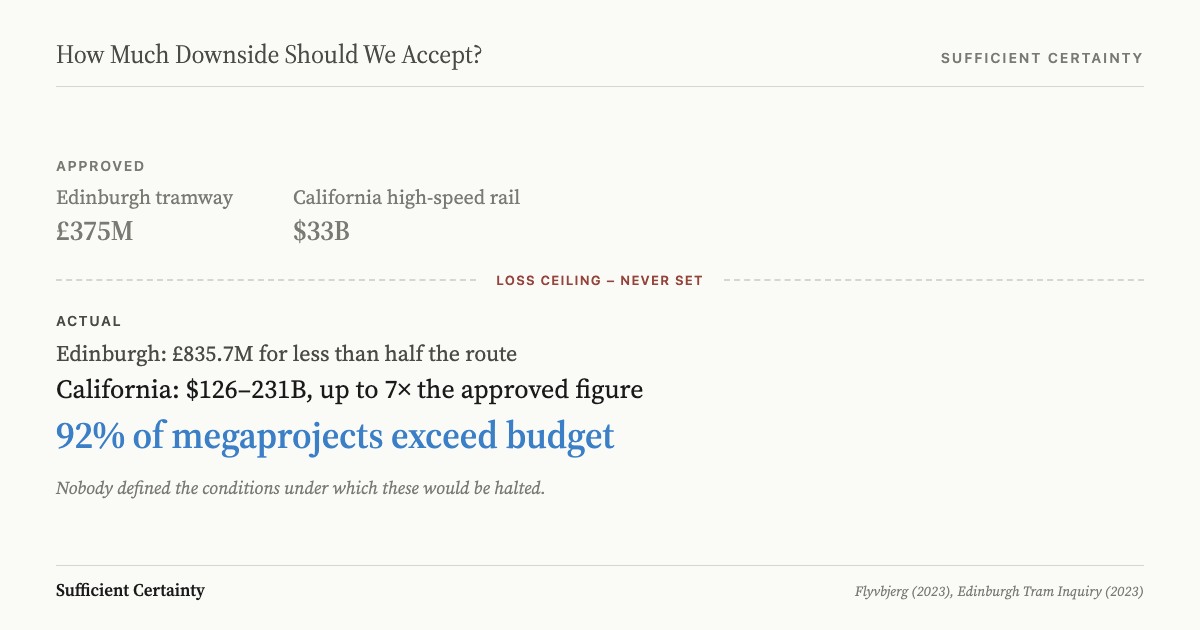
Edinburgh approved a twenty-mile tramway in 2007 at a budget of £375 million. By the time Lord Hardie published the Edinburgh Tram Inquiry Report in September 2023, the city had built 8.5 miles for £835.7 million: more than double the budget for less than half the route, five years late. The Inquiry found that the contract's risks were never quantified, optimism bias guidelines were ignored, and nobody in the governance chain owned the question of what Edinburgh could afford to lose. There was no mechanism to halt the project because nobody had defined the conditions under which it would be halted.
The same pattern is unfolding in California. In 2008, voters approved $9.95 billion in bonds for high-speed rail, on the strength of a $33 billion total estimate. By 2026, the 177-mile initial segment alone had reached $34 to $38.5 billion, and full-system estimates sit between $126 billion and $231 billion. That is four to seven times the figure voters consented to. No governance mechanism exists to trigger re-evaluation at a defined threshold.
These are predictable failures. The business case promised a return. Nobody recorded the threshold at which the decision would be reopened. When costs breached every projection, there was nothing to trigger a halt.
Name the loss your organisation cannot afford on the commitment in front of you and write it down before the money moves. Start the Walk →
Why the worst case is worse than you think
Edinburgh and California are not outliers. Bent Flyvbjerg built the largest database of project performance ever assembled: more than 16,000 projects across sectors. His finding: 92 per cent of megaprojects come in over budget or behind schedule, or both. Average cost overruns run to 45 per cent for rail, 34 per cent for bridges and tunnels, 20 per cent for roads, all in real terms.
The critical detail is the shape of the distribution. Project cost overruns follow fat-tailed distributions, which means extreme overruns of two, five, or ten times the original budget are a structural feature of how large commitments behave. Standard planning assumes a bounded range of outcomes. Fat tails mean the real range extends far beyond what any sensitivity analysis will show you.
If the distribution is fat-tailed, the question "how much should we accept?" stops being a governance formality. It becomes the question. An organisation that does not cap its acceptable loss is exposed to outcomes it has not imagined, let alone consented to.
How to set the downside boundary before committing
In 2003, HM Treasury revised its Green Book to require that all major project appraisals include explicit, empirically based adjustments for optimism bias. The revision was triggered by Flyvbjerg's research. Every major UK public project must now apply a cost uplift based on how similar projects actually performed. Recommended uplifts range from 2 per cent to 200 per cent depending on project type and stage.
The Green Book does not ask project sponsors to state their risk appetite. It asks what the evidence says similar projects actually cost, and it forces the answer into the business case before approval.
That is the principle. In the Universal Decision-Making Method, the same question appears in a sharper form: what does this decision rest on, and do you have sufficient certainty that those things will hold? The loss ceiling lives inside the decision, in the assumptions.
Before committing, ask what you can afford to lose. The loss your organisation can absorb without compromising its ability to operate. Sarasvathy's affordable-loss question, applied to the organisation rather than the founder.
Then identify which assumptions the commitment depends on. The assumptions that, if wrong, would breach the loss ceiling you just stated. In Edinburgh, the unstated assumption was that the contractor would deliver on price. In California, the assumption was that a $33 billion estimate was reliable for a project with no precedent at that scale.
The last question is what would reopen the decision. The monitoring step in the method requires you to define, before you commit, the trigger conditions under which you would return to the decision and reconsider. If Edinburgh had set a cost trigger at £500 million, the project would have been re-examined two years earlier. If California had set a per-mile cost trigger benchmarked against international rail, the full-system estimate would have tripped it before the first mile of track was laid.
That is risk-based decision making in practice. Most organisations skip these steps entirely. They commit on the strength of a return forecast, note the existence of risks in a register, and discover the real loss only after it has arrived.
The question is not whether you can calculate the risk. Any spreadsheet can do that. The question is whether you have agreed, before committing, on the loss you are prepared to absorb and the conditions under which the decision reopens. That is the step the risk management apparatus cannot perform. It requires a conversation, not a framework.
You could approve the next commitment and never state the loss you can absorb.
Work through your decisionNo sign-up. Just pick your decision and start.
Grant Purdy is the co-author, with Roger Estall, of Deciding (2020), and the architect of the Universal Decision-Making Method.