
Resource allocation is the part of strategy that actually costs money, and it is where most strategies quietly die. Organisations build ranked lists and debate the weights; then they fund exactly the same things they funded last year. I have watched this happen so reliably that the exceptions are what surprise me.
The problem is not that teams fail to prioritise. They prioritise enthusiastically. They score, they rank, they weight. Then the budget cycle starts and the money follows the same channels it followed last year, because the people who control those channels have careers attached to them. The ranking becomes a document; the allocation stays a habit. Every organisation I have worked with believes it is the exception, and almost none of them are.
Resource allocation is the process of distributing available capacity across competing commitments according to their assessed priority and the assumptions on which that priority rests.
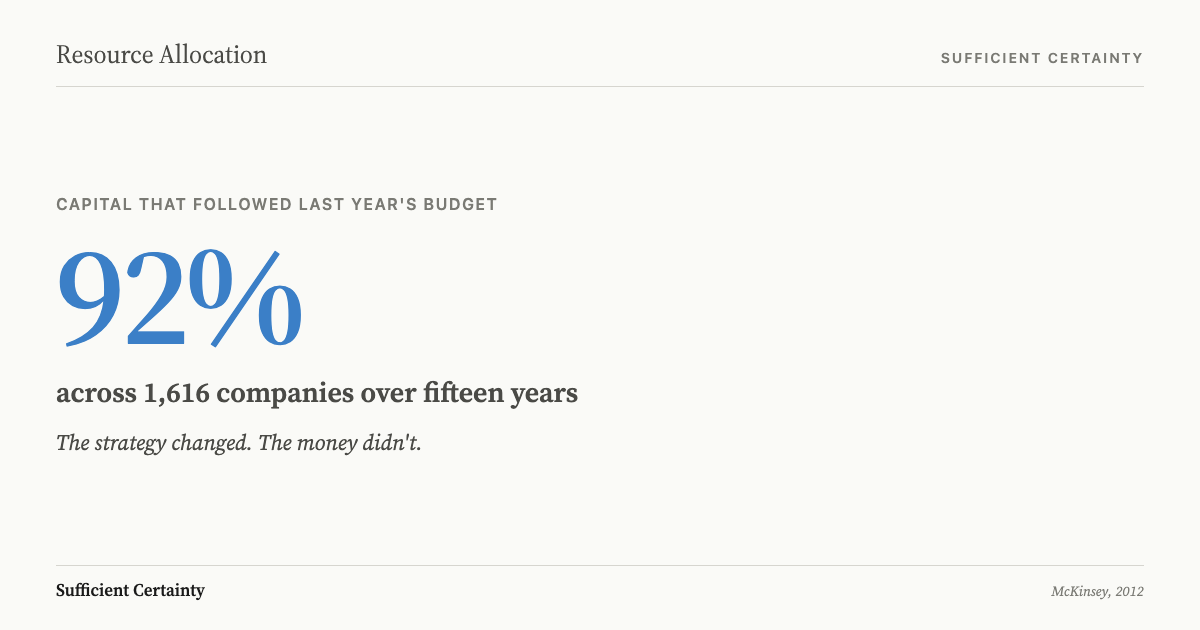
Resource allocation follows habit, not the ranking
A McKinsey study of 1,616 US companies over fifteen years found that the average company reallocates only about 8 per cent of its capital across business units from one year to the next; 92 per cent of the budget goes where it went last year. Even the 2008 financial crisis, which upended revenue forecasts across entire industries, had virtually zero impact on reallocation patterns. Companies that claimed to be reprioritising were not moving money; in practice, they were relabelling the same commitments.
The study also found that companies in the top third of active reallocation earned 30 per cent higher total returns to shareholders than companies in the bottom third. That is the cost of treating a priority list as a document rather than instructions to the treasury.
I have sat in enough steering committees to know why the inertia holds. Budget holders fight for their allocation because losing it signals organisational decline, and nobody volunteers for that signal. The grid ranks projects; the politics ranks careers. When those two rankings disagree, the careers win, and the prioritisation matrix sits in a drawer until next year's planning cycle. I have seen the pattern hold in Australian state procurement and UK nuclear regulation just as firmly as in private companies that pride themselves on agility.
The gap between strategy and what gets funded
Marakon Associates and the Harvard Business Review put a number on the damage. Their research, drawing on companies including Barclays and Cisco, found that organisations on average deliver only 63 per cent of the financial performance their strategies promise. The missing 37 per cent does not vanish because the strategy was wrong; it vanishes because allocation, planning and execution are disconnected from strategic intent. Resources flow to whoever argues loudest rather than to whatever the strategy identified as the priority.
That is what I have seen in every organisation where the allocation decision carries no record of the assumption it rests on. Every budget line contains an implicit claim: "The conditions that justified this spending last year still hold." In my experience, that assumption is rarely stated and almost never tested.
The Universal Decision-Making Method insists that assumptions are made visible before a commitment is made, precisely because invisible assumptions produce exactly this kind of drift. If nobody writes down why a project deserves its funding, nobody can tell you when it should lose it.
Take your next budget line and write the assumption it rests on, before the allocation process funds it by default. Start the Walk →
When fear decides the allocation
Nokia's collapse between 2007 and 2013 is the most thoroughly documented case of resource allocation driven by internal politics rather than strategic reality. Vuori and Huy interviewed 76 Nokia managers, from top executives to engineers, and published their findings in Administrative Science Quarterly. What they found was that shared fear at every level of the organisation distorted the information on which allocation decisions were made.
Top managers feared external competitors and shareholders. Middle managers feared their own superiors and peers. The middle managers inflated timelines and hid problems because reporting accurately would have meant admitting that Symbian, the platform receiving the bulk of Nokia's smartphone investment, could not compete with iOS.
Top managers, receiving optimistic signals from every direction, pushed harder and allocated more resources to accelerate Symbian-based touchscreen development. That was the wrong platform. Nokia's market capitalisation fell from approximately 110 billion euros in 2007 to under 15 billion euros by the time Microsoft acquired the handset division.
The organisation did not lack resources. It misallocated them because the prioritisation process could not accommodate a piece of information that threatened too many careers: the assumption that Symbian was capable of competing with the iPhone was false, and everybody with direct knowledge was too frightened to say so.
That is resource allocation failure at industrial scale, and no matrix or scoring model would have prevented it. The failure was upstream of the allocation: nobody could name the governing assumption because naming it would have exposed that the priority was wrong. In the method Roger and I built, the third step is to recognise assumptions. Nokia's middle managers could not do that because the organisational incentives punished honesty. The allocation process inherited a lie and funded it generously.
What the prioritisation grid cannot measure
The NDA Magnox nuclear decommissioning procurement illustrates a different failure mode. The winning bidder's submission scored 86.48 per cent against the runner-up's 85.42 per cent on the evaluation matrix. The High Court later found that the winning bidder should have been disqualified against threshold requirements. The National Audit Office put the resulting cost to taxpayers above 122 million pounds.
It is a textbook prioritisation matrix failure: the decommissioning burden and the threshold compliance requirements sat outside the scoring grid. The project that looked cheaper on the matrix was not cheaper once the hidden costs materialised. Allocation based on a grid that excludes the most consequential costs is a bet disguised as arithmetic, and a lucrative one for the consultants who built the model.
I keep returning to the same mechanism in every procurement failure I have reviewed. The grid measures what it was designed to measure, which is whatever the designers found convenient to quantify, and the allocation follows the grid. Consequences, however, follow reality. The gap between the two is where the 37 per cent of promised strategic value identified by Mankins and Steele evaporates year after year.
How to make resource allocation follow the decision
A better matrix will not fix this; the decision process upstream of the allocation is where the repair belongs. Before committing funds, state the assumption behind every significant allocation line. If the assumption is "demand for this product will grow at 12 per cent," write it down, date it, and attach a monitoring condition: what observable event would tell you the assumption has failed?
That is what the Universal Decision-Making Method requires in its fourth and fifth steps: sufficient certainty that the assumptions hold, and monitoring designed at the point of decision rather than delegated to an audit function six months later.
The evidence points the same way from every direction. Active reallocation pays a 30 per cent return premium according to McKinsey; passive allocation destroys 37 per cent of strategic value according to Mankins and Steele; and Nokia demonstrates what happens when fear-distorted information makes the allocation process fund the wrong platform with full confidence.
None of these failures required a broken process. They required a process that never asked: what are we assuming, and is it still true? Nokia adds the harder lesson: the question is useless if the culture punishes the honest answer.
Resource allocation is a trade-off problem before it is a distribution problem; it begins with the quality of the decision about what deserves resources. A priority that receives no capacity is a wish preserved on a slide, and everybody who sat through the scoring exercise knows it. If the organisation builds a ranked list and then funds last year's commitments anyway, the ranking was theatre.
You could approve the new priorities and fund exactly the same projects as last year.
Work through your decisionNo sign-up. Just pick your decision and start.
Grant Purdy is the co-author, with Roger Estall, of Deciding (2020), and the architect of the Universal Decision-Making Method.