
A risk based decision making tool should force one sheet onto the table with the decision at the top and the assumptions underneath. Most risk tools do the opposite: they produce registers full of rated items and leave the actual commitment buried somewhere in the board pack, unexamined.
I have sat in rooms where the board pack ran past 100 pages and the only page that mattered did not exist: a risk based decision making tool should force one sheet onto the table, with the decision and its Purpose at the top, and with the assumption that would hurt if it failed written beside the signal that would reopen the call. Consultants and the staff who administer the process benefit when that page never appears, because a vague method is hard to challenge and even harder to blame.
A risk based decision making tool is a one-page method that makes a team name the assumption that matters and judge whether evidence is sufficient for this decision.
What a risk based decision making tool is for
In my experience, the tool has one job: make the live decision visible before the room disappears into paperwork. I want the Deciders to state the choice in plain language and tie it to the organisation's Purpose; I also want the Context dated, because yesterday's fact often decays into today's assumption without anybody noticing.
A scoping review in Risk Analysis looked across 50 years of literature and found 61 relevant publications, yet only 34 used the term risk-based decision making directly. That looseness suits consultants and the people who run the internal process, because once the label can mean almost anything, the room can claim compliance without ever saying what the tool is supposed to force (which is convenient if you sell the procedure).
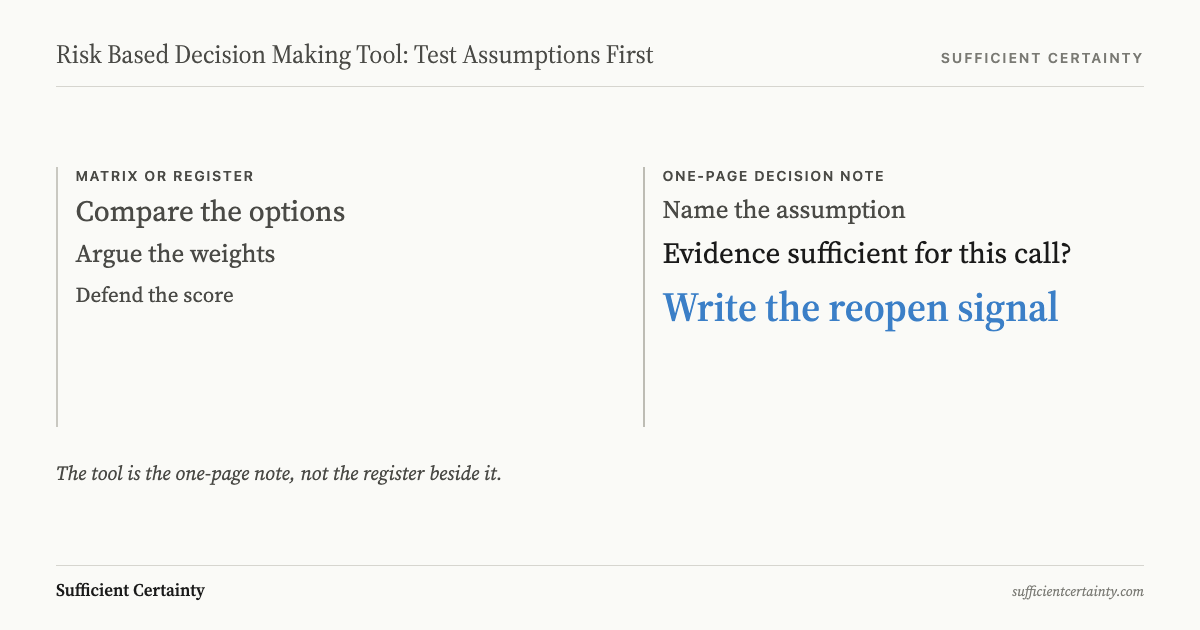
Most tools in the decision making tool guide compare options; the note I am describing here forces the room to own the assumption underneath them.
A register is a record of the discussion you had at one point in time. It does not tell the room whether the choice is ready, which is why a risk register does not help you decide when the board date is close and the context is moving.
Why scoring models stop too early
Matrices and weighted scores compare options that are already on the page; they do not test whether the page itself rests on a sound assumption. A risk based decision making tool helps only when it forces the room to test the assumption the matrix cannot test. I have watched teams spend half an hour arguing over weightings while nobody will say, out loud, that next year's demand forecast is still a guess.
The Federal Reserve review of Silicon Valley Bank says management changed its own assumptions to reduce how risk was measured. On 9 March 2023, deposit outflows were more than $40 billion, and management expected another $100 billion the next day. The apparatus had numbers and dashboards; it did not have a sound judgement about liquidity and concentration.
Once a room starts treating the ranking as the decision, responsibility leaves the table. People defend the colour or the total score because owning the assumption would force them to say what could still go wrong, and who would be accountable if it did. Once everybody is defending the score, the process is protecting the room; it stopped protecting the decision some time ago.
The assumption is the real decision
When I chair this part of the conversation, I ask one plain question: what must be true for this choice to work? The answer is usually short, and it usually exposes the real vulnerability faster than another round of scoring ever will.
The NTSB letter on the 737 MAX said FAA guidance did not adequately account for pilot response under multiple alerts and called for tools to validate those assumptions. The process existed and the experts existed; the live cockpit still exposed the assumption they had treated as settled.
APRA's governance review, published on 16 June 2026, says strong boards test management assumptions and act early as exposures change. That matches my own experience, and it is why the Universal Decision-Making Method puts Recognise assumptions before Sufficient certainty. I do not need another ceremony for this; I need the board paper to say which assumption would break the decision, and who will know first when it starts to break (most board packs work very hard to avoid that sentence).
Sufficient certainty is a judgement about whether the evidence is good enough for this decision, with the remaining uncertainty understood and owned. In my experience, the room usually knows when it has crossed that line; what it lacks is the discipline to write the line down, because that sentence creates accountability. That is exactly what the Walk forces: the assumption written, the evidence weighed, and the reopen signal named before the room moves on.
Write down the one assumption your next commitment rests on and name the signal that would reopen it. Start the Walk →
What I want on the table before anyone commits
I want a short Decision Document. It fits on one page because every field earns its place: the decision and the Purpose that justifies it at the top; the dated Context that tells the reader how fresh the evidence still is; then the harder half, which names the critical assumption and the person who must reopen the call if that assumption starts to fail. At that point, the risk based decision making tool is the Decision Document itself, not the register sitting beside it.
If the assumption is supplier capacity, I want a delivery date or fill-rate threshold that forces the room back together. If the assumption is demand, I want the sales line or order book watched from day one. That is what I mean by Design monitoring: naming the signal in advance and deciding who acts when it appears, rather than letting a monthly status pack tell everybody, too late, that the old assumption has already expired.
The Walk exists because most rooms will not produce that document without structure. It works through the method and produces a Decision Document at the end: assumption named, evidence weighed, monitoring signal written. No facilitator, no half-day workshop.
Roger Estall and I wrote Deciding after sitting through too many meetings that produced thick analysis with no decision attached. The document needs to be short for a reason; once it turns into a report, people start defending paragraphs instead of owning the call. Who benefits from the longer version is obvious enough: the people selling the process, and the people hiding behind it.
When a risk based decision making tool is enough
The one-page note is enough when the decision is bounded and the downside is containable. It is also enough when the room can name the assumption that matters and the signal that would reopen the call without needing a full strategy exercise.
I do not use this stripped tool for a plant closure or a board call that can materially hurt people and capital. Then I use the full Universal Decision-Making Method. The room must Frame the decision properly and Develop options that fit the Purpose. After that it must Recognise assumptions, reach Sufficient certainty, and Design monitoring before the commitment hardens. The Walk covers the full method, not just the stripped version.
I explain that judgement line more fully in making decisions with uncertainty, because the cost of extra analysis belongs inside the decision, not outside it. In my experience, delay looks respectable right up to the day it becomes expensive.
I have watched organisations call this governance when what they were really doing was protecting themselves from the discomfort of commitment. Plants stay open too long and bad suppliers stay onboard; the board arrives at the deadline with the same uncertainty it had at the start, only now wrapped in a cleaner folder.
You could walk into the board meeting with every risk scored and the real one unnamed.
Work through your decisionNo sign-up. Just pick your decision and start.
Grant Purdy is the co-author, with Roger Estall, of Deciding (2020), and the architect of the Universal Decision-Making Method.