
Risk vs uncertainty is a distinction that organises textbooks and paralyses meeting rooms. Executives sort unknowns into two columns and then treat the column labelled uncertainty as beyond method. Every uncertainty is just an assumption that has not been stated yet. State it, test it, and the divide collapses.
Risk vs uncertainty is a distinction that organises textbooks and paralyses meeting rooms. Executives sort unknowns into two columns and then treat the column labelled "uncertainty" as if it were beyond method. Every uncertainty is just an assumption that has not been stated yet. State it, test it, and the divide collapses.
I have sat with executives who could sort every unknown into a neat risk vs uncertainty table and still could not tell me which assumption would sink the recommendation. The columns were full, the categories were tidy, and the decision had not moved an inch. The table was a performance of rigour that had no effect on the actual bet.
Most page-one results on this topic promise the same civilised distinction. Risk is measurable, uncertainty is not. You get a table and a few examples, then the warm feeling that the matter has been settled. I think that is the wrong achievement. The table solves a classification problem while hiding the decision problem, which is what the person signing the paper actually needs help with. It is a filing exercise dressed as analysis. The person who actually has to commit resources needs something else entirely.
Risk vs uncertainty is the common distinction between future unknowns treated as measurable and future unknowns treated as unmeasurable, even though both concern uncertainty about what will happen.
Risk vs uncertainty began as an economist's distinction
The split came from one source that everybody cites and few have actually read: Frank Knight's Risk, Uncertainty and Profit, published in 1921. Knight was doing economics, distinguishing unknowns you can express as probabilities from unknowns you cannot. That was useful to his argument about profit and entrepreneurship. It was never a universal operating manual for boards or plant managers who have to commit resources in the real world. The mistake came later, when management writers forgot that origin.
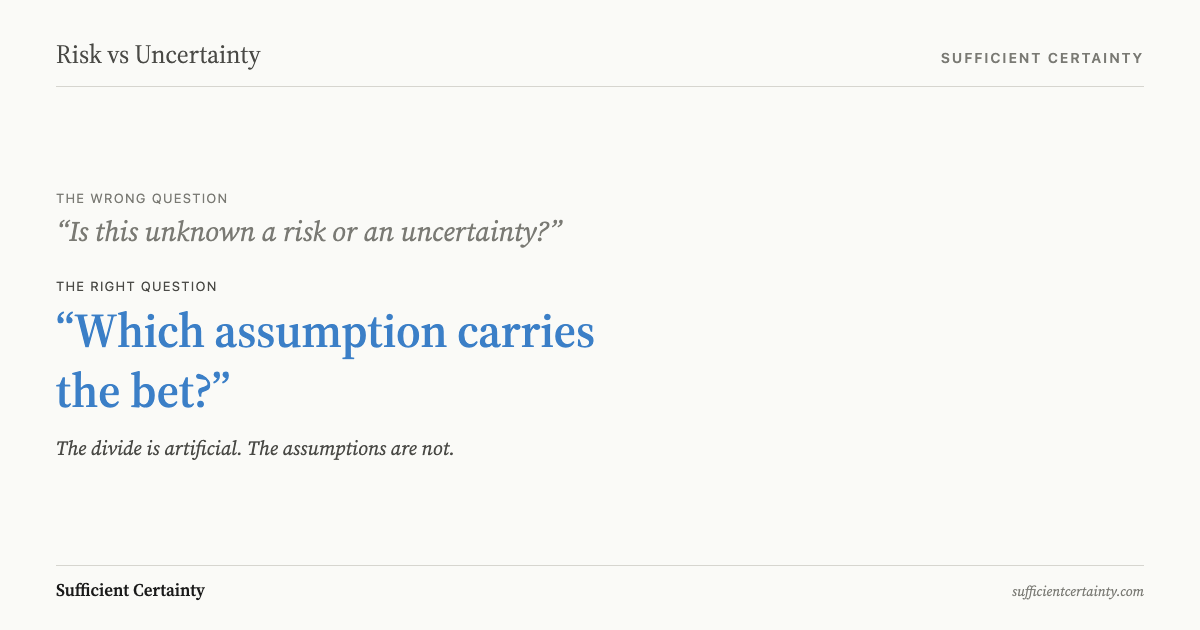
I have no quarrel with Knight doing economics. My quarrel is with the people who kept milking the idea. The supplier either delivers by March or does not. The regulator either permits the change or does not. Those are assumptions about the future, and the Decider still needs enough confidence in the important ones to proceed. Whether you file them under "risk" or "uncertainty" changes nothing about the bet. The distinction was always less important than the assumptions it was hiding.
Risk vs uncertainty disappears when the decision is real
The distinction collapses the moment you connect it to an objective. ISO did exactly that in its 2018 update to ISO 31000, defining risk as the effect of uncertainty on objectives. The UK Treasury landed in the same place in The Orange Book (May 2023), treating risk work as part of governance and decision-making rather than a separate classificatory exercise. Even the Society for Risk Analysis conceded that probabilities alone are not enough without judgement about the strength of the knowledge behind them.
I watched this play out at a water utility considering a new treatment plant. The project team had spent three months distinguishing operational risks (quantifiable failure rates, insurable losses) from strategic uncertainties (regulatory change, population growth). Beautiful spreadsheet. The distinction told them nothing about whether the demand assumption was strong enough to justify the capital. They had classified every unknown without testing the one that mattered. When I asked what the decision actually rested on, the room went quiet. Nobody had written down the specific assumptions carrying the preferred option. The risk vs uncertainty exercise had consumed a quarter and produced a taxonomy. The decision still needed a judgement. A serious risk assessment process would have produced that judgement in a fraction of the time.
None of this surprises anyone who has faced a real commitment. Nobody standing over a capital spend asks first whether an unknown belongs in the risk column or the uncertainty column. They ask whether it could change the outcome and how much confidence they have in the assumptions carrying the preferred option. I cover that practical side in making decisions with uncertainty.
Treat one uncertain call as a set of assumptions to test, not two labels to sort. Start the Walk →
Why the risk vs uncertainty split keeps the apparatus alive
The split survives because it lets organisations display concern without exposing what they are actually assuming. Once you declare that one class of unknown deserves measurement and another deserves a separate protocol, you need certifiers to police the boundary, consultants to sell the protocol, and board secretaries to file the results. A neat taxonomy is the one thing all of them need to keep earning.
I once asked a board secretary why the risk committee met quarterly but never discussed the three decisions that had kept the CEO awake all week. She said those were "strategic uncertainties, not risks." The taxonomy had its own gravity. It pulled the important unknowns out of the risk committee's jurisdiction and left them in nobody's. The CEO was still awake. The committee minutes were still tidy.
Once a room starts debating whether an untested market forecast is a risk or an uncertainty, it has already decided not to examine the forecast itself. I have seen that conversation consume an hour while nobody checks the main assumption. The labels were doing their real job: keeping the harder question off the table. That is why Roger Estall and I ended up rejecting the language altogether in Deciding. It kept steering good people back to categories when what they needed was a decision.
The practical cost is clear once you look at why your risk register doesn't help you decide.
What to do with uncertainty instead
Stop sorting unknowns into columns and attach them to the decision itself. If an unknown can change the outcome, write it down as an assumption under the option you are actually considering. Then judge how important it is and how much confidence you have in it. If the assumption is weak and central, either test it properly or change the option. If the remaining uncertainty can only be resolved after action starts, name what you will watch and who will reopen the decision if the assumption shifts. That is less work than maintaining a register, and it actually helps the Decider commit with their eyes open.
I have done this with infrastructure approvals, resource acquisitions, market entries. The discipline is the same each time. A board considering a port expansion wrote three assumptions on a whiteboard: container throughput would hit a specific volume within four years, the environmental permit would clear by a named date, and a shipping alliance would not move their hub. Two of those were testable before the commitment. The third required a monitoring trigger. None of them fit neatly into a risk column or an uncertainty column, and nobody in that room cared. They had the three things the decision rested on, and they could name what would reopen it. That is what surfacing assumptions looks like in practice.
Bank of England chief economist Huw Pill made much the same argument in his March 2026 speech on robustness. Many real policy problems, he said, involve radical uncertainty that cannot honestly be represented as probabilities or tidy risks. The useful response was not a finer classification scheme. It was robustness across scenarios and explicit judgement about what matters to the decision. That is where serious institutions end up once the labels run out of road.
That is why I prefer the plainer discipline in the Universal Decision-Making Method. Once the live assumptions are written plainly enough for another adult to challenge them, most of the old debate falls away. What remains is the only distinction I have ever found useful: which assumptions matter, and are they good enough yet?
For the wider argument against the whole edifice, start with decisions without risk management and the wider argument on risk. The distinction between risk and uncertainty was never the point. The assumptions behind your next commitment are.
You could close this tab and carry that decision into another week.
Work through your decisionNo sign-up. Just pick your decision and start.
Grant Purdy is the co-author, with Roger Estall, of Deciding (2020), and the architect of the Universal Decision-Making Method.