
Assumptions in decision making are the beliefs a team treats as facts without checking. Every board paper carries them. The ones that collapse a project are not the numbers on the page but the unstated conditions nobody thought to name before the room said yes.
Knight Capital went into the market with one server still on old code and 97 warning emails already sitting there. Forty-five minutes later it had lost more than $460 million. That is what assumptions in decision making look like when nobody checks the rollout state before treating it as fact.
I have sat with boards that could recite every risk label in the pack and still could not tell me what had to be true for the decision to work. Roger Estall and I built the Universal Decision-Making Method to drag that question into the room. Committee secretariats and consultants do rather well out of a pack that looks complete before anyone asks the awkward question, which is usually the only question that matters. The strategic thinking skills the industry sells look impressive until you notice none of them force that question into the open. Once the paperwork looks serious, the assumption can hide in plain sight.
Assumptions in decision making are the unproved beliefs that a choice depends on.
Assumptions in decision making are usually disguised as facts
The Mars Climate Orbiter was not lost because nobody wrote a specification. It was lost because people assumed the specification had been obeyed, although ground software was producing thruster data in pound-seconds where newton-seconds were required, as NASA’s mishap report records. The navigation team proceeded on that basis, and the spacecraft ended up at roughly 57 kilometres instead of the planned 226. Nobody in that chain thought they were making an assumption. They thought they were reading a fact.
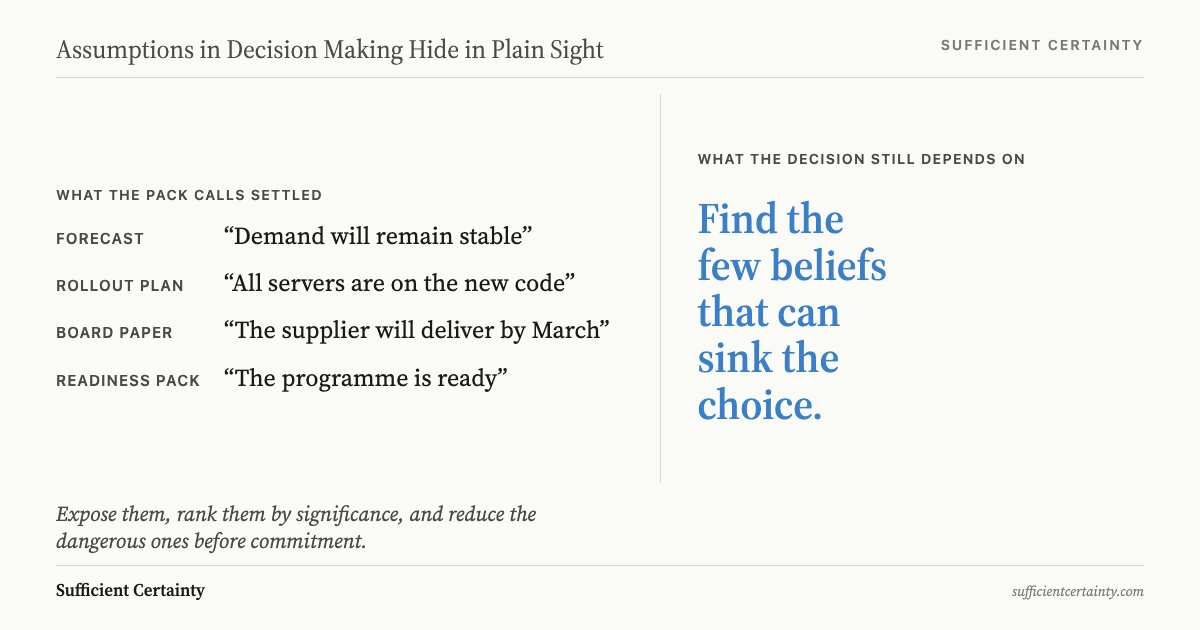
I hear the same trick in cleaner clothes. A board paper says demand will remain stable or the supplier will deliver by March. Those are still beliefs, not facts. The real question is which assumptions must hold for the option to make sense, a point buried in the FHWA guide on decision making under deep uncertainty that most boards skip past on the way to the forecast. That is how assumptions in decision making get smuggled into a board paper as if they were settled.
A board paper loves nouns such as forecast and readiness because they sound official enough to survive the governance machinery untouched. I do not accept them until someone says, “we are assuming that...” In my experience, the room gets quieter at that point because the paper was carrying more belief than knowledge.
Assumptions in decision making need ranking, not brainstorming
A long list of assumptions is no better than a long list of risks if nobody says which one can actually break the outcome.
Roger and I used a peanut butter launch in Deciding because it shows the dodge cleanly. The room thought it was discussing cost of production. It was really betting on peanut prices and on whether a premium market existed at all. The same dodge plays out on a larger stage in the Peloton five forces case, where five favourable ratings concealed the single demand assumption that broke all of them. Treating every assumption equally suited the room because ranking them would have exposed who was carrying the weak one.
I rank assumptions by two things only: how much the outcome depends on them, and how much basis I have for believing them. Most assumptions in decision making do not deserve equal time. High influence with thin support is where the danger sits, and where uncertainty has not yet become risk. A list is enough for governance theatre because it proves diligence on paper; it is useless for the Decider unless it shows which belief can still wreck the choice. It is the same reason how much due diligence is enough is never settled by the thickness of the file.
I have watched executives argue for an hour over a market forecast because the spreadsheet printed three decimal places. Precision is seductive, especially for people who would rather defend a spreadsheet than own a guess. When a room refuses to rank assumptions, it is usually protecting somebody from having to wear the weak one.
Triggers matter. I want significant assumptions recorded with their impact and a clear point for action. The UK Government’s Teal Book says the same thing, which tells you how low the bar is. The farce starts after that. Advisers and audit-minded boards enter the assumption in a register and act as if the work is done. The trail looks diligent, which is handy for everyone except the person who still has to live with the decision.
Rank the assumptions inside your current decision with the two-question test and see which one can actually break it. Start the Walk →
Reduce the assumptions that can break the decision
Once an assumption is both influential and poorly supported, the decision is not ready.
Knight Capital is useful here precisely because the hidden assumption was so ordinary. Everyone behaved as if all servers were configured correctly for the release. That belief needed checking, or the rollout needed redesign so one bad server could not wreck the firm, as the SEC order on Knight Capital makes painfully clear. Markets are unimpressed by the excuse that the assumption looked administrative rather than strategic.
People then ask how much information is enough. My answer is the same one I give in enough information to make a decision: the issue is not collecting everything, it is getting enough certainty around the few assumptions that can still sink the choice. That can mean checking them properly, or changing the option so they matter less. If I cannot do either, I take a different decision. Calling for more diligence at that point does not reduce the exposure, it just makes the delay look respectable.
Forecast worship is one of the cleaner ways to smuggle an assumption past a board. The real question is not what is most likely; it is what has to hold for the option to make sense. Forecasts are often the most expensive way to hide a guess in plain sight. The biggest hidden forecast is often the one behind the current business model, which is why innovation and decision making share the same root failure: the incumbent never has to pass the test the new idea faces. The same trick works on startup metrics: a retention curve after an MVP launch can pass for proof when every number rests on conditions the dashboard does not display.
Design monitoring while the assumptions are still fresh
A decision does not stop leaning on assumptions when the meeting ends. That is why I design monitoring while the decision is still warm. I want the signal and the tripwire written down then, not six months later after the context has moved and everyone is pretending to be surprised, which remains a favourite corporate performance. Call them triggers, whatever the governance fashion prefers; the point is simple: when the signal moves, the decision comes back on the table.
The awkward truth is that assumptions in decision making do not retire when the board approves the paper. If nobody named the signal up front, finance watches a dashboard and nobody watches the belief that can still wreck the outcome. The organisation files the review and calls it done, which is why lessons learned so rarely change the next commitment.
That is why most later post mortem analysis disappoints me. Once the decision has failed, people inspect the wreckage and hunt for process breach. My question is simpler and nastier: which assumption failed, and did anybody classify it as significant while there was still time to do something useful about it?
That discipline is bad news for advisers and committee machinery that prefer a neat paper trail to an exposed assumption. When assumptions stay hidden, strategic thinking collapses into analysis theatre. The broader case sits in the decision quality overview.
How to identify the assumptions carrying your decision
People hear “surface your assumptions” and freeze. I understand why. Every decision sits on hundreds of background beliefs, from the exchange rate to whether the building will still be standing tomorrow. Listing all of them is pointless. The practical question is narrower: which assumptions, if wrong, would make this decision fail?
I use a sequence that takes less time than the average agenda item. Start by writing the decision in one sentence. Not the topic, the decision. “We will consolidate three suppliers into one by Q2” is a decision. “Supplier strategy” is a meeting heading. The sentence forces a commitment that can be tested, which is why people resist writing it.
Then ask: what must be true for this to work? Write down the top three to five answers. Not twenty. Not everything the team can think of while someone fills a whiteboard. Three to five. If the list runs longer, people are confusing assumptions with preferences or background conditions that nobody in the room can influence. A belief about the weather next Tuesday is a background condition. A belief that your only alternative supplier can absorb twice its current volume by March is an assumption that can break the outcome.
I once worked with a mining services company evaluating whether to bid on a contract in a jurisdiction it had not operated in before. The team produced a respectable analysis: margins, logistics, equipment availability, labour costs. When I asked what had to be true for the bid to work, the room went quiet and then offered five things. Three were solid. The fourth, that the local regulator would approve their operating method within the timeline the contract required, had no evidence behind it at all. Nobody had checked. The bid document treated the approval as a scheduling item rather than a load-bearing assumption. That single belief was carrying the entire commercial case, and it was the one nobody had tested.
Once you have the short list, ask which assumption you are least certain about. Not which one worries you most, because worry tracks personality, not exposure. Least certain means: where is the gap between how much the outcome depends on this belief and how much evidence supports it? That is where the work needs to go. The rest can be accepted for now. I have written about this test at length in enough information to make a decision, where the same principle applies: the stopping rule is assumption coverage, not data volume.
The sequence is simple enough to run on a whiteboard in fifteen minutes. State the decision. Ask what must be true. Write three to five answers. Identify the weakest. Go and test that one. If it holds, you have your answer. If it does not, you have learned the most important thing before committing resources, which is more than most committees achieve in a month of papers.
This is what Roger Estall and I built into the Universal Decision-Making Method at Stage 3. The method does not ask people to brainstorm every possible uncertainty. It asks them to identify the assumptions the decision depends on, rank them, and then judge whether they have sufficient certainty on the ones that matter. The discipline is deliberately narrow because a broad list protects nobody. A ranked short list protects the Decider.
In my experience, the resistance is rarely intellectual. People understand the logic immediately. The resistance is political, because naming the weakest assumption also names the person who has been treating it as settled. That discomfort is precisely why the exercise works. The alternative is finding out after the commitment, when the only audience left is the post-mortem.
You could treat that rollout as fact and learn the missing assumption expensively.
Work through your decisionNo sign-up. Just pick your decision and start.
Grant Purdy is the co-author, with Roger Estall, of Deciding (2020), and the architect of the Universal Decision-Making Method.