
After a bottleneck analysis, compare the recorded and actual processing times for one completed order before approving more capacity. Stainless Works found that its scheduling system lacked correct routing information before welding emerged as the main bottleneck. The next decision needed reliable information about the work, not just a label for the slowest department.
Bottleneck analysis identifies the process step whose available capacity limits the output of the whole process under the conditions examined.
Stainless Works checked the welding constraint
Stainless Works makes performance exhaust systems in Ohio. A 2025 NIST Manufacturing Extension Partnership account describes long lead times and difficulty managing capacity. The company asked MAGNET for help with its process and enterprise resource planning system.
MAGNET documented the process and found gaps in the information entering the system. Routings needed correction. These records describe how work passes through operations. MAGNET updated them before configuring work centers for scheduling. During that work, welding was identified as the main bottleneck. The response included forward scheduling in the welding department.
The account reports lead times falling from twelve to fourteen weeks to five. Company president Greg Fuller linked the ERP improvements to better delivery. This is a delivery-network success account, not a controlled evaluation. It does not isolate each change's contribution. Nor does it establish that another factory should adopt the same scheduling arrangement.
The useful point is the sequence. Before trusting a capacity plan, establish whether its records describe the work being done. A calculation can be internally correct while relying on outdated routing times. Buying equipment on that basis adds a firm commitment to an uncertain diagnosis.
For a manager applying this lesson, start with the order selected in the opening sentence. Follow its actual route. Compare the recorded processing time at the reported bottleneck with what operators observed. Separate time spent working from time spent waiting. Note whether a delay came from unavailable material or from the operation itself.
One order provides an initial check, not sufficient evidence for a major purchase. Extend the comparison across representative periods and the product types that use the proposed capacity. Include periods when the reported bottleneck was idle. Ask what stopped it working then. A machine waiting for missing inputs presents a different spending question from one with more ready work than it can process.
Do not treat the largest visible pile as a complete diagnosis. Check when the queue formed and whether it persists. Look at completed output over the same periods. Record utilisation with its denominator: available staffed time is different from calendar time. Check whether reported utilisation counts useful processing or includes rework. Otherwise two departments may appear comparable while measuring different things.
This is a proposed check for the reader, not a claim that Stainless Works performed each comparison. The published account does not supply its underlying time records. It supports checking the information used for scheduling. It cannot establish the evidence needed for a different company's investment.
The check also differs from assigning responsibility after value stream mapping. Here the immediate question is whether relieving this operation will increase delivered output enough to justify the commitment. A named service owner can monitor a change. That does not, by itself, validate the capacity calculation behind it.
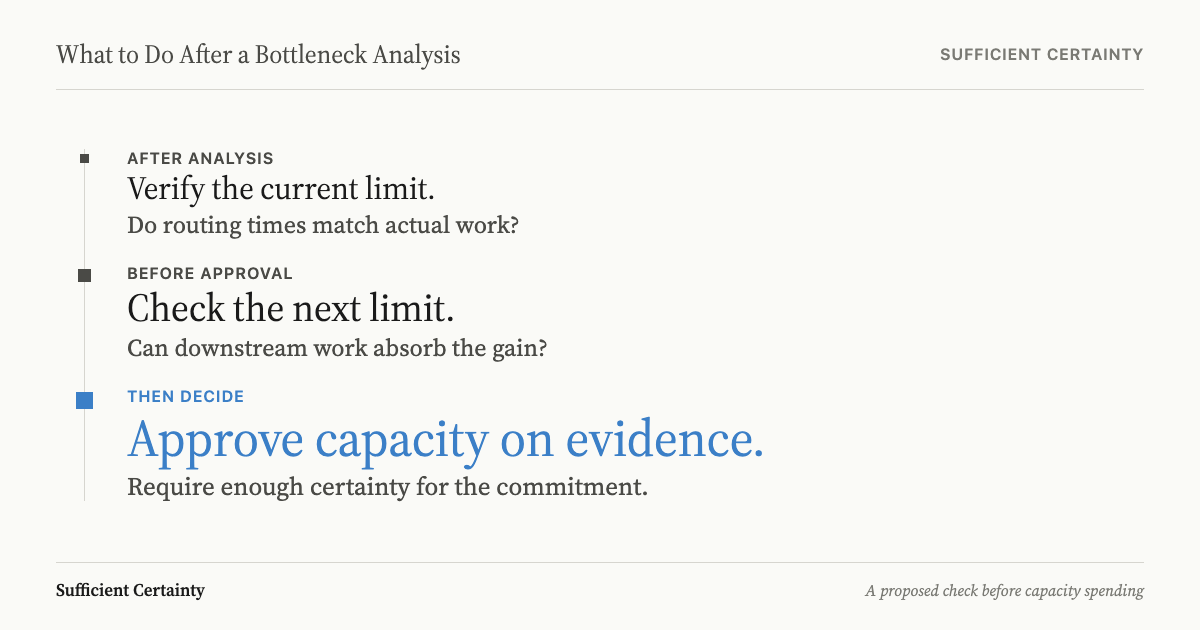
The decision is therefore narrower than whether welding, or any other department, is busy. It is whether the proposed intervention changes what customers receive. Keep that question beside the analysis so the equipment proposal answers the same problem that prompted the investigation.
Use the Walk to test whether relieving the reported bottleneck will produce the delivery gain needed for approval. Start the Walk →
What does the bottleneck calculation establish?
A sound analysis directs attention to the operation currently limiting the selected flow. It helps a manager compare demand with available capacity. It can show where an extra usable hour could matter and where speeding up work may simply create a larger queue.
The Lean Enterprise Institute's account of the theory of constraints stresses improvement of the whole system. That distinction protects the analysis from a familiar misuse: treating each department's efficiency as the outcome. A faster department matters when its improvement helps achieve the intended result.
Keep the measurements distinct. The Institute defines cycle time through actual measurement and distinguishes it from production lead time. A faster processing step and a shorter customer wait are different claims. State which one the proposed investment must deliver.
Keep the scope visible on the capacity sheet. State which orders use the constrained operation and which bypass it. Record the period covered by the measurements. When a proposed gain assumes that every additional unit can be sold and delivered, show the evidence for that assumption separately from the production calculation.
The calculation remains conditional on the work examined. A different product mix may put more demand on another operation. A schedule may assume staff availability that cannot be sustained. Check these conditions before transferring a result from one period to the next.
There is also a distinction between finding a restriction and establishing its cause. Use the discipline of checking a root cause finding when the proposed remedy depends on why time is lost. Additional machinery cannot automatically resolve a delay caused by how work is released.
Within data-driven decision making, the report is evidence for a choice. It does not set the certainty required for that choice. The manager must connect the expected output gain to the size and reversibility of the commitment.
Verify the next limit before buying capacity
Write the proposed gain as a claim about delivered output. Identify which existing record would support it. Then ask what becomes limiting when the diagnosed bottleneck can process more work. The Lean Enterprise Institute explicitly recommends examining the next bottleneck. The check belongs before the purchase, while the proposal can still change.
Follow the extra work into the next operation. Compare its usable capacity with the proposed arrival rate. Include work it already receives from other routes. Continue far enough to find the next binding limit. If that limit prevents the required delivery gain, revise the proposal before approving it.
Unused capacity downstream may be needed to absorb uneven arrivals. Treating every idle period as waste can remove the flexibility the proposed improvement depends on.
Capacity spending is not always the first available intervention. An ASQ conference abstract on constraint management places better use of the existing constraint before purchasing more capacity. That supports considering an operating change first. It does not establish that scheduling alone will solve every capacity shortage.
Match the check to the commitment. A reversible scheduling trial can justify acting with uncertainty that would be unacceptable for a machine purchase. For the trial, define the output measure and the condition for stopping. For the purchase, require stronger evidence that the gain survives the next constraint.
Give the approver a comparison that can change the decision. Show the expected delivered output under the present arrangement and under the proposed change. State where each estimate comes from. Mark unknowns as unknowns. If a disputed routing time determines whether the purchase meets its purpose, check that time before refining less influential parts of the estimate.
Agree what evidence would make the purchase unnecessary. The existing constraint might meet the required output after an operating change. Alternatively, the next operation might prevent enough improvement to justify the cost. Either finding can close the spending question without proving every detail of the factory model. The required certainty concerns this commitment and its consequences.
The decision-first approach to evidence helps keep this work bounded. Investigate the uncertainty that could change approval. Do not rebuild every process model merely because more data exists. The stopping condition for analysis is reached when further checks are unlikely to change the choice at the certainty required.
Use the Universal Decision-Making Method to make that judgment explicit. Record why the evidence is sufficient for the chosen commitment. Keep the predicted next constraint beside the decision. Revisit it if actual queues or delivered output contradict the prediction.
A completed bottleneck analysis gives a place to look. Approval needs a supported answer to what happens after that place improves.
How confident are you that the next operation can accept the extra work your capacity proposal assumes?
Work through your decisionNo sign-up. Just pick your decision and start.
Grant Purdy is the co-author, with Roger Estall, of Deciding (2020), and the architect of the Universal Decision-Making Method.