
The only analysis paralysis solution that holds is defining when the analysis should stop. Most advice says be more decisive or set a deadline. Neither works when the process itself has no sufficiency test. Name the assumption the decision depends on, test it, and the stopping point names itself.
The only analysis paralysis solution that holds is defining the point at which the analysis should stop. Most advice tells people to be more decisive or set a deadline. Neither works when the process itself has no sufficiency test. Name the assumption the decision depends on, test it, and the stopping point names itself.
How do you know when you have thought enough? That is the question behind every stalled decision. It is not whether the team is indecisive or lacks courage, but whether anyone has defined the point at which analysis should stop and action should begin.
In nearly fifty years of investigating decisions that produced outcomes nobody intended, I have found that the answer is almost never yes. Nobody designed a stopping condition into the process. So the analysis continues, not because more is needed, but because nothing signals that enough has arrived.
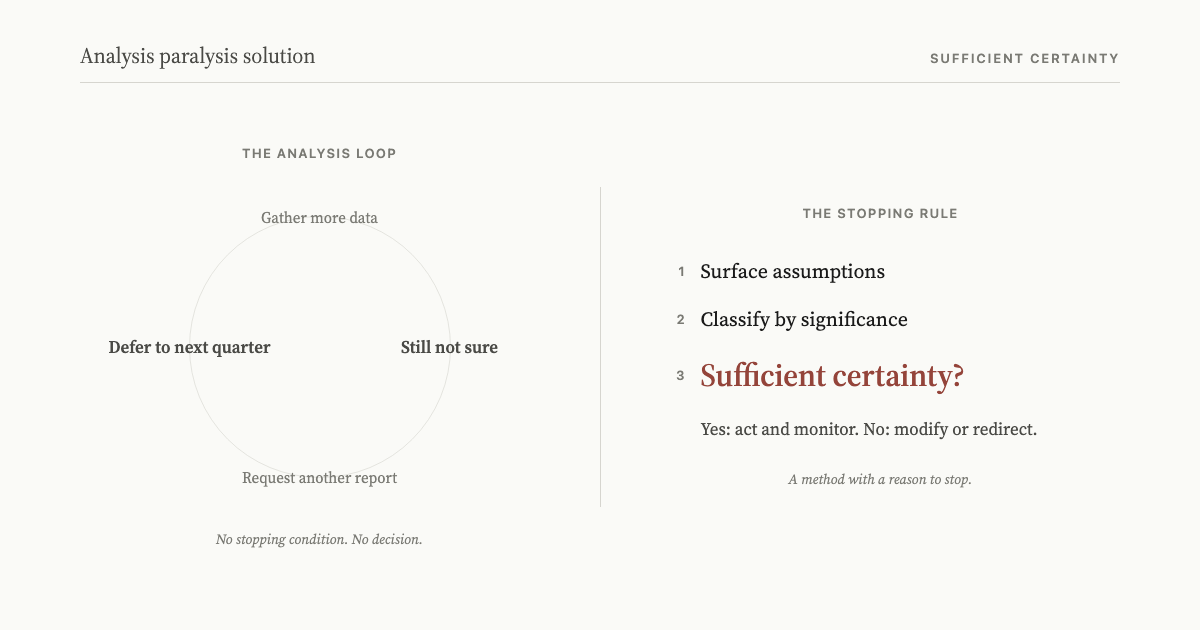
Roger Estall and I built the Universal Decision-Making Method around that principle. The third step, Recognise assumptions, forces into the open everything the decision is taking for granted. The fourth, Sufficient certainty, poses the only question that matters: given what you now know about those assumptions, are you confident enough to act? If yes, stop analysing and implement. If no, three options remain. Get more information about a specific assumption. Modify the decision. Or make a different decision entirely. There is no fourth option called "run the analysis again with more data."
An analysis paralysis solution is a decision process with a clear stopping condition, so review ends when further analysis is unlikely to change the choice.
Why the usual advice fails
Search for "analysis paralysis solution" and you will find the same advice recycled across hundreds of pages. Set a deadline. Limit your options. Trust your gut. The advice treats the symptom as a character deficiency and the cure as willpower. I have watched it fail in every industry I have worked in, because it misidentifies the cause.
PwC's May 2025 Pulse Survey found that 57% of executives said they are missing opportunities because they cannot make decisions fast enough. These are senior leaders running large firms. They do not lack nerve. They lack a test for when their analysis is complete. Nobody sold them that test. What they were sold, by vendors with dashboards and consultants with slide decks, was more data. Each new platform widened the pool of information demanding analysis. A lucrative arrangement for the sellers. A paralysing one for the buyers.
Aon's 2024 Business Decision Maker Survey told the same story from a different angle: of 812 business decision makers across seven countries, 72% said their organisations are not moving fast enough. The confident leaders were not the ones with the most data. They were the ones who had quantified their exposure in specific scenarios: supply chain disruption, cyber events, weather. They had framed their assumptions clearly enough to act. The rest were still gathering.
Set the decision that keeps reopening inside the five steps and define the stopping rule this process is missing. Start the Walk →
What a real stopping rule looks like
Jeff Bezos described it plainly in his 2016 letter to Amazon shareholders. Most decisions, he wrote, should be made with "somewhere around 70% of the information you wish you had." Wait for 90% and you are almost certainly too slow. Bezos was not advising recklessness. He was installing a threshold: a point at which analysis stops and execution begins. For reversible decisions, the threshold is lower. For irreversible ones, higher. The principle is the same. You define the stopping rule before the analysis starts.
That is precisely what Roger and I formalised. As I wrote in Deciding, "sufficient certainty does not necessarily mean the greatest amount of certainty possible because that could be wasteful of resources." There is no universal formula for it. Sufficiency is a judgment the Decider makes after surfacing the assumptions embedded in the decision, classifying them by significance, and asking whether the critical ones hold firmly enough to proceed. A process that never asks that question is a process that never finishes.
The evidence that stopping rules work
The Ottawa Hospital Research Institute published an evidence bulletin in August 2024 summarising 209 randomised controlled trials involving 107,698 participants. The trials compared structured decision aids with usual care across 71 different decision types. Informed, values-congruent choices rose from 295 to 481 per 1,000. Knowledge scores increased by nearly 12 points. Accurate risk perceptions almost doubled. Decisional-conflict scores below 25 correlated with follow-through; scores above 38 correlated with delay.
A decision aid does not give people more data. It makes the choice, the options, the tradeoffs, and the threshold question explicit. Once those are visible, indecision drops and follow-through improves. The mechanism is the same one Roger and I described: surface what matters, classify it, judge it, act. The OHRI data confirms at clinical scale what I have seen in boardrooms for decades. The problem is never insufficient information. The problem is the absence of a method that tells you when information is sufficient.
I have seen the same pattern across mining, water management, financial regulation, and public infrastructure. The industry changes. The failure does not. Wherever the process lacks a defined test for sufficiency, analysis quietly expands to fill every hour and every dollar available to it.
Sufficient certainty replaces maximum certainty
I described how to overcome analysis paralysis through the case of a public safety body whose governance apparatus consumed 99.97% of its budget while the function it existed to perform received 0.03%. That ratio is what maximum certainty costs. The machinery for deciding consumes the resources that should go to acting. Every committee member felt responsible. None felt accountable for calling a halt. The reviews multiplied because nobody had authority to declare: we know enough.
The analysis paralysis solution is not "stop thinking." It is a method that replaces the question "have we considered everything?" with a question that has an answer: "do we have sufficient certainty that this decision will deliver the intended outcome?" One question produces infinite analysis. The other produces a judgment, followed by action, followed by monitoring. That is the difference between a decision method and an analysis loop.
You could enter your next review with no stopping rule and no ending.
Work through your decisionNo sign-up. Just pick your decision and start.
Grant Purdy is the co-author, with Roger Estall, of Deciding (2020), and the architect of the Universal Decision-Making Method.