
After business continuity planning, draw the fallback route for one essential service. A second system can leave that service just as dependent on the first system as before. Before approving the completed plan, follow the route from the person who needs help to the person who can deliver it.
The question is what people must still receive during disruption. Starting with that service can change which backup arrangements deserve approval.
Business continuity planning sets out how an organisation will maintain or restore essential services when normal operations are disrupted.
A continuity plan names the service to preserve
A completed plan gives an approver something specific to review. It identifies important activities, recovery priorities and people responsible for action. The next task is to decide whether the proposed arrangements can preserve the services those activities support. Approval should give staff authority to use those arrangements when normal operations fail.
The Cabinet Office business continuity guidance starts with the organisation's products and services. Its business impact analysis identifies the critical activities and supporting resources. It also calls for training, exercises and regular plan maintenance. Those tasks matter after the document is written.
Start the approval review with the service statement. Does it name a result that a customer or other recipient can use? For a proposed payroll fallback, receiving a payment is a clearer result than restoring the payroll application. This is an illustrative review question, not a claim about a particular employer.
Name the service before approving its recovery route. A department can finish its assigned tasks while another department remains unable to use the result. A service statement makes that handoff visible. It also gives the approver a reason to include people beyond the team that wrote the plan.
Read the continuity plan alongside the original business impact analysis. Mark any essential service that appears in one but not the other. Check whether the proposed fallback changes who receives the service or what they receive. Record those differences for the approver instead of hiding them under a general promise to restore operations.
The approval boundary should follow the service across departments. The article on starting with Purpose explains why the intended result comes first. The risk assessment collection examines the evidence needed before acting on an assessment.
What does a fallback route depend on?
Drawing the route has a practical benefit. It lets each owner see what must be available before their part can work. A fallback that looks independent on a systems diagram may still need the normal authentication service. An alternative office may need the same telecommunications connection. These are proposed checks for the reader's plan.
NIST SP 800-34, Revision 1 links information systems to the business processes they support. Its business impact analysis includes resource requirements and interdependencies. This is guidance for federal information systems, not a universal legal requirement. Its distinction between a system and its supported process is useful when reviewing a continuity plan.
For each handoff, write what the receiving team needs. Include the information they need to act and the means of receiving it. Then mark anything shared with the normal route. Ask whether the disruption that removes the normal route could also remove that shared resource.
A different location does not establish an independent route. The important question is whether the fallback can function under the conditions that require it. A shared dependency may be acceptable. The approver needs to see it and know what would happen if it failed.
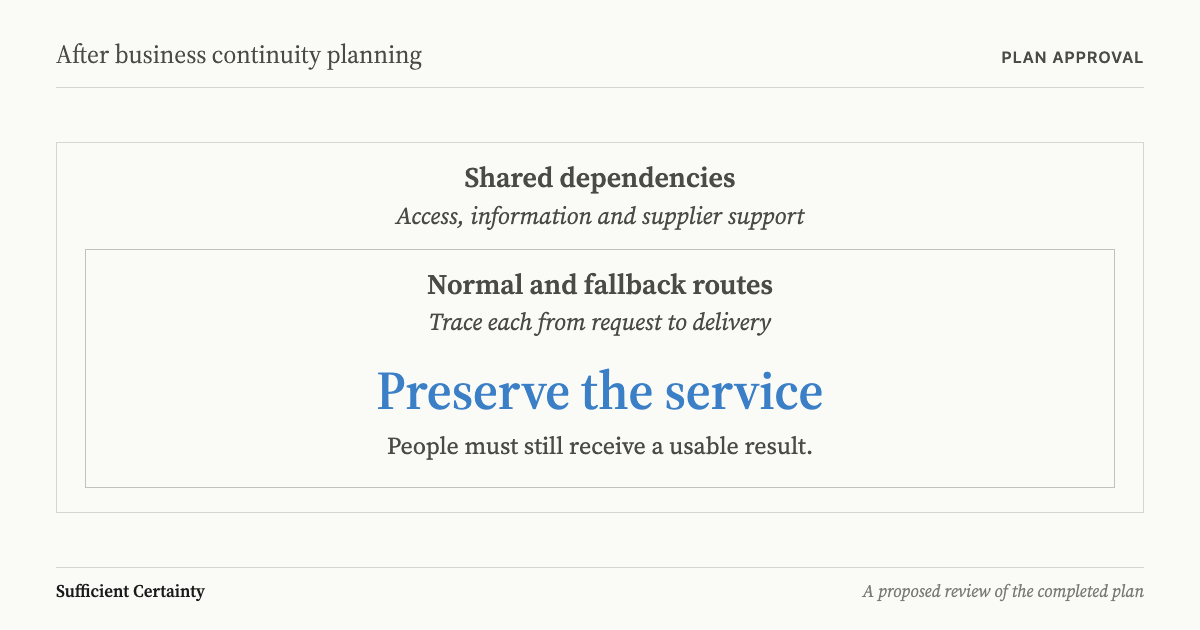
Keep the drawing small enough to discuss with the people who run the service. It need not show every technical connection. It must show the dependencies that can stop the agreed result. Unclear ownership belongs on that drawing too, because an available resource is useless if nobody can authorise its use.
Approval requires a route to the recipient, not just a list of recovered systems. Use the article on surfacing assumptions to turn uncertain handoffs into explicit questions.
Which shared dependency could stop the service your continuity plan promises to preserve? Start the Walk →
BT could not move calls to the backup platform
On 25 June 2023, BT's emergency call handling service suffered a UK-wide disruption. The Ofcom confirmation decision, issued in July 2024, records approximately 10.5 hours of disruption. Nearly 14,000 call attempts were unsuccessful. That figure counts attempts, including repeat attempts, rather than individual callers.
Ofcom found that a configuration error affected one network node. Failed calls returned to a shared virtual queue, spreading the effect across call handlers. The first transfer to the disaster recovery platform was incorrectly executed. Its findings included unclear failover instructions and an undocumented familiar transfer process.
BT's own review, published four days after the incident, described a backup ready to handle calls. The complex transfer process had not completed successfully. BT said it subsequently simplified that process. After the successful transfer, the backup provided basic functionality with longer call handling times. This was BT's early account, preceding the regulator's findings.
Ofcom later found the backup had insufficient capacity and functionality for reasonably expected demand. It could not handle relay calls. The regulator imposed a £17.5 million penalty. These were historical findings about emergency call handling. They do not establish that BT had just completed a business continuity planning exercise.
Include the transfer itself within the service being reviewed. A proposed review for another organisation should therefore trace entry into the fallback, not begin with the backup already operating. Ask who selects the route, what they need to switch it and how the recipient obtains a usable result.
The government post-incident review also identified limits in alternative public contact arrangements. The non-emergency numbers suggested during the disruption were not applicable everywhere. Fire and rescue services and HM Coastguard had no alternative public contact route if 999 failed.
Check who the fallback leaves unable to receive the service. The proposed application is broader than backup equipment. Ask whether the plan covers different access needs and destinations. The article on crisis communication planning examines the related problem of messages that depend on channels being available.
Trace one service before approving the plan
Bring the service owner and the owners of its fallback dependencies into the approval review. Ask each to follow the drawing from request to completed service. Use the existing plan, diagrams and supplier agreements. Record a missing dependency as an unanswered question, rather than filling the gap with an optimistic statement.
These are proposed readings for an approval meeting. No single reading is enough. The service owner can define an acceptable result, but needs the other owners to explain whether the fallback can deliver it. Supplier confirmation should address the actual arrangement in the plan, including support needed during a wider disruption.
Define an acceptable reduced service before accepting reduced functionality. Identify what can wait and what cannot. Put the recipient's needs beside the proposed limitation. If the fallback excludes part of the essential service, change the route or narrow the approval explicitly. Do not leave staff to discover the exclusion during activation.
The Universal Decision-Making Method gives this review a clear sequence:
- Frame: name the essential service and the people who must receive it.
- Tentative Elements: set out the normal route and proposed fallback.
- Assumptions: identify shared resources and unconfirmed handoffs.
- Sufficient Certainty: decide what evidence justifies approving this route.
- Implement+Monitor: assign ownership and changes that require another review.
Finish with an approval note attached to the plan. Record the service boundary and any accepted limitation. Name the owner of each unresolved question and say whether it prevents approval. A changed supplier or new access requirement should prompt a review of the route affected by that change.
Approve a defined service under stated conditions. That note gives later training and exercises a specific arrangement to examine. The article on the handoff before a crisis explains why the people who must act need those conditions before disruption begins.
Before approving your continuity plan, define the service its fallback must still deliver.
Work through your decisionNo sign-up. Just pick your decision and start.
Grant Purdy is the co-author, with Roger Estall, of Deciding (2020), and the architect of the Universal Decision-Making Method.