
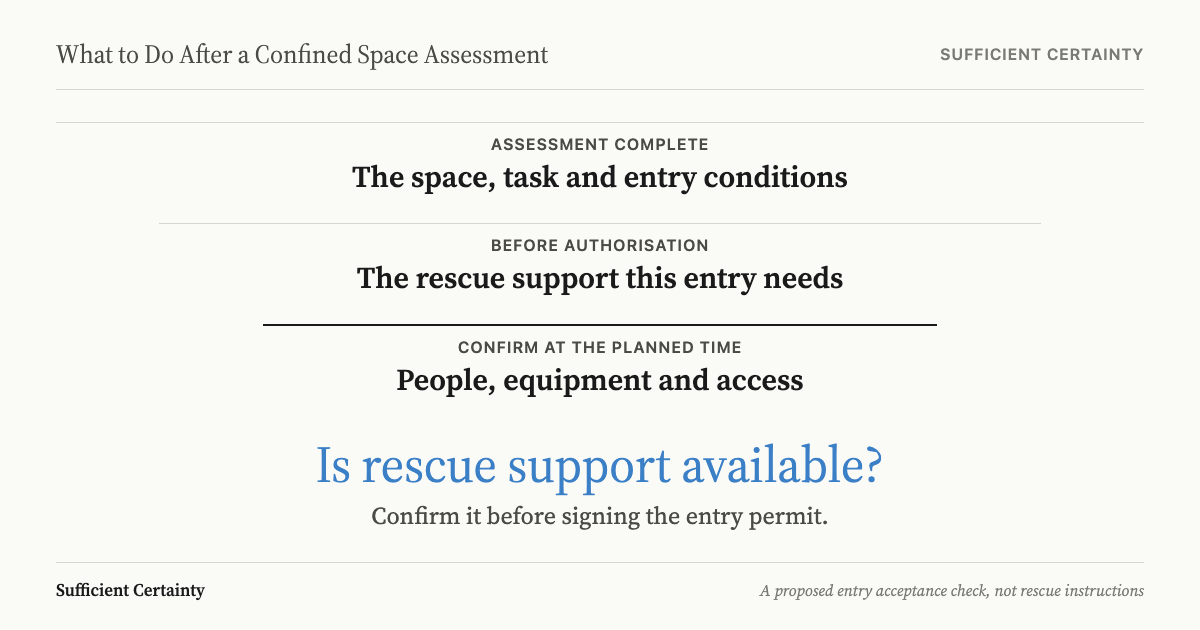
After a confined space assessment, ask the entry supervisor to confirm the named rescue team is available for the planned entry. A completed assessment can still leave that question unanswered. Before authorising work, connect its rescue findings to the people, equipment and access available at the time of entry.
A confined space assessment identifies the hazards of a particular space and task, and the controls needed before entry.
An assessment gives entry conditions, not permission
A completed assessment should make the proposed work specific. Read it alongside the task instructions. Identify the space, the reason for entry, the work to be done and the conditions assumed. If the job has changed since the assessment, ask a competent person whether its findings still apply. The signature on an earlier document cannot settle that question.
The assessment helps the authorising manager ask whether entry is necessary and what must be in place if it proceeds. HSE guidance on confined spaces puts avoiding entry first. Where entry cannot be avoided, it calls for assessment and control of the particular risks. That starting point prevents the permit process from making entry seem inevitable.
Use the findings to organise the work rather than create another summary of hazards. Give each required condition an owner who can confirm it. Record which evidence the supervisor needs before work begins. This is a narrower task than repeating the whole risk assessment process. It connects completed analysis to the entry about to happen.
The assessment also creates a common reference for the entrant, supervisor and specialists. They can identify a disagreement before anyone enters. One person may understand that rescue support will attend the job. Another may have arranged only a telephone contact. Those are different arrangements, even if both people use the same phrase in a meeting.
Ask the assessment author to mark any part that depends on further confirmation. A document may describe a planned condition without showing that it has been achieved. Keep those items open in the entry decision. The person who wrote the assessment need not be the person who can confirm the required support on the day.
Keep coordination with other work visible. The check after job hazard analysis concerns how tasks interact in a shared work area. Here the manager must decide whether this specific entry can proceed with the support it requires. A coordinated schedule is useful evidence, but it does not confirm rescue availability by itself.
Does this entry have the rescue support it needs?
Reframe the approval question around the actual entry. Instead of asking whether the assessment is complete, ask whether the required rescue arrangements can work for the named people in this space during this work period. This changes what the manager needs to inspect. A generic rescue document is only one input to that decision.
Ask the competent person responsible for rescue planning to identify what must be available. Then compare those requirements with the current arrangements. Check the named provider, confirmed availability, relevant equipment and access to the work location. These are acceptance questions for the responsible specialists. They are not instructions for an untrained manager to design or attempt a rescue.
Write the outcome in a rescue-readiness acceptance record attached to the entry paperwork. Include the entry reference, the evidence checked, the person who confirmed it and any limit on the confirmation. A verbal assurance that a team is nearby should prompt a question about its actual commitment and ability to support this entry.
An unchecked assumption can affect the later response. The following chain is a proposed failure route to examine, not a reconstruction of a particular accident.
Treat a gap in rescue support as a decision to resolve before authorisation. The general lesson after workplace risk assessment is to check conditions where the work occurs. For confined entry, the check must include the response needed if those conditions stop protecting the entrant.
Kettering had not assessed the manhole entry
On 1 February 2022, an employee at Kettering General Hospital was found unconscious in a manhole while unblocking a drain. The employee suffered a traumatic brain injury. The HSE prosecution report records that the trust had failed to identify the manhole as a confined space and had not properly assessed the activity.
The report also identifies missing safe working arrangements, training, information and instruction. The trust pleaded guilty and was fined in January 2024. This was not a case in which a completed confined space assessment had authorised the entry. The documented failure occurred earlier, when the physical conditions and work were not recognised and assessed properly.
Use those physical facts to check the coverage of a completed assessment elsewhere. Does the document cover the actual manhole or connected space? Does it cover drain clearing rather than a different inspection task? Would the person authorising the work recognise the conditions that require a different decision? These are proposed checks for the reader, not findings about documents at Kettering.
The case report says the fire and rescue service extracted the employee. It does not establish that a tested rescue plan had been arranged. Do not turn the eventual emergency response into evidence that planned rescue arrangements were adequate. The HSE confined spaces safety guide should inform competent planning, alongside the requirements that apply to the particular workplace.
This distinction matters when reading accident accounts. Missing assessment, missing controls and unavailable rescue support are different findings. Each needs its own evidence. The check after a safety audit also requires evidence of what changed. A report title or a completed action row does not demonstrate the condition needed at the next entry.
Which rescue condition must be confirmed before this entry can proceed? Start the Walk →
Verify rescue availability before signing the permit
Before signing the permit, bring the entry supervisor and the responsible rescue specialist to the same record. Ask them to confirm the entry and the work period being accepted. Reference the approved arrangements rather than copying technical rescue instructions into a management checklist. Keep the evidence accessible to the people who can stop or authorise the work. The check after an ISO 45001 audit also links system findings to evidence at the work itself.
The following checklist shows questions to resolve for a proposed entry. Its unchecked items are prompts, not statements that any particular workplace has failed them.
If an item remains unresolved, record who must resolve it and hold entry until the responsible person accepts the arrangements. A production deadline does not provide the missing evidence. Refer changed conditions to the competent people who can decide whether the assessment and safe system need revision. Avoid making a local workaround seem acceptable by adding another signature.
Consider the handover if the planned entry crosses a shift boundary. Ask who receives the current confirmation and how they will know whether it still applies. A copy of the assessment in an office does not tell the incoming supervisor whether the people providing support have changed. Include that question in the planned handover.
If work is postponed, revisit the confirmations affected by the delay. Avoid carrying a previous entry acceptance forward simply because the assessment remains unchanged. The space may be the same while the available support differs. The authorising person needs current evidence for the conditions on which this entry depends.
State the limits of permission in words the supervisor can use. A change of task, personnel, support availability or site condition may require another check. Specify the changes relevant to this entry with the specialists. Do not assume that an earlier confirmation remains valid when the work is delayed or transferred to another crew.
The Universal Decision-Making Method helps keep the decision focused on its purpose and the conditions needed to act. Here the purpose is to complete necessary work with adequate protection and emergency arrangements. Completion of the assessment is evidence for that purpose; it is not the purpose itself.
File the acceptance record with the permit and retain the reasons for any hold. The manager should be able to explain what was checked, who accepted it and when another decision is required. That makes the authorisation specific enough for the next supervisor to use and challenge.
A completed confined space assessment still needs rescue support confirmed for the entry being authorised.
Work through your decisionNo sign-up. Just pick your decision and start.
Grant Purdy is the co-author, with Roger Estall, of Deciding (2020), and the architect of the Universal Decision-Making Method.