
After a Job Hazard Analysis, compare the job plan with tomorrow's work schedule before authorizing work. At Evergreen Packaging in September 2020, contractors worked at the same time inside connected vessels before a fatal fire. The decision to start a job needs to cover other work that can affect the same area. A review limited to one crew's tasks can leave that connection unexamined.
This article concerns the step between completing that analysis and allowing work to begin. It belongs within the wider risk assessment process, but its focus is narrow: whether several jobs can safely proceed together.
A Job Hazard Analysis examines individual job tasks to identify hazards and choose controls. It considers the worker's relationship with the task and equipment, within the work environment.
Evergreen contractors worked inside connected vessels
Evergreen Packaging's Canton, North Carolina mill was undergoing a planned shutdown. Universal Blastco repaired an upflow tower while Rimcor worked inside a connected downflow tower. Blastco's safe work permit and contractor daily briefing indicated that no hot work was planned. These are documented planning records. The Chemical Safety Board investigation does not establish that a formal Job Hazard Analysis was completed.
Cold conditions slowed the resin used by Blastco. Workers introduced a heat gun to warm it. The gun fell into flammable resin, starting a fire that spread between the vessels. Two Rimcor workers died. The contractors had treated the towers as separate confined spaces. They lacked a shared communication method and had not effectively coordinated their simultaneous work.
The proposed application to a JHA follows from those findings. Before approving two jobs, review the work area they share. Do not assume that separate work orders establish physical separation. Ask what can move from one job into the other crew's location. Then examine how a change in either job could affect people outside its own task description. For entry work, the follow-up to a confined space assessment adds a check that the named rescue team and access arrangements are available when needed.
Separate job plans need a shared area review. A permit issuer should be able to locate the other crew and explain how its work affects the proposed job. A contractor supervisor should know which activities depend on the same isolation. Neither answer should depend on an informal understanding that cannot be checked by the next shift.
The following readings are proposed prompts for a joint review. They describe questions to ask at a current work site, rather than statements attributed to Evergreen personnel.
A useful response starts with the decision being authorized. Instead of asking whether each crew has completed its paperwork, ask whether this combination of work should proceed now. That is a change in the way the decision is framed. It changes which people need to participate and which evidence belongs in the review.
The review can also change the schedule. Ask whether one task can wait until the other crew has left. If overlap is necessary, require a competent assessment of the interactions and the controls they need. The schedule forms part of the safety decision. Planned timing deserves the same scrutiny as the tools named in the job plan.
The CSB recommendations for Evergreen called for a formal simultaneous operations program, including shared communication. That recommendation addresses work occurring close together in time and place. For the reader, the practical question is who examines the combination before individual authorizations are issued.
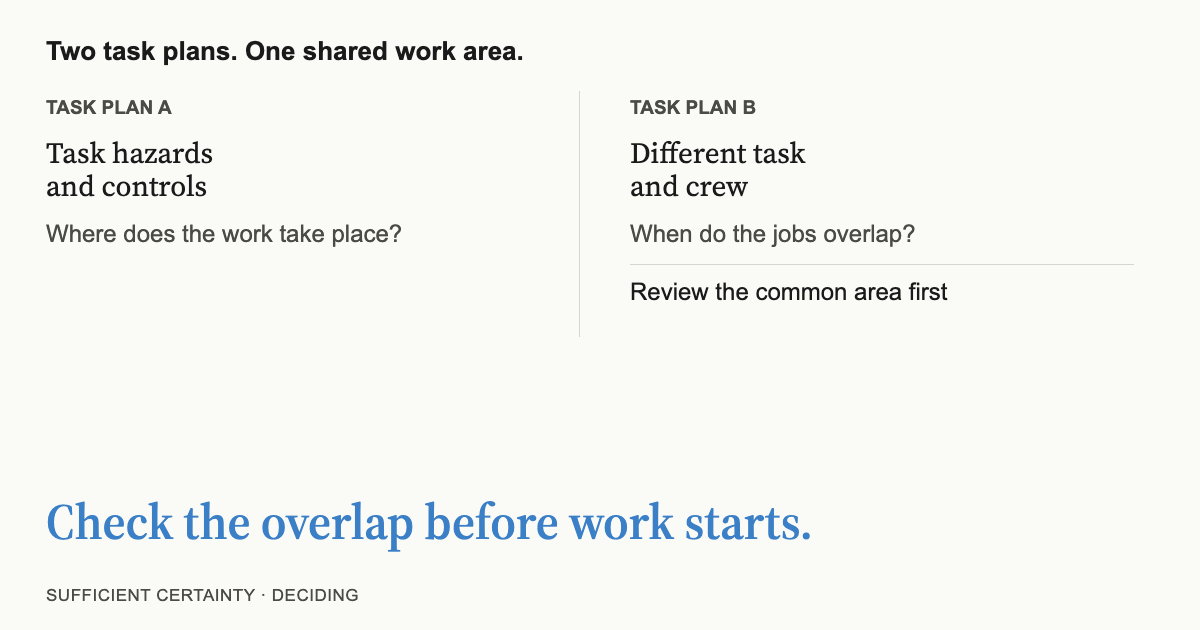
For a current job, ask both supervisors to review the same schedule. Have them identify the other activity that could alter their crew's conditions. Compare their answers before release. If each describes only their own work, return to the shared area rather than adding another signature. This is a proposed way to make the missing connection visible.
The diagram presents a proposed review sequence. It does not reconstruct the mill or show a complete confined space safety procedure. Review the combined work before releasing either crew.
A completed Job Hazard Analysis still needs a decision about which other jobs can safely share its work area. Start the Walk →
What can a task-level analysis leave outside?
A JHA provides a useful starting point. OSHA's Job Hazard Analysis guidance describes breaking work into tasks and involving workers. It also explains how to select controls. It includes the work environment. The problem is therefore not an instruction to ignore nearby work. The problem is using a completed task sheet as sufficient evidence for a wider authorization.
Keep the analysis and implement its controls. Then check whether its description matches the job that will occur. A task sheet prepared for an empty work area needs another look when a second crew arrives. A plan prepared for one method needs review when the crew proposes a different tool. Check the conditions behind the task sheet.
This is more specific than assigning fresh likelihood and severity ratings. The related workplace assessment article examines the evidence behind those ratings. Here, the question is whether the assessed task includes the other work that could affect it. Changing a rating cannot resolve an omitted interaction.
The following chain is a proposed failure pattern. It shows why the shared work area must appear in the authorization decision, even when each crew has its own documents.
Use the task sheet to identify the conditions requiring confirmation. For each dependency on another crew, record who confirms it and how. This turns an unstated assumption into a question someone can answer. If the answer remains uncertain, change the work arrangement before seeking authorization.
Distinguish a planned control from confirmation that it is ready. If one crew depends on another crew finishing first, a scheduled finish time is not confirmation. Require the responsible person to report completion through the agreed process. Record the response beside the dependency, so the permit issuer can see which conditions still need an answer.
Keep unanswered questions specific. An entry such as “contractors informed” does not identify the activity discussed or the people affected. Record what each crew needs to know before starting. Use the current task sheets as working evidence, then add the interaction between them. A longer form is useful only if it makes that interaction easier to review.
A signature must cover the work actually planned. Preserve the specific combination of jobs reviewed, so a later change can be recognized.
Review the shared work area before authorizing the job
Bring the relevant job plans to the same review. Mark where the crews will work and when their tasks overlap. Include connected spaces rather than relying on the names of separate work orders. Ask the responsible site personnel to confirm the boundaries against current drawings and the actual site.
For each interaction, ask whether the jobs should proceed together. Consider separating them in time or changing the work method. Record the chosen arrangement and the conditions that support it. The Universal Decision-Making Method starts by framing this specific decision before examining its assumptions.
For US general industry permit spaces, 29 CFR 1910.146(d)(11) requires coordination when entrants from multiple employers work simultaneously in a permit space. The standard also requires terminating entry when a prohibited condition arises in or near the space. Apply the relevant site procedures and legal requirements; this review does not replace them.
Name the person who can authorize the combined work. Assigning each crew its tasks does not answer who resolves an unsafe overlap. That distinction is part of accountability for the decision. Ensure the affected crews know who to contact when their agreed conditions change.
Check the review against the shift handover. The incoming supervisor needs the current arrangement and any unresolved conditions, rather than a folder of earlier approvals. If a job is delayed, check which overlap the delay creates. If another job moves forward, check whether it enters the reviewed area. Treat the revised schedule as a proposed change requiring the appropriate review.
Retain the decision in a short, usable record. State which jobs may run together and which must remain separated. Identify the evidence used to confirm the agreed arrangement. Add the responsible person's decision and the conditions requiring another review. The record should let a replacement supervisor understand what was authorized without reconstructing the discussion from memory.
Before release, confirm that those crews can communicate through the agreed site system. Record which changes require work to stop and be reassessed. Make a new tool or changed nearby activity visible to the person responsible for authorization. Authorize a defined work arrangement with clear conditions for reassessment.
How certain is the permit issuer that the job's controls remain valid while neighboring crews work?
Work through your decisionNo sign-up. Just pick your decision and start.
Grant Purdy is the co-author, with Roger Estall, of Deciding (2020), and the architect of the Universal Decision-Making Method.