
After a FedRAMP assessment, put one unresolved finding beside the agency use it could affect. GSA's public May 2026 report records four recommendations from a review of Kahua Federal Network oversight. The missing work concerned ongoing checks, not the production of another assessment.
A FedRAMP assessment evaluates a cloud service's security controls against applicable program requirements. Its results support review of the service and agency authorization decisions.
A FedRAMP assessment supports an authorization decision
A completed assessment gives the agency reviewer evidence about the service. It records what was assessed and the results of that work. The report helps the reviewer question a provider's statements rather than relying on a sales description. That is useful work. Repeating it without a specific reason adds expense and may leave the actual agency decision untouched.
The Rev5 control guidance in the Consolidated Rules for 2026 separates control assessments from continuous monitoring. Assessment results go to the relevant roles, including agency customers. Monitoring includes analysis and response to the resulting information. The reviewer needs both. A report about an earlier assessment cannot establish what happened after that assessment ended.
Start with the agency's intended use, stated in ordinary words. Identify the information the service will hold and the task it will support. Keep that statement beside the assessment findings. Otherwise, a technically complete discussion can answer a different question from the one facing the authorizing official.
The 2026 terminology changes make an important distinction. FedRAMP certification concerns the cloud service. It is separate from an agency authorization to operate. The new provider rules replace POA&Ms with a list of Accepted Weaknesses. Agency continuous monitoring remains necessary. Certification does not authorize every agency use.
A reviewer should therefore establish which rules apply to the package in front of them. A legacy POA&M and a provider's current Accepted Weaknesses list are different records. Relabeling a document does not show that the conditions behind the agency decision have been checked.
The distinction belongs in organisational governance: someone must decide whether the evidence supports the intended use. The difference between governance and compliance matters here because meeting a program requirement leaves that agency decision with its responsible official.
Which unresolved condition affects the agency use?
Do not begin by rewriting every finding into a new action plan. Choose a finding that could change the intended use. Ask which assumption allows the agency to proceed while that condition remains unresolved. Write the assumption as a statement that evidence could confirm or contradict.
That statement might concern whether a remaining weakness is contained under the configuration the agency will use. The point is to identify a condition, rather than describe an aspiration. "The provider will resolve it" says little about what the agency can safely rely on before resolution.
Name the condition for reliance. Then ask what evidence supports it now. The provider's response may describe a planned fix. The assessment may document an earlier test. Neither establishes that the relevant condition currently holds unless its scope and timing fit the agency use.
The evidence-weight illustration below counts statements in a proposed decision note, not measured security performance. Suppose only receipt of the assessment is confirmed. Agency fit, containment of the remaining weakness, and current monitoring evidence still require checks. That leaves one confirmed statement beside three unverified statements. The bars show those statement counts, not probabilities.
This is a way to surface assumptions before a decision. It helps the reviewer separate an available document from the claims made on its strength. Replace each unverified statement with the evidence actually obtained. Keep unresolved statements visible to the official who decides.
A planned fix needs present evidence. If the required evidence is missing, ask for it before treating the condition as satisfied. The agency may need to narrow the proposed use or defer its decision. Those are choices for its authorizing official, based on the relevant consequences and obligations.
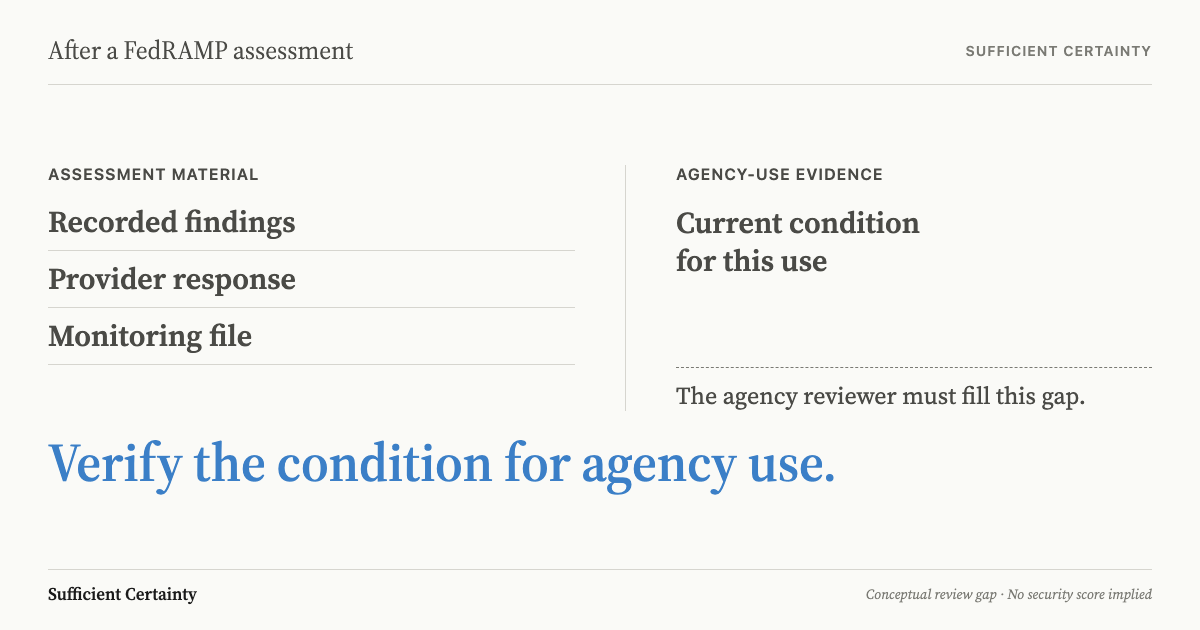
The graphic shows a blank agency-use evidence column beside the available assessment material. It represents the gap a reviewer must investigate. It does not claim that every assessment omits this evidence.
Which unresolved finding could change the intended agency use? Start the Walk →
Kahua monitoring needed checks after the assessment
GSA's public management report to Congress, No. 74, identifies a March 26, 2026 review of Kahua Federal Network oversight. Its attached OIG summary records the findings and the Chief Information Officer’s agreement with the recommendations. The original audit is restricted from public release; the public summary is the evidence available here.
The published recommendations concerned monthly review of monitoring deliverables and validation of scan configurations. They also addressed timely mitigation of outstanding vulnerabilities and updates to the customer responsibility security plan. GSA listed them as not fully implemented at March 31, 2026. That date does not establish their present status.
This was an oversight review of a service already in use. It was not a published initial FedRAMP assessment. The public material does not establish a breach or show that an assessment guaranteed protection. It does show why agency oversight requires work after assessment activity.
Check whether the evidence was reviewed. For a reader applying this lesson, a monitoring file's existence is only the start. Ask whether the relevant reviewer examined the condition that matters to the agency decision. Record the evidence used and what the reviewer concluded. This is a proposed application, not a claim about undocumented Kahua practices.
There is a related distinction in acting after a governance audit: an assigned response needs evidence of the required result. Here, the agency's question is narrower. Does the available monitoring evidence support continued reliance on the service for this use?
The historical recommendations referenced earlier FedRAMP playbooks. A present reviewer should not copy those references as a current rule set. The official 2026 adoption deadlines distinguish Rev5 from 20x and separate dates for obtaining and maintaining certification. Establish the applicable transition position before requesting a particular provider record.
Keep historical findings dated. The useful lesson concerns what to verify, not a claim that an old finding remains open. A later remediation record may change the agency's conclusion. Read that evidence before repeating the earlier finding as a present fact.
Verify one authorization condition before relying on the service
Put the selected condition into an agency decision note. State the intended use, then identify the finding that could change it. Add the current evidence for the assumption behind proceeding. This note is a proposed working aid. It supplements the required agency records and does not replace the authorization process.
Keep the unresolved condition specific enough to check. A reviewer should be able to name the document or observation that would establish whether it holds. If an answer refers only to future work, record the remaining uncertainty rather than treating the answer as closure.
The split below distinguishes visible assessment material from questions that need an agency review. It describes a proposed review approach, not missing items proven in every package.
- Assessed controls
- Recorded findings
- Fit with the intended agency use
- Current evidence for the unresolved condition
- Who reviews changes affecting reliance
- When the authorization decision needs reconsideration
Assign the review to a named role. The agency responsibilities in the governing memorandum include regular review of monitoring material and timely, actionable feedback. A proposed note should show who must act when the evidence changes. A distribution list alone does not identify that responsibility.
Use the Universal Decision-Making Method to examine the assumption supporting the decision. Specify what evidence would justify proceeding and what change would require another review. The work should address the chosen condition, rather than expand into a fresh assessment of unrelated controls.
Define when reliance must be reconsidered. Link that point to the condition: missing current evidence, a changed configuration, or failure of the protection being relied on. Record who receives the signal. This connects decision monitoring to an action the agency can take.
The immediate next step is complete when the selected condition has a clear evidential status and an accountable reviewer. The authorizing official can then make the agency decision with that uncertainty visible. Assessment completion alone cannot supply that judgment.
Before relying on the service, connect the agency-use condition to current evidence.
Work through your decisionNo sign-up. Just pick your decision and start.
Grant Purdy is the co-author, with Roger Estall, of Deciding (2020), and the architect of the Universal Decision-Making Method.