
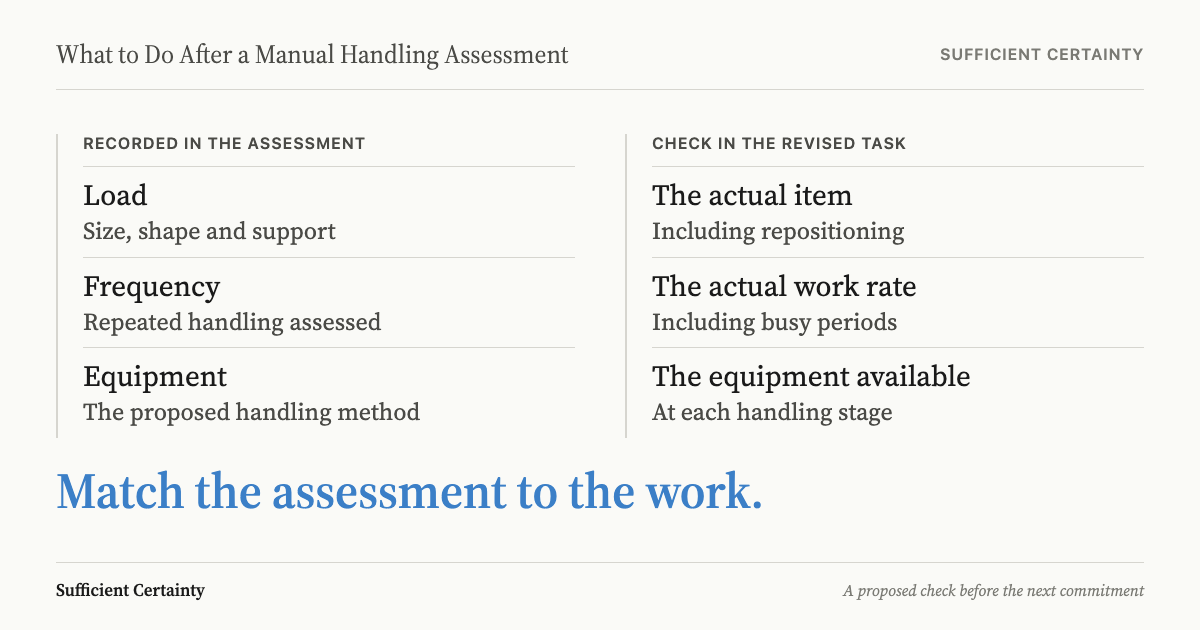
After a manual handling assessment, compare the revised task with the recorded load, frequency and equipment before accepting the change. The action sheet may say that a handling aid is available while the people doing the work still cannot use it. Check the actual arrangement with them before closing the assessment.
The immediate decision is whether the revised work can proceed as described. Keep the assessment beside a short change record. Use it to show what changed, what was checked and which conditions still need attention. For a returning worker, the return-to-work assessment follow-up also checks that the proposed shift matches the recorded restrictions.
A manual handling assessment examines injury risks from moving or supporting loads by bodily force and identifies changes to avoid or reduce them.
The assessment becomes a changed task
After the assessment, the work manager normally allocates improvements, arranges equipment, updates instructions and tells workers what will change. That sequence gives the findings an owner. Acceptance should depend on the revised task being ready, rather than the action list having a completion date.
Start with the task identified in the assessment. Name the item, where it starts, where it finishes and each movement between those points. Include repositioning during processing. A change that helps with transport may leave the worker supporting the same item while another operation takes place.
Record the proposed arrangement in terms that someone on the next shift can check. Identify the equipment and its location. State which handling steps it replaces and which remain. Record the working pattern assessed, including repeated movements and the conditions under which the task changes. Where that pattern depends on rest and relief, the follow-up to a fatigue risk assessment checks the next roster against those assumptions.
Use the assessment to check whether the hazardous handling can be avoided before accepting an arrangement that merely reduces it. HSE guidance sets out that sequence. The practical decision should follow the same order: establish what work remains necessary, then examine how that work will be done.
This is narrower than reviewing every workplace hazard. A workplace risk assessment covers the wider setting. Here the manager is deciding whether one specific handling change matches the conditions assessed.
What must the revised arrangement achieve?
The assessment gives the manager a basis for choosing changes. It can make awkward postures, repeated handling and unsuitable working space visible. It also gives workers a way to explain which part of a task causes difficulty, rather than reporting only that the job feels heavy.
HSE assessment guidance covers the task, load, environment and individual capability. For the acceptance decision, turn the relevant findings into observable conditions. A proposal to reduce carrying should say which carrying movement is removed. A proposal to change the work rate should identify the working pattern to be used.
Keep improvement and verification separate in the change record. Installing equipment is an action. Establishing that it is suitable and available for the revised task is a further check. The person accepting the change needs evidence of both.
Consider these questions before arranging the acceptance check. They describe possible gaps, rather than findings about any particular workplace.
A safety audit follow-up can help keep responsibility visible. The handling decision still needs a direct connection between the identified problem and the physical change.
Before accepting revised handling work, establish which conditions the assessment assumes are present. Start the Walk →
Recorded conditions and work on the floor
The revised task depends on conditions that can be easy to leave implicit. The equipment must reach the work area. The load must match the assessed description. The work rate must allow the agreed method. A substitute item or a different shift arrangement may change those conditions.
Ask the people who do the work to compare the proposed method with the actual sequence. Include the point where the item changes direction, position or support. Ask what happens when the normal route is blocked, the equipment is unavailable or an unusual item arrives. Record the answer without treating an improvised workaround as an accepted method.
Do not ask workers to demonstrate a hazardous movement to prove that it is hazardous. Arrange any observation or verification through the competent person responsible for the assessment. Stop the acceptance process if the proposed check would expose someone to the unresolved problem.
HSE guidance on reducing injury risk describes changes to equipment, tasks, loads and working conditions. Selecting the appropriate change requires knowledge of the operation. A generic instruction to lift carefully cannot resolve a mismatch between the task and the available equipment.
The wider risk assessment approach is useful here: connect the evidence to the decision it supports. An action marked complete does not establish that an unobserved condition has been met.
Fitzpatrick had no assessment for the hopper task
In October 2026, HSE reported the prosecution of Fitzpatrick Fabrications following a worker's hand injury in October 2024. The task involved repositioning a hopper during fabrication. Its larger side was being held while its smaller side rested on a desk. The hopper slipped, crushing the worker's hand and causing partial loss of his thumb.
The HSE account explicitly states that the company had not assessed the task and had no safe system of work. It also reports a near-identical earlier incident. The company pleaded guilty and was fined £48,000. The hopper weighed 133kg; the report does not say the worker lifted its full weight.
This case does not show a completed paper assessment failing. It shows a specific handling operation left without an assessment or clear instructions. For a reader who has completed an assessment, the relevant question is whether it covers the equivalent physical detail: how the item is supported and repositioned at every stage.
Apply that question to the revised arrangement, without copying the case as an equipment specification. Find the point at which the load changes support. Confirm that this step appears in the assessment and the revised method. If the task description stops at moving the item to the workstation, it may leave the processing movement unexplained.
Also check how reports of difficulty reach the person who can change the task. A manager should be able to identify which finding would prevent acceptance or reopen it. Recording that route makes a worker's report actionable before the next occurrence.
A broader change management assessment may consider readiness for a rollout. This decision concerns a more immediate question: whether the changed handling arrangement covers the actual operation.
Verify the change before accepting the work
Set an acceptance check against the specific findings. Bring the assessor, work manager and relevant workers together around the change record. Establish who can resolve any difference between the written method and the actual arrangement. A completion signature should follow that resolution.
For each important condition, record the evidence and its limits. A check on one item may not cover a larger or differently shaped item. An observation during quiet work may not represent the assessed frequency. State what the check covered so another manager can see when further assessment is needed.
Choose the response to any remaining gap before accepting the work. The options include further redesign, competent specialist assessment or restricting the work to the conditions already established. Select the response through the responsible people and applicable safety arrangements. Do not leave an unresolved condition hidden inside a general approval.
The Universal Decision-Making Method helps make those dependencies explicit. The decision is whether to accept this arrangement under these conditions. The evidence must address the conditions that could change that decision.
Use gap analysis follow-through to keep the remaining differences specific. Close each difference with a checked change or an explicit decision about the work. Keep the acceptance record with the assessment, and identify which changes require review.
The useful result is a revised task that people can perform under the recorded conditions. The acceptance record should let the next supervisor identify those conditions and act when the work no longer matches them.
Make the record usable during a handover. State where the assessed equipment is kept and who receives a report that it is unavailable. Identify the task description that applies to this arrangement. A supervisor should not have to search several versions to decide whether the work still matches the assessment.
How confident are you that the revised handling task matches the load, frequency and equipment assessed?
Work through your decisionNo sign-up. Just pick your decision and start.
Grant Purdy is the co-author, with Roger Estall, of Deciding (2020), and the architect of the Universal Decision-Making Method.