
After a fatigue risk assessment, compare tomorrow's roster with the rest periods and relief cover assumed in the assessment. UPS Flight 1354 crashed in 2013, killing both pilots. Fatigue was among the contributing factors. Put a review trigger where the actual work can depart from the assessed conditions.
A fatigue risk assessment examines how work arrangements and recovery opportunities could impair alertness and identifies measures to reduce the resulting harm.
UPS1354 exposed several failures, including fatigue
The NTSB investigation of UPS Flight 1354 describes the August 14, 2013 crash during a nighttime approach at Birmingham, Alabama. The probable cause was the crew's continuation of an unstabilized approach and failure to monitor altitude. The aircraft descended below the minimum approach altitude and struck terrain.
The NTSB identified several contributing factors. These included configuration and communication failures, incomplete weather information and missed callouts. It also identified the first officer's fatigue from acute sleep loss and circadian factors. The captain's performance deficiencies were likely associated with factors that included fatigue, distraction or confusion.
This was not a finding that fatigue alone caused the crash. Nor does the case establish that a prior fatigue assessment was ignored. Its relevance here is the need to keep actual operating conditions visible alongside other safety controls. A fatigue review must not displace the procedures and checks required for the task.
The next shift needs a check against the conditions assessed, not just a completed assessment form. The proposed monitoring check is a recommendation for readers. It is not a claim that a particular additional roster check would have prevented this accident. Keep that boundary clear when using an investigation to examine future work arrangements.
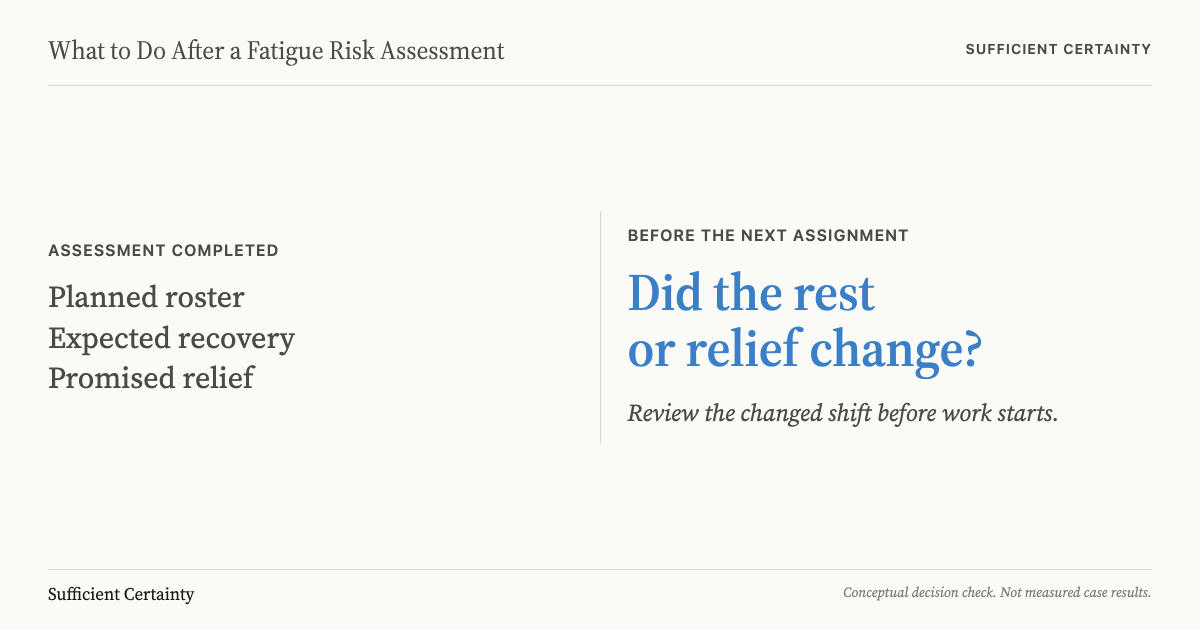
This timeline is schematic. It describes a future shift review rather than the sequence of the UPS accident. The marked point is where a supervisor can compare changed work with the assessment before assigning further work. An alert at that point needs a person authorized to arrange relief or change the task.
For the reader's operation, identify what the assessment assumed about the period before the shift. Then establish what information the supervisor can reasonably obtain when work changes. Record uncertainty instead of treating an unknown rest opportunity as a confirmed one. The comparison should support an operating decision and respect the organization's established reporting arrangements.
A workable trigger names a change and the action it starts. A warning that says only to be aware of fatigue leaves the supervisor to invent the response under pressure. State which change requires review, who receives the information and what must happen before the work continues. Keep the response aligned with the applicable operating rules.
Use monitoring linked to the decision to retain that connection. The purpose is to detect a loss of the conditions supporting the assignment while the assignment can still be changed. Counting completed assessment forms does not show whether those conditions survived the next roster revision.
Check whether tomorrow’s roster preserves the rest and relief conditions behind the assessment. Start the Walk →
What remains true when the roster changes?
A fatigue risk assessment gives a basis for designing work and selecting controls. It can identify difficult shift timing and inadequate recovery opportunities. It can also help supervisors explain why a proposed overtime arrangement needs another look. These benefits depend on the assessment describing the work people will actually do.
HSE's fatigue guidance calls for assessment of changes to working hours and systems to record working hours, overtime and shift swaps. It identifies workload, timing and breaks among the relevant factors. The practical point is that the approved roster is only one input. Changes made after approval need to remain visible.
The trigger belongs at the point where an assessed condition can change. A planned relief break may disappear when another worker is absent. A callout may reduce the recovery period before the next assignment. These are illustrative situations, not findings about the UPS crew. Compare them with the conditions recorded in the reader's assessment.
Choose a small number of consequential conditions from that assessment. Do not create a generic checklist that treats every change as equally important. Ask the assessor which differences could alter the control decision. Then establish how scheduling or supervisory staff will detect those differences using information they already handle.
The NIOSH overview of fatigue and work connects fatigue with schedules that disrupt or shorten sleep and other workplace factors. That supports checking the conditions behind work arrangements. It does not provide a universal numerical threshold for every role, worker or task.
Use the operation's assessment and applicable requirements to define the review condition. This article does not supply a safe number of hours. A rule chosen for a different operation can conceal different demands. Ask a competent assessor to resolve uncertainty about the appropriate condition rather than copying a convenient threshold.
Keep the assessment within its broader risk assessment purpose. Reducing fatigue involves work design and practical controls, not only reporting whether someone feels tired. The recorded assumptions should explain what the roster and relief arrangements depend on, so a change can be recognized.
Review how reports reach a supervisor. If the reporting route is unclear, test it with the people who use it. Find whether a worker can report a concern before assignment and whether the recipient can arrange a response. Recording a concern after the task has finished may be useful for learning, but it cannot change that completed assignment.
Check the handover between scheduling and supervision. A roster can change in one system while an earlier copy remains in use elsewhere. Choose the record that governs assignment and make its update visible to the supervisor. Where a change is communicated by phone, record the decision in the same place as other shift changes. The next handover should not depend on someone remembering a separate conversation.
Compare the next shift with the assessed shift
Begin with tomorrow's roster and the latest actual work record. Identify changes in duty, recovery opportunity or relief availability that affect the assessment. Ask the responsible supervisor to review those differences before assignment. Keep the finding with the roster so the person handing over the shift can see the current position.
The response must be available when the trigger occurs. A relief plan requires someone who can provide relief. A referral requires someone who can answer before the task begins. Confirm those arrangements with their owners. Do not describe a control as available merely because it appears in the assessment.
The assessment assumes relief cover. A roster change removes it without reaching the supervisor assigning work.
The changed roster triggers review. The supervisor checks relief availability before assigning the task.
The comparison describes an illustrative roster change, not a measured improvement. The difference is whether the supervisor sees that the planned condition has failed and can act before assigning the work. Preserve the decision and the action taken. That record helps the next supervisor understand why the roster was changed.
Use evidence relevant to the assignment when deciding what to do next. A revised schedule may need confirmation of relief cover. A reported recovery problem may need a different task or escalation under existing procedures. The responsible person should select the response with suitable advice and authority.
The Universal Decision-Making Method places monitoring within implementation. Roger Estall and Grant Purdy set out the method in Deciding. Applied to this decision, the assessment supports a work arrangement that remains subject to checks on its material conditions.
Check whether the monitoring arrangement detects actual changes before adding more reporting. Review a recent roster amendment and trace how it reached the person assigning work. If the information arrived too late, repair that handoff. More fields in the assessment will not correct a reporting route that misses the assignment decision.
Give staff a clear way to identify an unresolved review at shift handover. The incoming supervisor needs to know what changed and whether a response has been authorized. Closing the shift log should not close an outstanding fatigue concern. Transfer responsibility explicitly when the original supervisor leaves, and keep any temporary restriction visible until the responsible person reviews it.
Finally, retain lessons from repeated changes. If relief cover repeatedly fails, reopen the staffing arrangement rather than treating each occurrence as an isolated exception. Distinguish this physical and operational fatigue issue from executive decision fatigue. The immediate commitment is the next work assignment and whether its assessed conditions still hold.
Who can change the assignment when its assessed rest or relief conditions fail?
Work through your decisionNo sign-up. Just pick your decision and start.
Grant Purdy is the co-author, with Roger Estall, of Deciding (2020), and the architect of the Universal Decision-Making Method.