
After an operational risk assessment, write the customer service being assessed beside its risk ratings. A well-supported rating can still describe the wrong thing. The report may assess a department's controls carefully while leaving the service delivered across departments outside its scope.
Keep the assessment. Before approving its action plan, check what the customer needs to receive and where responsibility for that outcome ends. This changes the question asked of the evidence.
An operational risk assessment examines how failures in daily operations could affect outcomes and how existing controls affect that exposure.
Operational ratings describe a chosen unit of work
A completed assessment gives the person responsible for an operation a structured account of possible failures. It can identify weak controls and record the evidence used to judge them. Its action plan connects those findings to work that someone must complete. Those are useful outputs when the operation being examined matches the decision being made.
The Basel principles on operational risk call for assessment across material activities and systems. They also connect assessment with change management and ongoing reporting. This banking guidance does not reduce the task to producing a rating. It expects management to understand the operation and act on what the assessment reveals.
Before doing this, read the scope statement beside the rating. Does it cover a machine, a team, or the complete service? A label such as “payment processing” can refer to a technical process or to the customer's ability to pay. Those are different assessment boundaries. The rating needs a stated service boundary.
Local operation
- Assess the controls inside the department
- Rate failure within the stated process
- Leave later handoffs outside the scope
Customer service
- State the outcome the customer needs
- Include the dependencies that determine delivery
- Accept only the boundary supported by evidence
Neither column removes the need for technical expertise. The difference is where the assessment starts and stops. A service assessment still needs evidence about the systems that support it. It also needs evidence about what happens beyond those systems. Control evidence must connect to the intended outcome.
The wider risk assessment discussion concerns this connection between analysis and a decision. A detailed inventory of failures can help allocate work. Accepting that inventory as complete requires a separate judgment about whose work and whose outcomes it includes.
Which customer service sits outside the rating?
Take the service named in the assessment and describe it without naming a department. State what the customer must be able to do. Then read the report again. Does each important part of that outcome appear in its evidence? Begin with what the customer must receive. A service description makes exclusions easier to see.
For a payment service, that description could concern whether the intended recipient receives usable funds when required. This is a proposed way to review an assessment, not a claim about how any bank conducted one. Checking that outcome requires looking beyond whether a processing system starts successfully. It also raises questions about information passed to other organisations.
This is a framing question before it is a scoring question. Stating the purpose of the decision makes the intended outcome explicit. It helps the reviewer distinguish a requirement to keep equipment running from a requirement to deliver a service. Changing the boundary can change the available actions.
The review also needs a time condition. A service delivered eventually may fail the customer's requirement. Record when delay becomes consequential and who determines that point. Then ask whether the evidence behind the rating covers that duration. This question concerns the assessment's scope before approval. It does not require a separate recovery-plan exercise.
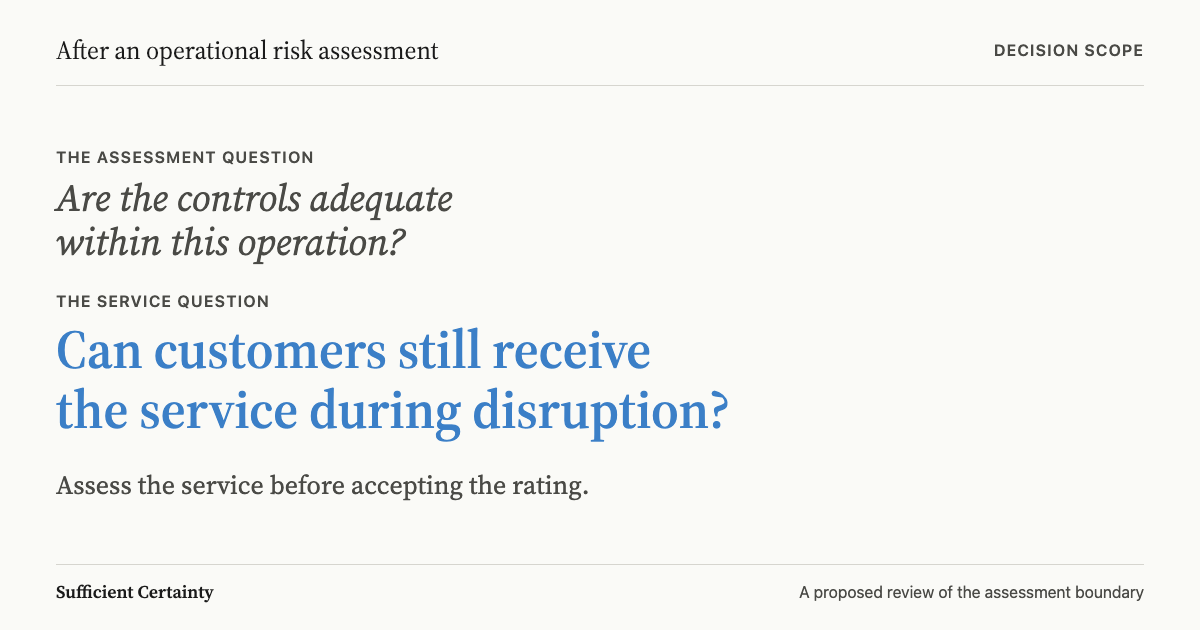
Review the scope while the action plan is still a proposal. Once its boundary is accepted, extra analysis inside that boundary may leave the omission untouched. Check the service before accepting the rating. RBS provides a documented reason to examine this distinction.
Your operational risk rating needs evidence that the whole customer service lies inside its scope. Start the Walk →
RBS assessed IT risk through a narrow policy
In June 2012, an IT incident disrupted services at RBS, NatWest and Ulster Bank. The FCA's enforcement announcement describes a software upgrade followed by an untested uninstall. Customers lost access to banking services. Some organisations could not meet payroll commitments. In November 2014, the FCA fined the banks £42 million.
The FCA final notice identifies a narrow policy boundary. The IT Continuity Policy Standard concentrated on recovery after loss of a data centre. It gave insufficient attention to more probable software failures with potentially comparable effects. An earlier external review had found the policy's control requirements adequate overall and comparable with peers.
The notice also records a failure to carry out a risk assessment for the software upgrade. This case cannot support a claim that a completed formal assessment approved the change. Its relevance here is the policy that shaped attention. A policy boundary can exclude a consequential failure. The comparison with peer policies did not resolve that limitation.
The PRA enforcement notice describes effects beyond the banks' own internal processes. Customers of other institutions could not receive payments from affected customers. The banks' participation in clearing was also impaired. The assessment boundary therefore mattered to people and organisations beyond the technology function.
This chain is an illustration of the article's proposed review, not a reconstruction of a particular RBS assessment. The documented incident shows why customer outcomes deserve explicit attention. A reviewer should ask which shared operation supports the service and who depends on it. Include consequences beyond the assessed department.
For the reviewer, the practical question is what the report would need to cover before acceptance. Include the recipient of the service, even when another organisation serves them directly. Ask whether the proposed controls protect delivery through that dependency. This is an application of the findings, rather than a further historical finding about RBS.
The FCA acknowledged subsequent improvements in systems and controls. The lesson here concerns the earlier framing, rather than a claim about present bank performance. As with using a risk register to support a decision, the existence of an organised process does not establish that it includes the relevant outcome.
Rewrite one assessment around the service outcome
Choose the assessment that management is about to accept. Rewrite its scope statement as a service outcome. Name the customer or recipient and state what delivery means. Keep the original scope beside it. Ask the responsible manager to identify any part of the rewritten outcome that the report does not examine.
Next, compare the evidence supporting the rating with that outcome. Mark the point where direct evidence ends. A successful component test may establish something about that component. It does not establish delivery through an untested handoff. Making assumptions explicit helps the reviewer record what is being accepted without evidence.
Give each consequential omission a decision owner. That person must determine whether to extend the assessment or change the proposed operation. Avoid assigning the gap to a department that can only report it. The person accepting the operation needs the service evidence. Technical staff can establish what a system does; the service owner must explain whether that is enough.
Ask what evidence would change acceptance. A test should answer a disputed service question, rather than repeat work already supported by the report. If the necessary evidence is unavailable, record that limit in the recommendation. Management can then decide whether to restrict the operation while the missing evidence is obtained.
The Universal Decision-Making Method begins by making the decision's frame explicit. Here, that means defining the service before treating a local rating as grounds for acceptance. The assessment contributes evidence to that decision. Its format does not determine the service that management is responsible for delivering.
Keep the revised boundary with the accepted action plan. Record the service question that remains open and the condition requiring another review. Monitoring the decision should detect when a dependency changes enough to invalidate the evidence. Changes in service ownership or a newly shared operation can justify reopening the scope.
At the approval meeting, put the original rating beside the revised service statement. Ask whether the report supports that statement under the conditions proposed. If it does, the action plan has a clear basis. If it does not, the missing work is now identifiable. Accept the assessment only within the boundary its evidence supports.
Which customer outcome sits outside the operational risk assessment you are about to accept?
Work through your decisionNo sign-up. Just pick your decision and start.
Grant Purdy is the co-author, with Roger Estall, of Deciding (2020), and the architect of the Universal Decision-Making Method.