
After a regulatory inspection, add a check for repeat failure beside each observation in the response log. A response meeting can approve a revised procedure while leaving the next use of that procedure unchecked. Keep the observation beside the evidence needed to show that the correction still works. The immediate response matters. So does the decision about what would require further action after the regulator accepts that response.
A regulatory inspection is an official examination of activities or records to assess compliance with requirements enforced by a regulator.
Inspection observations need a considered response
Start with the document the regulator actually issued. Keep its wording and any supporting evidence together. Identify the requirement at issue and the work affected. Confirm the response arrangements in that document before assigning actions. A label copied into a task tracker can lose the conditions that made the observation significant.
The status of the document matters. In the United States, the FDA explains that Form 483 records inspection observations and is not a final agency determination of a legal violation. The agency considers those observations with other evidence and the company's response when deciding what further action is appropriate.
Respond to the observation as issued. Do not quietly promote an observation into a final decision. Equally, do not dismiss it because the regulator has further work to do. Record any disagreement precisely. Preserve the evidence behind it. Ask the appropriate legal or technical specialist to resolve questions about the requirement.
Identify any action already required by the regulator. The proposed checks in this article supplement those requirements. They cannot change an instruction or extend a deadline. Keep the actual obligations visible to the person approving the response. For customs findings, the follow-up to a customs audit compares the assessed shipment with its supporting records before the response is approved.
Keep the operating consequence visible. Describe what the affected activity must achieve after correction. That connects governance and compliance: the formal response addresses the requirement, while an authorised person decides how the activity will be controlled.
Why does evidence matter more than a closed task?
A response plan makes the proposed correction explicit. It assigns work and lets the organisation explain what it has done. Supporting records allow the regulator to assess that explanation. Those are useful results. Without them, neither party can easily distinguish a completed correction from an intention to correct.
The FDA's close-out process makes this distinction concrete. A close-out letter requires corrective actions to have been made and verified by FDA. Representations that action will be taken, or has been taken, are insufficient on their own. FDA says verification usually involves a follow-up inspection.
Completion needs evidence from the work. In a proposed response, distinguish the changed instruction from evidence of its use. If the correction adds a review before release, examine a completed review at that point. A signed training record may establish attendance. It does not establish that the review happened when required.
Choose evidence that answers the observation. A large folder can still omit the record that matters. The response should explain why each attached record supports the correction. Keep that explanation short enough for another reviewer to check without reconstructing the whole investigation.
Task completion records
- Procedure revised and approved
- Training attendance recorded
- Response action marked complete
Evidence from use
- Required review recorded before release
- Record tied to the affected work
- Missing review flagged for follow-up
This differs from simply repeating a control review. A regulatory response must address the regulator's specific concern. Evidence that a general control ran may leave that concern unresolved. Test the connection between the supplied record and the condition being corrected.
The organisation also needs an internal decision about continued operation. State what the available evidence supports today. Record any restriction that follows from missing evidence. That decision can change as the correction is tested in use.
Which failed check would require further action after the regulator accepts your inspection response? Start the Walk →
A correction can fail after the response is accepted
A successful test supports a conclusion under the conditions tested. It does not establish that those conditions will remain unchanged. A procedure may depend on an experienced reviewer who later leaves. A replacement system may store the required evidence differently. These are possible changes to examine, not reported findings about the case below.
Acceptance does not operate the control. The organisation still has to perform the corrected activity. Its check must remain attached to that activity after the response project ends. Otherwise, the person who implemented the correction may leave without transferring responsibility for checking it.
For the proposed release review, a missing required review would trigger investigation. The operating record supplies the signal. A named person checks it and sends a failure to the person authorised to restrict the affected work. This is a suggested arrangement, not a universal regulatory procedure.
A missed check leaves a gap in evidence. Record a scheduled check that did not occur as missed. Do not give it the same status as a check that found the correction working. The difference matters when management decides whether continued operation remains justified.
Choose checks that can reveal failure before the consequence becomes unacceptable. This is the purpose of monitoring a decision. A calendar review alone may arrive too late if the affected activity happens frequently. Link the check to actual work where that gives earlier evidence.
Dr Reddy received a closeout with continuing obligations
On 27 August 2020, FDA issued a closeout letter to Dr. Reddy's Laboratories Limited. It referred to a warning letter dated 5 November 2015. FDA said its evaluation indicated that the company had addressed the violations and deviations in that warning letter.
The closeout preserved the company's responsibility for sustained compliance. It also stated that future inspections and regulatory activities would further assess the corrections' adequacy and sustainability. Future regulatory action remained possible if violations or deviations were observed. The cited letter does not report the results of later inspections.
Closeout leaves continuing work to do. The letter establishes an evaluated correction and a continuing obligation. It does not identify every condition that kept the correction effective. Nor does it establish what internal monitoring system the company used. Those details cannot be supplied from this document.
For a reader applying the distinction, keep the accepted response as a record of what was assessed. Beside it, identify which operating evidence will show whether the correction remains effective. This is a proposed application of the case, not a description of the company's subsequent practice.
If a correction depends on a review before release, preserve that requirement when responsibility changes. Check whether the replacement reviewer can access the evidence. A handover that transfers the task but omits the record could weaken the check. This hypothetical failure gives the reader a concrete reason to review a staffing change.
The broader governance framework must make the decision authority clear. Someone must receive the failed check and decide what follows. Recording the failure without that handoff leaves the operating decision unresolved.
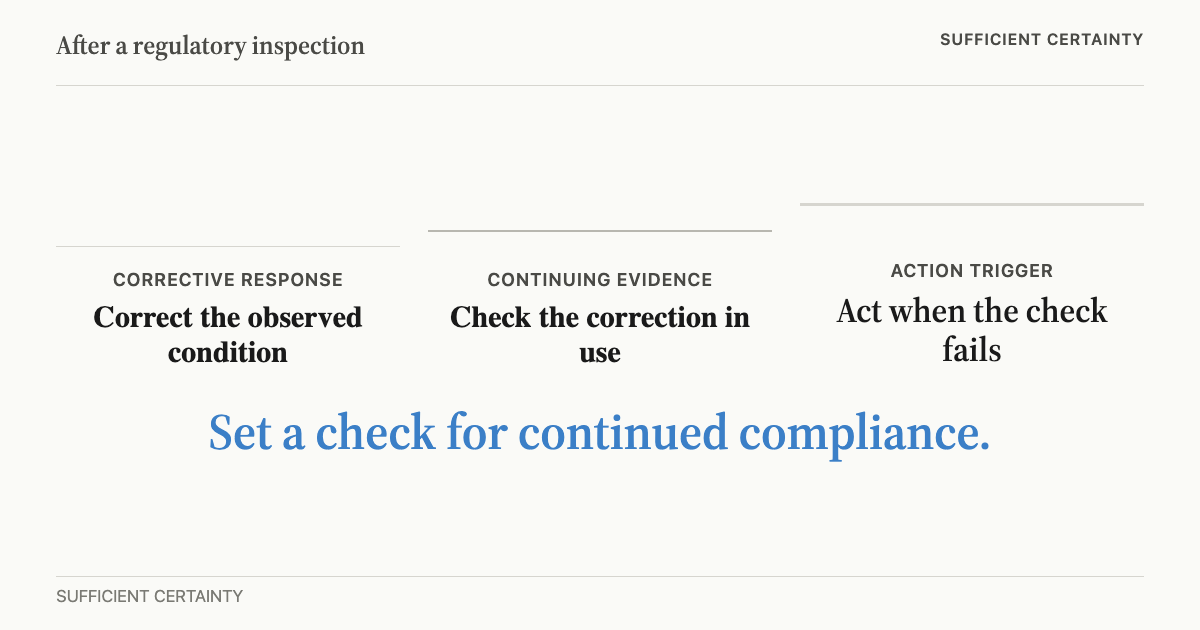
Set a check for continued compliance
Before approving the response, add the continuing check to the same log. State which result would require further action. Name the person who will examine the evidence. Then identify the person who can decide whether the activity continues under its current conditions.
Specify the result that changes the decision. For a required review, use evidence that the review occurred before the affected release. Decide what happens when that evidence is absent. The response may need further investigation. Continued operation may need a restriction. The action must fit the actual consequence and the applicable requirement.
Choose when the check happens from the activity being controlled. Check after a change that could alter the correction's effectiveness. Consider a new system or a transfer of responsibility. Do not assume that the date of the next regulatory inspection supplies an adequate internal check.
The legal setting remains specific. In Great Britain, HSE describes inspection as assessing how well dutyholders manage health and safety risks and bringing about improvements. It states that primary responsibility remains with dutyholders. This is a separate regulatory setting. FDA forms and close-out procedures should not be applied to it by default.
The common decision task is to keep the correction connected to evidence from its use. The Universal Decision-Making Method provides a way to record that connection. Define what the response must achieve and what continued operation assumes. Set the observation that would require another decision.
Keep responsibility after the response ends. A project closure should transfer the check into ordinary work. Confirm that the receiving person can perform it. Retain the evidence so another reviewer can see why the operating decision remained justified.
This is a practical part of organisational governance. The regulator assesses compliance within its authority. The organisation must keep doing the work that compliance requires. Tomorrow's useful addition is a check beside each observation, with a clear route from failed evidence to further action.
A closed inspection response leaves an operating decision: what evidence shows that the correction still works?
Work through your decisionNo sign-up. Just pick your decision and start.
Grant Purdy is the co-author, with Roger Estall, of Deciding (2020), and the architect of the Universal Decision-Making Method.