
An organisational governance framework that took nine months and 146 pages will stay on the shelf. The board needs a repeatable test, not a document: who decides, what does the call assume, and which condition would force it back onto the table before the commitment hardens?
A board chair once showed me a governance framework that had taken nine months and two outside advisers, ending in 146 pages. An hour later that same board was arguing about an acquisition larger than the company's prior two years of profit. Nobody opened the framework. The real paper was a slim brief built on hurried assumptions. That is my shelf test.
If the framework stays on the shelf while the hard decision gets made somewhere else, it is not governing anything. Roger Estall and I wrote about that habit in Deciding because we kept seeing it in different costumes. The document satisfied the annual report and the audit trail. It did not help the next Decider. In my experience, that convenient split is exactly why the document survives.
A governance framework is the system that assigns decision authority and shows how important decisions will be challenged and reopened if the basis for them changes.
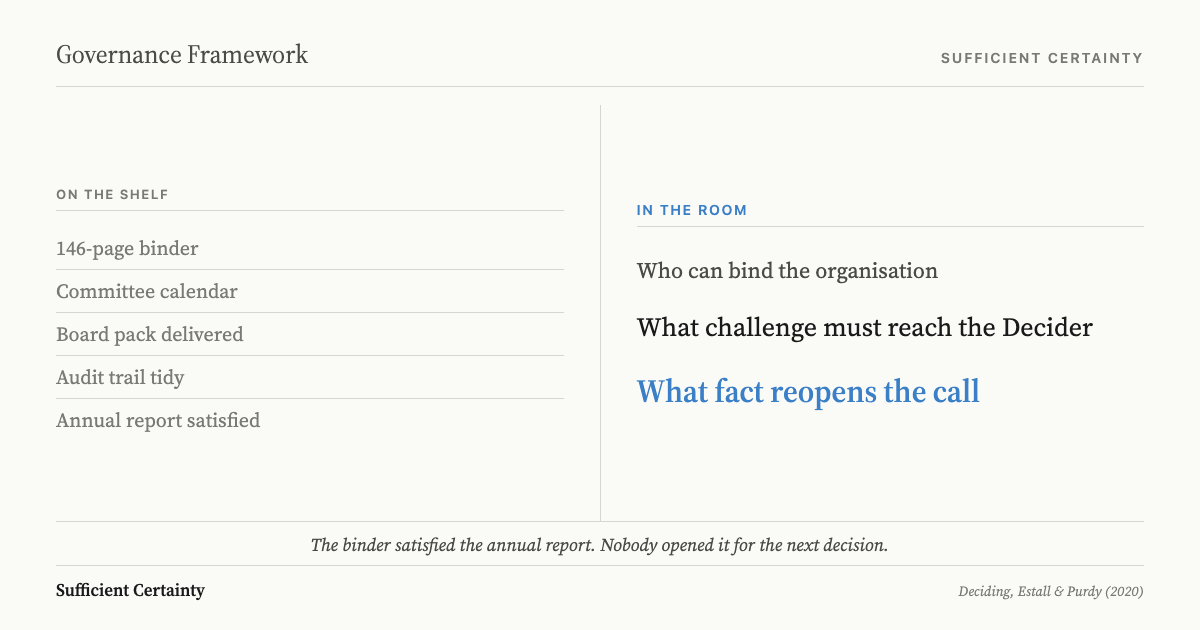
A governance framework should make the next decision better
APRA’s 2026 governance review consultation paper says governance should provide clear accountability and decision-making structures, and it complains that boards are burning time on scattered compliance chores instead of judgement. It also wants board information to be timely and useful. Boards do not fail because the pack arrived with too little grammar. They fail because nobody was forced to bite on the live assumption. The only question I care about is whether the framework changes a live decision before commitment hardens. If it does not, the paper is just another permission slip for process.
Show me who can bind the organisation. Then show me the challenge that must reach that person, and the fact that drags the matter back into the room. If a framework cannot do that, it is only a cast list for the annual report. That is why I keep coming back to who the Deciders are.
Why most governance framework documents stay on the shelf
Most of these documents start with an answer and then go hunting for a question. The answer is always more structure and more paper. Once months have been sunk into that machinery, very few people ask whether it helped anybody decide. Why would they? The document already proves diligence, and the advisers have already been paid (which rarely cools the appetite for version two). That is how governance failures take root.
Parliament’s report on Carillion is what this looks like when the bill finally arrives. Carillion went into liquidation in January 2018 with nearly GBP 7 billion in liabilities and just GBP 29 million in cash. It had every formal check a listed company is supposed to have. The report said non-executives failed to challenge reckless executives and the checks and balances failed. The arrangement protected anyone who preferred respectable process over a real interruption, starting with directors and executives.
After a collapse like that, someone always asks for a stronger governance framework. Fine, make it stronger at the point of decision. If the framework does not force challenge before commitment hardens, it is just more cabinet work. That is also why I have no patience with the IIA Three Lines Model. Once people start managing the labels, the decision slips out the side door. A governance model is worth only as much as the live check it puts on the Decider's call.
Use one board decision to test whether your framework names the decider and the fact that reopens the call. Start the Walk →
Board packs do not prove the framework works
The board-paper version of the problem is now well documented. NACD and Board Intelligence found in 2024 that only 13% of directors rated their board packs “extremely effective”, while 59% reported three or more concerns. Most public-company packs ran past 200 pages, and in financial services many ran past 500. More than a third of directors said the material did not arrive early enough. Half of every pack consisted of slides. Those packs read more like archives than tools for a clear board decision.
I have sat through meetings where directors spent the first hour locating the recommendation and the second deciding whether management believed it. If the first pages do not say what the board is being asked to decide, and what fact would make the recommendation wobble, the pack is just organised delay. A decision record should let challenge land before the room gets lost in slides. In my experience, the oversized pack serves two quiet interests: it shields management from direct challenge, and it gives everyone a paper trail afterwards.
People then tell themselves the annual review will catch whatever the meeting missed. I have never found that comforting. Audits sample, and they arrive late. A framework worth anything should tell you quickly that the basis for the decision has shifted. Otherwise the board is governing the paperwork that followed the decision, not the decision itself.
What a governance framework worth having actually does
The Reserve Bank of Australia’s 2025 progress report is worth reading, though not because another org chart is inherently impressive. Legislative reforms that took effect on 1 March 2025 split one board into specialist boards. The useful question is narrower. Did that split make challenge harder to evade, and authority harder to blur? If yes, the redesign did some work. If not, it produced a tidier diagram and a fresh round of reassurance.
In my experience, a governance framework worth having does not start with the committee map. It starts with the live call. When an operations director has a plant closure or a supplier exit on her desk, she does not need another diagram. She needs to know who decides and what signal reopens the call. If the recommendation hangs on one heroic forecast, I want that exposed before the vote, not discovered later in the post-mortem. The challenge belongs in the paper before approval, not in the corridor afterwards. That is where the Universal Decision-Making Method earns its keep.
That is what organisational governance is supposed to do. If the framework does not change the live decision, it exists for the people who profit from decorative control, especially advisers and directors who would rather inherit a binder than own a call.
You could adopt the next governance framework and still leave the live decision untouched.
Work through your decisionNo sign-up. Just pick your decision and start.
Grant Purdy is the co-author, with Roger Estall, of Deciding (2020), and the architect of the Universal Decision-Making Method.