
After a transfer impact assessment, ask counsel to match the unresolved findings to the recipient named in the live contract. The assessment can be filed while a supplier update changes where personal data goes. Before continuing the transfer, give each material change a clear reason to return for review.
A transfer impact assessment examines whether the circumstances and safeguards of an international personal data transfer provide the protection required by applicable law.
The transfer record needs a named recipient
The first task after the assessment is to identify the transfer it supports. Write down the exporting organisation and receiving legal entity. Include the destination and the service involved. Compare those details with the live contract. A familiar supplier name may cover several entities, while the assessment concerns only one recipient under stated conditions.
Connect every unresolved finding to the actual transfer. Ask counsel which finding affects continuation and why. Some findings may require a contractual correction. Others may concern access to readable data or the ability to meet a safeguard in practice. Keep those differences visible so the transfer owner knows what evidence must arrive before making the next commitment.
The European Commission's guidance on standard contractual clauses describes a transfer impact assessment covering the transfer circumstances and destination-country laws. It also includes the additional safeguards used. Match the assessment to the mechanism counsel has identified. The existence of an assessment document does not establish that it covers another recipient or another legal route.
Keep the relevant contract annex with the assessment. Ask the supplier to identify onward recipients and the access arrangements relevant to the finding. Where information is missing, record the missing answer rather than replacing it with the supplier's general security statement. Someone reviewing the decision later should be able to trace the finding to the information used.
Make the approval cover one described transfer arrangement. The transfer owner can then identify whether a later supplier change falls within it. This is part of organisational governance: specialist advice informs a commitment made by a named person. The record should state who can authorise continuation and who must obtain further legal advice.
The adjacent work after a DPIA considers the processing and its effects on people. This checkpoint is narrower. It asks whether the identified recipient and safeguards support this cross-border transfer. A favourable answer in one assessment should not silently resolve the distinct questions in the other.
Connect the transfer assessment to the recipient route you are being asked to approve. Start the Walk →
What makes the safeguards usable?
A completed assessment is useful because it states the circumstances behind its conclusion. It can explain why an identified transfer tool is appropriate and where additional measures are needed. Preserving that reasoning gives the owner a basis for checking later changes. A bare approval label loses the conditions that make the conclusion applicable.
Ask for evidence of the safeguard that carries the conclusion. If the finding depends on a technical arrangement, ask the responsible engineer to show its configuration and limits. If it depends on a contract obligation, identify the agreed clause and the party responsible for performance. Counsel needs the operational facts, rather than a promise that the supplier takes privacy seriously.
The EDPB recommendations on supplementary measures include re-evaluating transfers and monitoring relevant developments. Their sequence connects the transfer tool with destination-country conditions and any necessary measures. The recommendations do not make a signed contract a substitute for effective protection. Use the assessment to identify what needs to remain true in this particular arrangement.
Record the evidence in a form the owner can check again. Identify the configuration or contract version relied on and the date it was examined. Explain who would notice a departure from it. A supplier's assurance can be an input, but the decision record should distinguish that assurance from something the organisation has independently confirmed.
This makes supplier assessment findings easier to use. A general finding about supplier security may help identify a question. It does not by itself answer the specialist transfer question. Ask counsel which part of the supplier evidence matters to the proposed recipient route and which uncertainty remains.
Give a continuing transfer observable conditions. An approval that depends on a safeguard should explain how loss of that safeguard becomes visible. If no one can observe the relevant change, ask how the organisation will obtain notice. The answer can change whether continuation is justified on the evidence available.
Tele2’s historic transfers faced an enforcement decision
The Swedish privacy authority IMY examined transfers through a version of Google Analytics used on 14 August 2020. Its July 2023 announcement says the companies relied on standard contractual clauses. IMY found their additional technical measures insufficient for the required protection. It imposed a fine on Tele2, which had already stopped using the tool voluntarily.
The announcement does not establish that Tele2 completed a formal assessment under that name. It concerns historical transfers and their safeguards. IMY's official case status records that the appeal court rejected Tele2's appeal on 15 October 2025. That later procedural outcome does not change which transfer conditions the original investigation examined.
Keep the historical route separate from today's legal basis. On 10 July 2023, after IMY's announcement, the European Commission adopted the EU-US Data Privacy Framework adequacy decision. The Commission's current explanation of EU-US transfers describes transfers to participating US companies. The Tele2 case therefore does not establish a blanket current ban on Google Analytics.
For a present decision, ask counsel to verify the receiving entity and whether the relied-on route covers the transfer. If the proposal relies on participation in the Data Privacy Framework, check the relevant recipient's participation and scope. If it relies on contractual safeguards, examine that route on its own terms. The supplier's product name cannot settle either question.
The monitoring lesson is a proposed application for the reader. Save the legal basis used for this approval, together with the recipient evidence. Then specify which change would make the conclusion require a new assessment. The trigger must concern the arrangement actually approved, rather than depend on someone recognising a familiar supplier name in privacy news.
- Recorded transfer tool
- Recipient examined at review
- A newly appointed onward recipient
- A changed access arrangement
- Loss of a relied-on safeguard
- Changed coverage under the legal route
A contract update can affect more than one team. Procurement may receive the notice, while engineering changes the configuration and counsel maintains the assessment. Connect those handoffs explicitly. The work after a contract review can help identify the operating owner, but the transfer owner must still bring a relevant change back to counsel.
Set triggers for checking the transfer again
Write a short continuation record before authorising the next period of service. Identify the transfer and the conclusion relied on. Attach any unresolved finding that could change the decision. State who must act when its answer arrives. Where protection remains unresolved, ask counsel what action is legally required before allowing the transfer to continue.
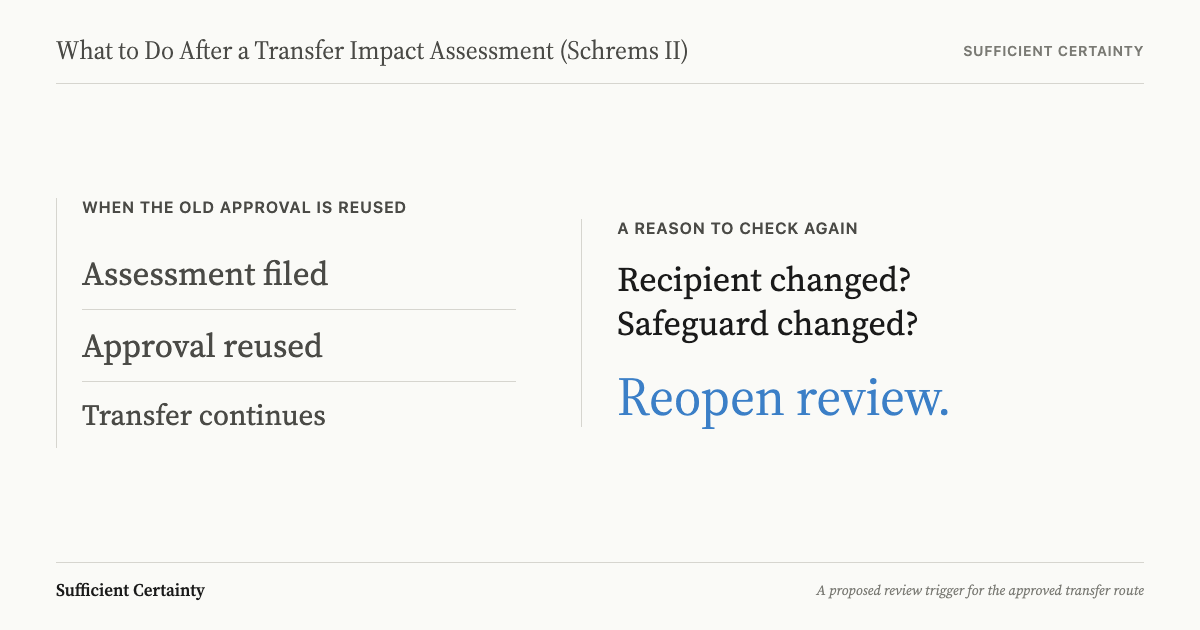
Define the change before choosing the review date. A calendar review can provide a backstop. It cannot replace action when a critical fact changes earlier. A different receiving entity or a material change in access arrangements can require attention before the scheduled review. Ask counsel to identify which changes require suspension or another immediate response.
Make each trigger usable by the person who first receives the information. A procurement owner should know which supplier notice to forward and to whom. An engineer should know which configuration change requires review before deployment. Avoid a condition that simply says to report anything important. It gives the recipient no way to decide what matters to this transfer.
The Universal Decision-Making Method connects implementation with checking the conditions supporting a decision. Apply that principle to the transfer finding rather than adding a second privacy checklist. One record can identify the owner and the relevant signal. It can also state the temporary action to take while a changed condition is assessed.
Retain the earlier conclusion when the record is updated. Show what changed and why the new evidence supports the next action. This makes monitoring a decision different from repeatedly renewing the same approval label. The organisation can explain which recipient route it authorised and when the evidence required that decision to change.
A transfer conclusion needs checking again when its recipient or relied-on safeguards change.
Work through your decisionNo sign-up. Just pick your decision and start.
Grant Purdy is the co-author, with Roger Estall, of Deciding (2020), and the architect of the Universal Decision-Making Method.