
After a contract review, write down what starts and stops each charge before approving the first invoice. In 2013, the Ministry of Justice found anomalies in electronic-monitoring data during retendering and commissioned a forensic audit. The immediate question after reviewing terms is who will put each important obligation into practice.
A contract review examines an agreement's terms to identify obligations, rights and issues that need resolution before the agreement is signed or used.
A contract review should leave usable terms
Start by closing the issues that the review identified. Record which wording changed, which questions remain open and who can accept the remaining exposure. Keep the approved agreement with its schedules and amendments. Anyone setting up delivery or payment needs to know which version governs the work.
A useful review can clarify the service scope, acceptance requirements and payment basis. It can also identify notice deadlines, change procedures and termination rights. These details give both parties a basis for discussing performance. They also let managers distinguish a contractual requirement from a request that needs further agreement.
Clear terms give the operating team something specific to implement. That value should survive the handoff. Give the people responsible for service delivery the relevant requirements, rather than asking them to extract everything from a file. Link each operating instruction back to its clause so the team can check it.
The UK government's contract management principles call for an effective handover from sourcing and clear responsibilities. They also call for a documented contract management plan. This supports treating the review's findings as input to operating arrangements, rather than leaving them with the people who negotiated the agreement.
Separate approval of the wording from readiness to operate it. A reviewer can confirm that an acceptance clause reflects the intended deal. The service manager still needs a person who can inspect delivery and record acceptance. Finance needs access to that record when checking the invoice. Each task needs an owner and a route for resolving questions.
Include the buyer's obligations in that handoff. If delivery depends on site access, specify who arranges it and when. If acceptance needs a test, confirm who can run it. Check that the receiving team has the required authority and resources before setting a start date for the supplier.
The distinction between accountability and responsibility helps assign that work. Identify the manager answerable for the contract's intended result, then assign the actions that support it. Do not treat a shared mailbox as the owner of a decision.
Before closing the review, ask the receiving manager to show where the findings will be used. This might be an acceptance form, a payment instruction or a notice calendar. The review is more useful when its findings reach the people who must act on them. For existing customers, the follow-up to a terms of service review connects revised terms to the actual notice and the response available when a customer declines.
Which reviewed obligation still has no owner or supporting record? Start the Walk →
Who turns contract wording into daily work?
The question “Are these terms acceptable?” directs attention to the agreement. After review, widen the question: “Can the organisation deliver and manage this agreement?” The second question includes internal work that the supplier cannot do for the buyer, such as approving access or sending a required notice.
The post-review decision concerns the whole operating arrangement. Ask what result the contract is meant to support. Then check whether the planned service, records and decisions can produce that result. A list of clauses alone will not show whether the buyer can meet its own dependencies.
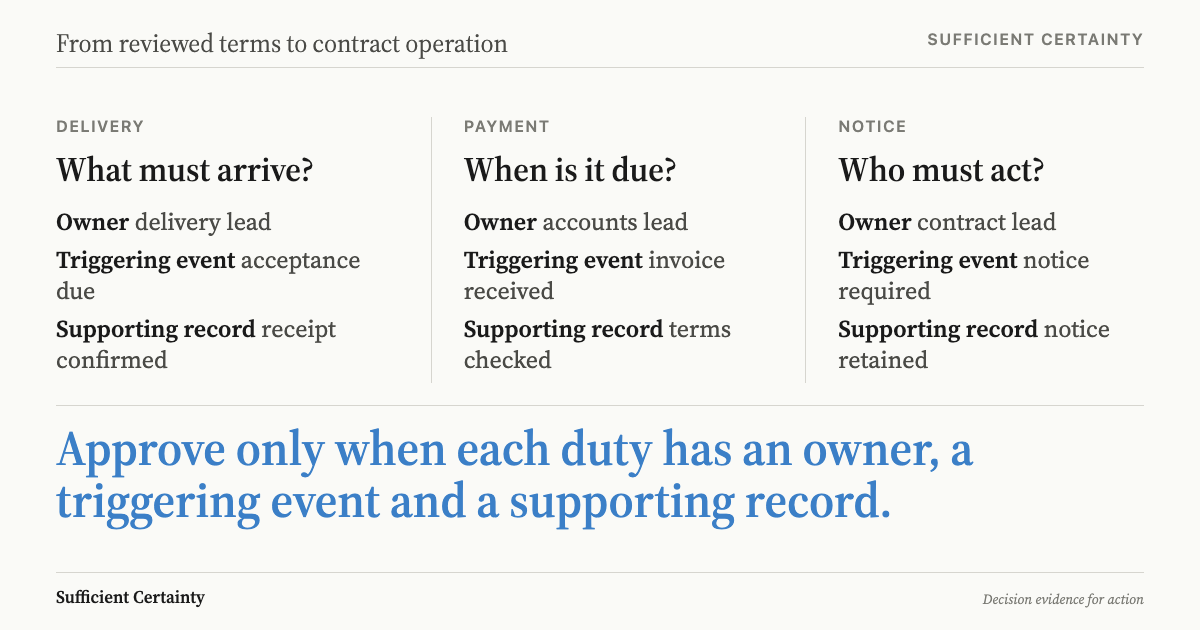
Consider how an approved agreement reaches three roles. The following readings illustrate different tasks that need to be joined before operation begins.
Join those tasks in a short handoff record. For each important obligation, record the clause, the action and the responsible person. Add the event that makes the action due and the evidence that shows completion. Start with obligations whose failure would interrupt service or create a disputed payment.
NISTA's guidance for PFI contract management plans combines a plan with an obligations matrix and contract calendar. Its scope is PFI contracts. The useful application here is to connect wording with assigned actions and dates, while preserving the agreement as the governing document.
Use problem framing to examine options beyond another review of the same clauses. A missing record may require a change to the payment process. An unassigned notice may require a named sender. A disputed meaning may require commercial and legal resolution before staff receive instructions.
Choose the response that addresses the specific gap in the handoff. Use governance and management roles to distinguish who sets approval conditions from who performs the daily work.
What the Ministry's billing review exposed
The Ministry of Justice's 2013 retender prompted questions about G4S data on average monitoring-order length. The Ministry could not obtain the assurance it needed. It commissioned PwC's forensic audit, which began in May and later expanded to Serco. The National Audit Office report records that sequence in Part Two.
The providers said they charged per order rather than per person. They also said charges continued until formal notification closed an order, and began after an attempted installation. The Ministry disputed those interpretations. The report describes charges continuing after monitoring had stopped or never started.
The NAO explicitly did not decide which party interpreted the contracts correctly. Its account therefore supports examining disputed charging practices, without establishing fraud or a contractual breach. The recorded dispute concerned how contractual wording became charges in operating systems.
The practical inference is to trace the event behind an invoice line. Identify whether the billable unit is a person, an order or another defined item. Locate the record that starts charging. Then locate the event and notice that stop it. Ask whether the buyer and supplier use the same interpretation.
This is an operational check derived from the case, not a procedure the NAO says the Ministry followed before the dispute. It also cannot settle a contested legal meaning. Where interpretations differ, record the disagreement and refer it to the people authorised to resolve it.
A notice requirement brings the handoff into view. Ask who learns that the service has ended, who sends the notice and who records receipt. The discussion of accountability and ownership helps keep that chain assigned through changes of staff. A payment check must include the information that changes whether payment is due.
Test the contract handoff before approving operation
Use the handoff record at a defined checkpoint: before approving operation under the reviewed terms. For an existing agreement, use it before approving the next operating change or renewal. State what is being approved so that a review of one issue does not imply acceptance of the whole contract.
Take one invoice line and ask finance to show the billable unit and its supporting clause. Ask operations to locate the start and stop records. Include the required notice where charging depends on notification. Check a proposed invoice against the agreed rules if the contract has not yet started.
Then extend the check beyond payment. Ask the service owner how delivery will be accepted and how failures will be recorded. Check who can approve a variation and where that approval will be kept. Confirm the route for required notices and the arrangements for service continuity at exit.
One sample can expose a missing handoff; it cannot assure the entire contract. Expand the check where the consequences justify it. Record unresolved items with an owner and an approval condition. Use the decision rights framework to identify who can accept an exception or require further work.
The Universal Decision-Making Method supports framing the decision around the intended result and available options. Here those options include correcting an operating instruction, obtaining missing evidence or resolving disputed wording. Match the evidence required for approval to the consequences of being wrong.
Keep the handoff record in the contract management plan. Revisit it when a variation changes an obligation, an owner leaves or a required record is missing. This makes organisational governance part of the approval decision. Approve operation with clear responsibilities and explicit conditions for unresolved work.
Before approving contract operation, decide what evidence would show that the handoff is ready.
Work through your decisionNo sign-up. Just pick your decision and start.
Grant Purdy is the co-author, with Roger Estall, of Deciding (2020), and the architect of the Universal Decision-Making Method.