
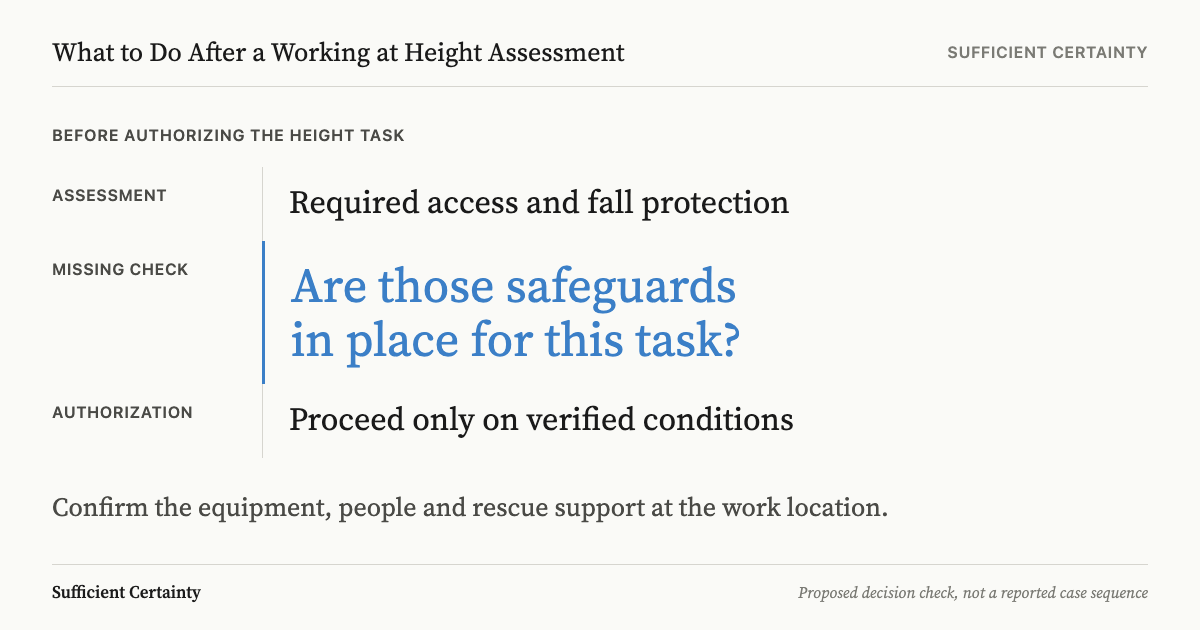
After a working at height assessment, take the task record to the work location and verify that the specified access equipment is in place. A signed assessment can reach the task manager while the equipment it requires is still unavailable. Record that difference before deciding whether the task can start.
A working at height assessment examines a task’s fall hazards and the arrangements needed to avoid harm during the work.
The assessment must become a site arrangement
The usual next step is to prepare the work and communicate the assessed method to the people carrying it out. That includes arranging suitable equipment and making the responsibilities clear. The task manager then has a live decision: whether the conditions needed for this particular task are present when work is due to begin.
Begin with the exact task, location and shift. A document for roof maintenance may not cover the access route or work area proposed today. Check the assessment’s scope with the competent person responsible for the work. If the planned task differs, resolve that difference before treating the document as an authorisation basis.
The HSE introduction to work at height sets out the hierarchy: avoid the work at height where possible, prevent falls when it cannot be avoided, and minimise the consequences where a fall risk remains. A task manager should preserve that sequence. The availability of a harness does not itself establish that the selected work method is suitable.
Put the required conditions into the task record in words that can be checked on site. Identify the access arrangement, the protection at the work area, and the support required if something goes wrong. Refer technical questions to the competent person. A manager’s visual check cannot replace an inspection or specialist judgement that the work requires.
Connect this record to the existing site authorisation process. Do not create a second permit merely to repeat the assessment. The useful addition is evidence of the actual conditions relied on for permission. The workplace risk assessment checkpoint concerns broader ratings; this check concerns whether one task’s planned safeguards are available.
What does the height-work assessment help decide?
A good assessment helps the manager choose a workable method and arrange the necessary support. It makes the intended protection visible before people begin. It also gives the supervisor something specific to discuss with the crew. That is valuable preparation, particularly when different organisations supply equipment and carry out the work.
The document can identify what must be present. It cannot, by itself, establish what is present at the start of a later shift. Equipment may be booked but not delivered. An access route may be blocked. The worker briefed for the task may be absent. These are proposed checks, not claims about the case below.
The HSE brief guide to working at height explains planning and suitable equipment, including emergency and rescue arrangements. Use that guidance with the site’s competent advice to determine the required conditions. The purpose of this management check is to verify their implementation, rather than make technical equipment choices from a general article.
The risk assessment hub discusses the connection between analysis and a decision. Here the decision must have a defined scope: permission for this task under these conditions. A signed assessment can support that decision, but the authorisation record should say how the manager established that its necessary conditions actually held.
The height-work decision depends on the safeguards available at the work location. Start the Walk →
Recorded safeguards versus available equipment
The critical assumption is that the work will occur under the conditions described in the assessment. State that assumption directly. Then identify what would disprove it. Missing specified equipment is a clear example. A changed work area or unavailable rescue team may also prevent the planned method from being carried out as intended.
Check dependencies across organisations. A subcontractor may expect the principal contractor to provide access, while the site team expects the subcontractor to arrive with its own equipment. Do not settle this by asking whether everyone has read the assessment. Confirm who supplies each necessary arrangement and whether it is ready at the agreed location.
Check the period of availability as well as the starting condition. If access equipment is due to be removed before the task ends, the authorisation cannot silently assume continuous availability. If rescue support is provided by another crew, confirm that the support covers the work period. Refer a gap to the person responsible for the assessed method.
Can the team use every required safeguard at this location now?
Rescue needs particular attention because its absence may remain invisible until help is needed. HSE construction guidance on work at height says emergency and rescue arrangements must be planned and should not depend on the fire brigade. Confirm the site arrangement with competent staff instead of assuming that an external emergency call supplies the whole plan.
The safety audit follow-through offers a related check on whether corrective actions produced their intended result. For the height task, inspect the evidence that matters now. A purchase order shows an order; a briefing record shows communication. Neither establishes that the required access arrangement is ready to use.
B&O Developers lacked the specified scaffolding
The HSE account of the B&O Developers prosecution describes unsafe roof work at a Kings Cross construction project. Photographs sent in January 2024 showed work without fall-prevention controls and unsafe access. HSE found that measures identified in the roofing subcontractor’s assessment, including scaffolding around the roof, were absent.
The company pleaded guilty to a breach of the Work at Height Regulations and was fined in July 2026. HSE also reported that controls preventing falls were missing on at least two dates. The source describes unsafe work and enforcement. It does not report a fall, injury or death at this project.
The case illustrates a precise implementation gap. The assessment had identified a necessary arrangement, but that arrangement was not in place. It does not establish that a particular contractor change caused the gap. The proposed reader application is to compare the assessed requirement with the actual site before authorising the task.
A manager seeing that mismatch should identify the missing condition and refer it through the site’s work-control process. Repeating the document’s wording does not supply the equipment. A verbal promise to improve matters does not show that the condition is ready for the next task. Obtain the required evidence before reconsidering authorisation.
The ISO 45001 audit checkpoint makes the same distinction between an action and its verified effect. Keep the task record focused on the specific work, however. A wider management-system action can remain open while the immediate task is stopped or redesigned through the authorised process.
Verify the task conditions before authorizing work
Use the Universal Decision-Making Method to connect the assessment with the commitment to begin. Name the required outcome, examine the proposed method, and identify what it assumes about the site. Seek enough evidence for the actual authorisation decision. This supports the competent assessment and does not replace its technical requirements.
Record the decision in the existing task or permit record. State the work location and scope, the conditions verified, and the person who checked them. Reference equipment inspections where applicable. Identify any condition that prevents starting. The person receiving the decision should not have to infer whether work is permitted from a list of unfinished actions.
Give the authorisation clear limits. Specify the change that requires work to stop and the task to be reconsidered, consistent with the site procedure. A change in the access arrangement, weather beyond the assessed conditions, or loss of rescue support can invalidate the basis for permission. The precise limits must come from the competent task planning.
At handover, pass on those limits as well as the completed checks. The next supervisor needs to know which conditions must remain true. The quality audit checkpoint can help structure evidence of completion, but a site record must remain specific enough to guide the next shift’s decision.
Finish by recording the authorised next step: proceed within the verified conditions, obtain missing support, or revise the method through the proper process. A missing safeguard is a condition to resolve before exposure. Keep the assessment and actual work connected each time the authorisation depends on equipment or people being available.
Which missing access or rescue condition would prevent this task from starting?
Work through your decisionNo sign-up. Just pick your decision and start.
Grant Purdy is the co-author, with Roger Estall, of Deciding (2020), and the architect of the Universal Decision-Making Method.