
After a quality audit, record the failure that would reopen each finding in the audit log. A closure meeting can confirm that a procedure was revised while the next production batch remains untested. The follow-up decision needs a named person who will check whether the change works during normal operation.
A quality audit checks evidence against defined quality requirements. Its findings identify departures that need investigation and corrective action.
Put each quality finding beside the affected process
Start with the auditor's evidence, the requirement, and the process that produced the finding. Preserve these together in the findings log. A short description such as “training incomplete” loses the conditions that made the gap matter. Record which work, products, equipment, or records the auditor examined.
Then identify the decision that follows. Some findings require immediate correction of affected work. Others require investigation before the team chooses a lasting change. Separate those tasks. Correcting one defective item does not establish why the process produced it, or whether other items share the problem.
Keep the product consequence visible. A missed inspection matters because an unsuitable product could proceed to the next operation or customer. The follow-up record should explain that connection. A procedure number alone does not tell the process owner which outcome needs protection.
Assign the investigation and corrective action to people with access to the work and authority to change it. Specify who can approve the revised process and who can challenge its effectiveness. This distinction follows the practical difference between owning a decision and carrying out its tasks. Where the action is agreed after a management review, keep the responsible manager and the operating-result check with that decision.
The scope may need to extend beyond the sample that produced the finding. In pharmaceutical manufacturing, 21 CFR 211.192 requires investigation of unexplained discrepancies and specification failures. It also requires attention to other associated batches or products. An internal audit outside that sector needs its own applicable requirements.
Use the checklist below as proposed follow-up questions. Its untested labels describe questions to resolve, rather than findings about a particular organisation.
Define closure evidence before work starts. The owner should know which records will demonstrate implementation and which observations will demonstrate effectiveness. This makes the closure decision inspectable when the due date arrives.
Closing audit findings can restore control
Corrective action gives the audit a practical result. It can remove a damaged tool, restore an inspection, clarify a disputed requirement, or change an unreliable handoff. These changes deserve clear completion dates and evidence. Without follow-up, the audit has identified a departure without resolving it.
Documented closure also helps the next reviewer understand what changed. Preserve the original finding, the investigation, the selected action, and its approval. Record the limits of the evidence. A trial on one machine may justify a decision about that machine without supporting the same change across every line.
Separate implementation from effectiveness. A revised procedure establishes what people are expected to do. Training records establish who received instruction. The effectiveness check asks whether the process now delivers the intended quality under the conditions in which it operates.
The distinction is especially useful when a finding concerns inspection. More inspection can contain a problem while the underlying production cause remains unresolved. The related work on following a root cause analysis examines the evidence needed before a proposed cause guides corrective action.
For drug manufacturing, FDA's process validation guidance describes continued process verification during routine production. It recommends collecting and analysing process and product data to evaluate continuing control. That guidance concerns pharmaceutical processes; it is not a universal audit closure rule.
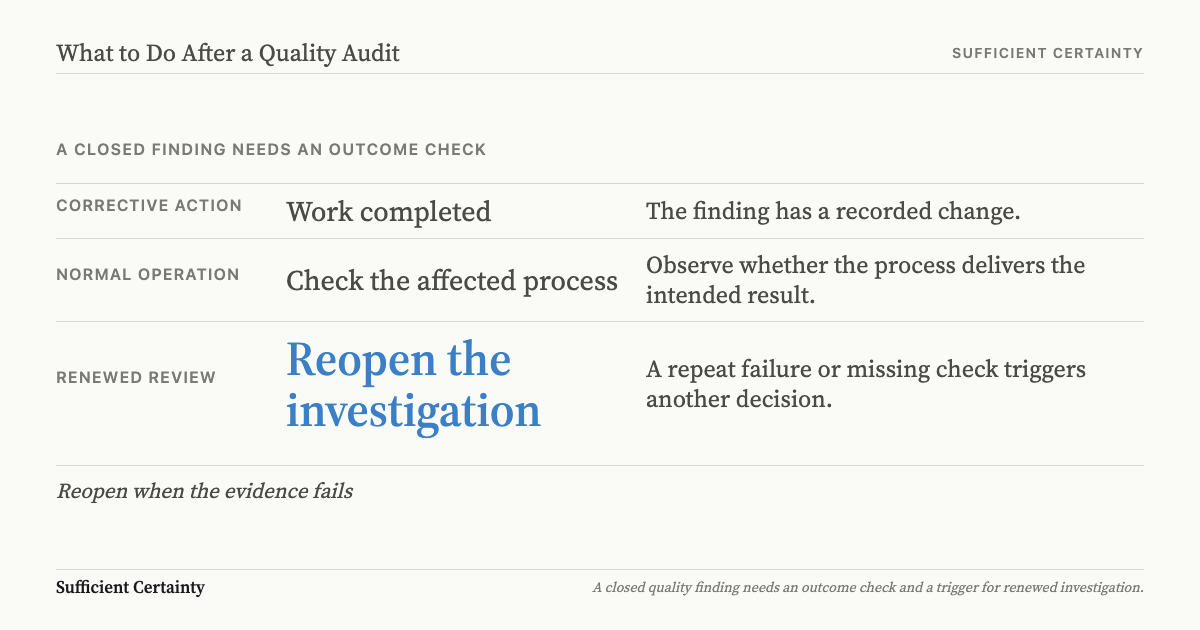
A useful closure record therefore contains two dates: when the action was implemented and when its performance will be reviewed. The second date should follow a meaningful opportunity for the failure to recur. An empty production period provides little evidence about a change intended to work under load.
Retain the conditions behind the result. Record the product mix, operating conditions, and test coverage. Those details help a later reviewer decide whether a change in production requires another check.
Which repeat failure would make the quality audit finding need another investigation? Start the Walk →
When does corrective action need another review?
The answer should be written before the finding closes. Repeated defects, unexplained test invalidations, or a change in material can challenge the reason for closure. A missed effectiveness check also deserves attention. The absence of a reported failure means little when the planned observation never happened.
Baxter Pharmaceuticals India's Ahmedabad facility illustrates the problem. FDA inspected the drug facility in January 2023. Its July 2023 warning letter identified inadequate investigations into endotoxin testing and automated visual inspection.
FDA described earlier commitments to improve investigations following a 2017 inspection and a 2018 warning letter. A third-party retrospective assessment omitted a previously cited investigation and approximately 20 invalidated tests from 2021 and 2022. FDA found the response inadequate.
The letter requested dated remediation actions and periodic independent reassessment of the plan's effectiveness. It also requested review of investigation trends and documented corrective-action effectiveness. These were FDA findings and requests. The letter does not establish that later remediation succeeded.
This was a regulatory inspection, rather than an internal quality audit or certification audit. The analogy concerns follow-up: promised changes need evidence about recurring failures and the completeness of the review. It does not establish that Baxter conducted an internal audit, closed these findings, or used the Universal Decision-Making Method.
Recurrence must reopen the investigation. For an internal quality finding, define the observation that challenges the selected corrective action. A repeat of the same failure is one candidate. Another is discovering that the original investigation excluded an affected product, shift, or piece of equipment.
Also check the test itself. A falling defect count may reflect fewer units inspected or easier inspection conditions. Compare results with the amount and type of work examined. A change in sampling can invalidate the comparison even when the dashboard looks better.
A missing check is a review trigger. Assign someone to notice when evidence does not arrive. Set a response date and a person who can decide whether additional containment or investigation is needed. This is the decision-focused use of monitoring.
Do not wait for a scheduled annual audit when the agreed trigger has already occurred. Bring the evidence to the person with authority over the affected process. That person needs to review the current operating decision, including whether the original corrective action remains suitable.
From a closed finding to a monitored process
Use one follow-up record for each significant finding. Include the failure being prevented, the evidence to collect, the observation schedule, the owner, and the trigger. Add the decision required when the trigger occurs. “Review needed” is incomplete unless someone can start that review.
The Universal Decision-Making Method gives that record a clear sequence. Applied to quality follow-up, its five steps can be expressed as practical questions:
- Frame: Which product or process outcome must the corrective action protect?
- Tentative Elements: Which correction, lasting change, and temporary containment are being considered?
- Assumptions: What must remain true for the selected change to prevent recurrence?
- Sufficient Certainty: What evidence is enough to approve that change for the affected work?
- Implement+Monitor: Who will check the outcome, and what observation requires another decision?
The timeline below shows a proposed review sequence. The highlighted point is when routine work first tests the assumption behind closure. It is not a reported Baxter timeline.
Keep the review proportionate to the consequence and the uncertainty. A serious defect needs stronger evidence and faster escalation than a minor record error. Use the applicable quality requirements to set acceptance criteria. Do not invent a generic number of batches or a fixed waiting period.
Keep monitoring after administrative closure. The findings log can show that the corrective work is complete while the process owner retains continuing checks. The organisational governance question is who can act when those checks challenge the decision.
Review the record when production conditions change. New equipment, a revised material, or a different product can make earlier effectiveness evidence less useful. Record why the existing check remains adequate, or change it before relying on the previous closure.
A quality audit produces findings at a point in time. Its lasting value depends on what happens in the process afterwards. The related ISO 9001 audit follow-up covers certification-related decisions. Here, the task is to notice when product and process evidence requires corrective action to be reconsidered.
A closed quality finding needs evidence that the corrected process still delivers the intended result.
Work through your decisionNo sign-up. Just pick your decision and start.
Grant Purdy is the co-author, with Roger Estall, of Deciding (2020), and the architect of the Universal Decision-Making Method.