Scenario planning tests decisions against multiple futures, which is valuable, and then stops before anyone names the assumption that carries the bet, which is not. Shell used it well because the exercise broke the house forecast before events did. The version most organisations copy kept the workshop and dropped the discipline.
Scenario planning is a structured way of testing decisions against multiple plausible futures. It becomes useful only when each scenario forces the Decider to name the assumptions that would have to hold for the decision to succeed. Without that discipline, scenario planning is speculation with a budget.
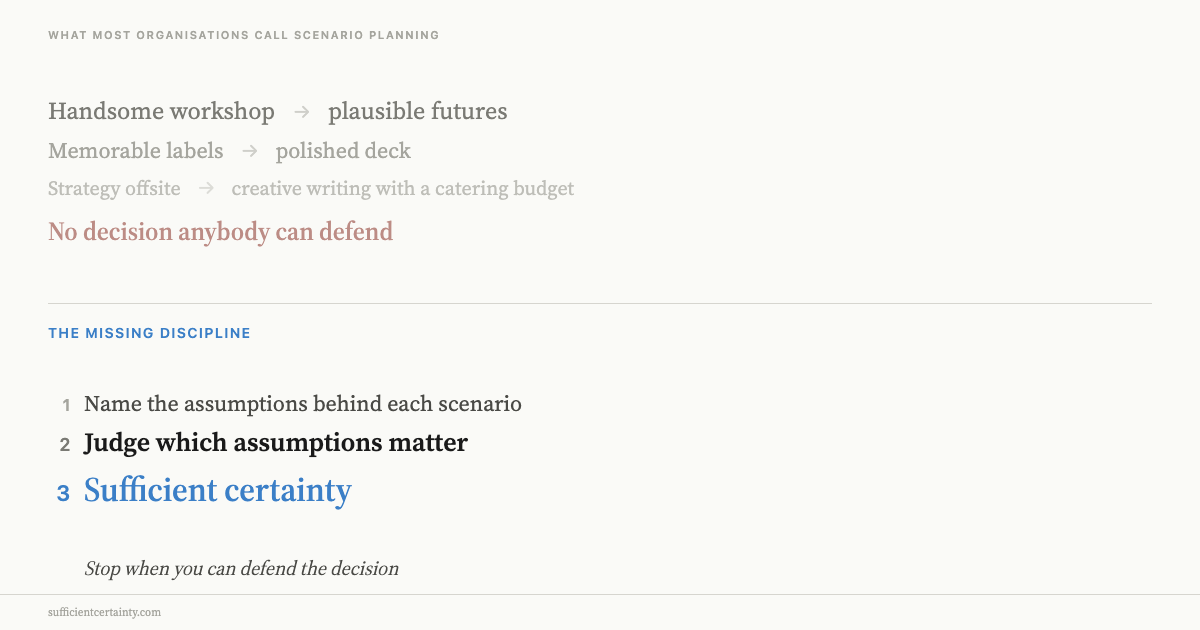
I do not object to the discipline. I object to the respectable fiction that passes for it in many organisations: the handsome workshop, the polished deck, and no decision anybody can defend. Shell used scenarios well because the exercise made management doubt its own house view before the oil shock did. That is the standard. Anything less is theatre.
Scenario planning is the practice of testing a decision against several possible futures by asking what would need to be true for it to work in each one.
What scenario planning is (and is not)
At its best, scenario planning is not a way to predict the future. It is a way to keep a decision honest when the future will not sit still. A forecast says, "this is what we think will happen." A scenario asks, "if this happened instead, would our decision still make sense?" That difference matters.
Shell did not prosper in 1973 because it guessed October like a fortune teller. It prospered because managers had already rehearsed the possibility that oil politics could turn ugly, and because the organisation had not married itself to one comforting number. The value was not the story about the future. The value was the permission to question the assumptions beneath the current decision.
The copied version forgot that hard part. It kept the scenarios and dropped the assumption work. That is why so much scenario based planning becomes a creative writing exercise with a catering budget. People spend a day naming futures, give each one a memorable label, and leave without asking what would have to be true for their decision to succeed in any of them.
The full case is worth reading: Shell scenario planning broke the forecast everyone kept because the team forced managers to doubt the house number before events did it for them.
Why most scenario planning fails
Most scenario planning fails because it begins with futures instead of Purpose. A decision has to serve something. If we have not said what outcome we are trying to achieve, over what period, and in what Context, then the workshop floats free of the real decision. The room may be busy. The Decider has not been helped.
The usual critical-uncertainties exercise makes this worse. Everyone contributes a driver, the cards go onto a matrix, and the room feels industrious because there is a neat square on the wall. The decision does not care about neat squares. It cares about which assumptions are load-bearing and weak. I have taken that matrix apart properly in a separate piece on critical uncertainties scenario planning, including what I rank instead of drivers.
The final failure is the most common: nothing is watched after the workshop. No premise is named, no threshold is set, no response is agreed. Forecasting versus scenarios is almost the wrong contest here. Both can fail when they hand the Decider a story about the future instead of a judgement about the assumptions under the decision. I have written a full comparison of forecasting and scenario planning, including the evidence from the Bank of England, the FAA, and Silicon Valley Bank.
Pick one scenario your plan depends on and name the assumption that separates it from the others. Start the Walk →
Where scenario planning works and where it fails
Good scenario work does not try to sound clever. It tries to be usable. The better cases share the same discipline I covered in decision making under deep uncertainty: several plausible futures, explicit assumptions, and a way to revise the decision when the premises move.
Colorado River planning is a useful example. The Bureau of Reclamation tested thousands of hydrologic futures because the river serves tens of millions of people and no single forecast was honest enough. The point was not the impressive number of scenarios. The point was to look for choices that could survive more than one version of the future.
TEPCO is the opposite lesson. Internal modelling before Fukushima showed a tsunami run-up higher than the seawall, but the design assumption remained effectively buried until the sea tested it. The organisation had information. It did not force the premise into the decision.
I have written a longer piece on scenario planning examples that actually changed decisions, grading the fuller set against this discipline. The pattern is not subtle: the useful ones leave an owned trigger behind; the failures leave a premise nobody wanted to name.
The scenario planning framework that actually works
If you want a scenario planning framework that does more than decorate a board paper, it has to sit inside the Universal Decision-Making Method. Scenario planning is not a separate planning religion. It is a way of testing tentative elements of a decision against different Contexts before you commit. A wargame does the same against a rival team, and its lessons deserve the same suspicion. I have set out what to do after a wargame, starting with the rulings and rival brief the game itself never tested.
The outline is plain. Frame the decision and its Purpose. Develop real options, not one preferred option in three costumes. Recognise the assumptions each option depends on. Judge whether those assumptions give you sufficient certainty to proceed. Then decide what will be monitored after implementation. That is enough of the framework for this page; the full sequence belongs in what a scenario planning framework is actually for: naming the assumption that carries the decision, then monitoring it.
The small moment that tells me whether the work is real comes when someone in the room says, "we are assuming customers will tolerate the delay." Now we have something to judge. Before that sentence, we had a future. After it, we have a decision premise.
Most scenario planning tools have the same weakness as the market for risk registers. They sell apparatus. A useful tool should force the Decider to record the tentative decision, the assumptions attached to it, their influence and confidence, and what will be watched afterward. If the tool cannot do that, it is a drawing aid. I am not hostile to software. I am hostile to software that helps people avoid the only hard question.
From scenarios to decisions, and what to watch after
The bridge from scenarios to decisions is sufficient certainty. That is where many organisations lose their nerve. They keep working the futures because it feels safer than choosing. Good strategic scenario planning stops earlier. It asks whether we know enough about the assumptions to make a sound commitment, not whether we have eliminated uncertainty from the world.
When we do not have sufficient certainty, there are only three honest responses. We can get more information. We can modify the decision with staged commitments, price terms, fallback capacity, or other secondary elements. Or we can decide that the option should not go ahead. None of that is glamorous. All of it is real decision work.
The monitoring that follows should be equally plain: a named premise, a trigger, and a response. That is far better than the generic recovery scenarios I criticised in disruption, where organisations keep a folder of dramatic events and no live rule for what to watch this month.
The real danger is often slower than the workshop imagined. A cost assumption drifts. A policy assumption hardens. A customer assumption stops holding. Because nobody named the premise, nobody sees the failure until the outcome has already moved. Scenarios are respectable. Unnamed assumptions are not. I have written a practical sequence for what to do after scenario planning, starting with the assumption most teams leave inside the chosen scenario. Financial scenario analysis has the same blind spot: a downside case can pass because every case held the same variable still, which is where I start on what to do after scenario analysis. When the exercise helps us see what must be true, decide whether that is sufficiently certain, and watch the premises afterward, it is worth doing. When it does not, it is respectable fiction.
You could sketch the futures, then keep betting on the one you prefer.
Work through your decisionNo sign-up. Just pick your decision and start.
Grant Purdy is the co-author, with Roger Estall, of Deciding (2020), and the architect of the Universal Decision-Making Method.