
Scenario planning examples split into two groups. Oregon doubled transit funding because the scenarios forced a choice. Britain rehearsed a pandemic under Exercise Cygnus, filed the report, and changed nothing before COVID arrived. The difference is whether the exercise left an owned trigger behind.
In October 2016, more than 950 people in the United Kingdom spent three days rehearsing a severe pandemic under Exercise Cygnus. The report later set out 22 lessons and four key learning points. When COVID-19 arrived, the country was still short of the hard follow-through those lessons should have produced. That is why I distrust most scenario planning examples.
I may as well save you the suspense: I am not against scenarios. Roger Estall and I wrote Deciding around the plain fact that outcomes are experienced later, under conditions that have moved. What I object to is the little industry around pre-packaged futures and named-world decks that never asks the awkward question: what would have to be true for this decision to work?
Scenario planning examples are real cases where teams tested a decision against multiple futures before committing, revealing which assumptions held and which collapsed under different conditions.
How I judge scenario planning examples
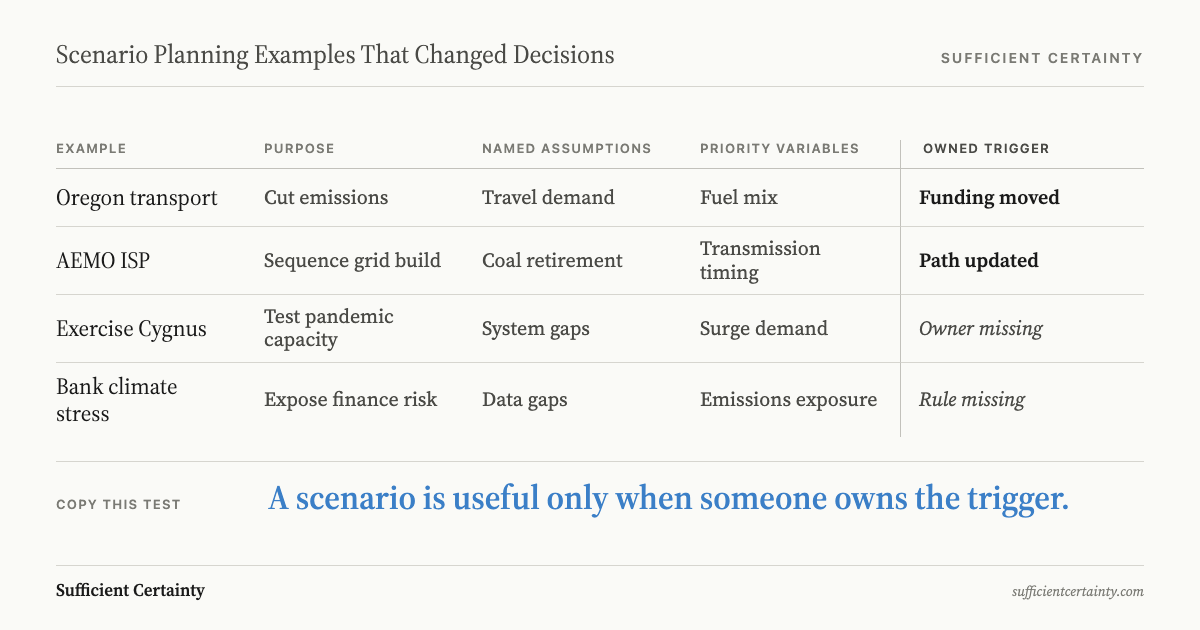
I ask whether the exercise began with a real decision and named the assumptions that would later break it. Then I ask what would make somebody revisit it. Starting with futures is comfortable for facilitators and strategy teams because nobody has to say which executive is about to spend money or own the mistake.
That is straight from the Universal Decision-Making Method: frame the decision before inventing futures, surface the assumptions holding it up, and write down what would force a rethink before anyone claims Sufficient certainty. If an example cannot survive that discipline, I would not copy it.
In my experience, the useful sentence is usually the least glamorous one in the pack: if fuel prices move past this point, or hospital capacity does, we do this. A board can use that. A beautifully named future with no attached decision merely borrows the tone of seriousness.
Scenario planning examples that changed money and capacity
Oregon is useful because the Purpose was plain: cut transport emissions, not produce a handsome climate binder. The Statewide Transportation Strategy used scenarios to test what would have to change in transport demand and fuel choices, then carried that logic into the 2024 to 2027 funding cycle with a climate lens and roughly doubled active-transportation and public-transit funding.
That is when scenario work earns its keep, when money moves and capacity follows. Public agencies produce plenty of reports that sit in a drawer and radiate virtue. Oregon at least turned the exercise into budget pressure on the real system.
The Australian Energy Market Operator is useful for a different reason. Its 2024 Integrated System Plan does not pretend coal retirement and the build-out of transmission can be settled by one heroic forecast. It uses scenarios and sensitivities, then lands on an Optimal Development Path that sequences transmission and firming investment while assumptions keep moving.
That is how I want examples of scenario analysis to behave. They should discipline the next investment decision, not flatter the planning team into thinking it has seen the future. The same problem appears in decision-making under deep uncertainty, where borrowed certainty is usually the first trap.
Take your own contingency plan through the five steps and attach the trigger that turns scenarios into an actual decision. Start the Walk →
Where public scenario exercises still leave a gap
Cygnus belongs here because the 2016 exercise report concluded that the country's preparation was not sufficient for a severe pandemic. That sentence should have had an owner.
Exposure is not closure. A lesson becomes useful only when it turns into an owned decision and a threshold for checking whether the change happened. When COVID-19 arrived, the old gap between knowing and doing was sitting in plain sight, and it did not pass the pub test.
Mont Fleur is worth including because it shows the best use of scenario language. Adam Kahane's account of the Mont Fleur scenarios shows a group using stories to steady a dangerous political transition and give people a way to talk without pretending the future had become tidy.
That matters. I would never sneer at language that helps people avoid calamity. I still would not confuse shared orientation with decision management. Language can steady a room, but only a Decider can turn it into an owned choice.
Scenario analysis examples are not decisions by themselves
The Bank of England makes the institutional version of the problem very plain. Its 2021 Climate Biennial Exploratory Scenario found material data gaps and weak modelling capability across major UK banks and insurers. The comfortable stopping point is the published finding. Banks can nod gravely and supervisors can say the exercise was run, while the underwriting rule stays exactly where it was.
A stress exercise can reveal poor emissions data or weak counterparty information. It cannot decide the underwriting change or the data investment. That is usually where accountability starts, which is why so many exercises politely stop just before it.
The Future Energy Scenarios from National Grid sit in the same category. They are useful public infrastructure, but they are not a decision, and treating them as one is how boards borrow seriousness from somebody else's document.
If I am advising a manufacturer on a factory electrification project, the document becomes useful only when I translate it into my own assumptions. The power-price range and the grid-connection date are what hold up the business case, which is where the decision-making process under uncertainty begins to earn its keep.
The example worth copying is the one with a trigger
When a team tells me its scenario work was excellent, I ask for the trigger list. I want to see the assumption being watched and the point at which its owner must make a new decision. Without that, the workshop settled nothing; it just produced a handsome set of minutes. The tidy quadrant chart is usually the culprit, and I have said exactly why in critical uncertainties scenario planning.
The useful pattern is almost embarrassingly plain. Write down the decision and the few assumptions carrying it. Then record the point at which one of them is considered broken, along with who acts next. That is too practical for people who prefer a large diagram, which is one reason it works.
I have written separately about monitoring because this is where elegant methods usually die. The trigger list is the part most workshops skip, and the part that separates a useful exercise from a handsome set of minutes. For the wider picture, see scenario planning as a decision discipline. By all means study scenario planning examples, just copy the ones that leave an owned trigger behind for the person who will otherwise pretend the workshop settled something. The practical checklist is in what to do after scenario planning.
You could run the scenario exercise and meet the real crisis unchanged.
Work through your decisionNo sign-up. Just pick your decision and start.
Grant Purdy is the co-author, with Roger Estall, of Deciding (2020), and the architect of the Universal Decision-Making Method.