
Critical uncertainties scenario planning ranks external drivers on a matrix and sorts them into four quadrants. The matrix fills a wall and the workshop feels productive. The decision that justified the exercise slips out the side door because nobody asked which assumption breaks the call.
In the UK Government's Net Zero Society work, 35 people from 25 organisations sifted 40 drivers down to 18 critical uncertainties and then forced them into four scenarios about life in 2050. I can see why critical uncertainties scenario planning spreads so easily. The wall fills up and the workshop feels serious, while the decision that supposedly justified the exercise slips quietly out the side door.
Critical uncertainties in scenario planning are the factors whose outcome you cannot control but whose direction would change your decision. They form the axes of the scenario matrix, the variables worth building multiple futures around because getting them wrong invalidates your strategy. The usual gap is that the matrix ranks outside forces without naming the assumption the decision rests on.
That is the textbook version, and the textbook stops one step short of the decision.
My name is on the byline, so I may as well make the complaint plain. Roger Estall and I wrote Deciding because too much strategic work starts with apparatus and ends with applause. The 2x2 "critical uncertainties" matrix flatters the same instinct. It is easy to teach and handsome on a slide, which is splendid if your business is workshops. What it does not force anybody to say is which assumption is carrying the decision in front of them.
Critical uncertainties scenario planning ranks outside forces by impact and unpredictability, then builds futures around the top two, but stops short of naming the assumption that actually carries the decision.
Why critical uncertainties scenario planning spreads so easily
It spreads because it is teachable. In his 2x2 matrix technique note, Alun Rhydderch calls it one of the most widely used scenario methods and says it can be run in a small number of workshops with anywhere from three participants to more than 100. Of course it travels well. One page and four boxes, and the sponsor goes home with something handsome to circulate (which is often the real brief).
The UK National Cyber Security Centre is still recommending the same pattern in 2026: choose a couple of major uncertainties, build a matrix around them, and test which actions still make sense across the resulting futures. I do not object to rehearsal. I object to the usual stopping place. A workshop can be run beautifully and still leave the decision untouched, which is marvellous news for the workshop and useless news for the Decider. The rare exception is Shell's original use of scenarios, and the difference was that the team attacked the forecast rather than decorating it.
Driving forces scenario planning still dodges the real question
Driving forces scenario planning sounds rigorous because it begins by sorting outside forces. Teams rank them by impact and uncertainty, then spin scenarios from the winners. In my experience, decisions rarely fail on the most interesting external force. They fail on an assumption inside the business case that nobody had the decency to write down. The same problem runs through the wider forecasting and scenario planning debate.
The NCSC guidance gets close when it asks teams to note information gaps and actions that make sense across several futures. Close is not enough. Before I let anyone call an action obvious, I want the room to answer the old question Roger and I kept asking: what are we assuming here? If the move still depends on demand holding up or regulation staying friendly, critical uncertainties scenario planning should be ranking those assumptions, not merely admiring the outside forces.
That is where the Universal Decision-Making Method is less polite than the classic matrix. It drags the conversation off the wall and back onto the live decision. Recognise assumptions is the step most scenario workshops hurry past, because naming the assumptions also names the owner, and that is where the room becomes less cheerful.
Serious scenario work abandons the tidy 2x2
Public foresight projects give the game away. The Government Office for Science used a critical-uncertainties matrix in Net Zero Society, but only after a horizon scan surfaced 40 drivers, and only before those were cut to 18 critical uncertainties and boiled down again. Reality refused the neat picture. The team had to keep adding variables until the tidy axes stopped being honest.
The same thing happened in AI Scenarios 2030. More than 70 experts informed the work. Six critical uncertainties were identified. Thirty-two combinations were generated, then trimmed to 13 internally coherent combinations, and only then turned into five scenarios. The tidy 2x2 survives because it is teachable and presentable, which suits sponsors who want a diagram more than an argument. Once the Context gets dense, the job starts to look more like decision making under deep uncertainty than classroom matrix design.
The Department for Transport says this even more plainly in its 2026 think piece on scenarios and deep uncertainty. Traditional scenario analysis tends to choose the critical uncertainties up front and explore a small set of futures. Deep-uncertainty methods can generate sometimes thousands of futures, with the most critical uncertainties emerging as an output of the analysis rather than being assumed at the start. Once the stakes rise, serious people stop worshipping symmetry and start stress-testing the decision.
Map today's strategic choice through the five steps and identify which assumption your scenarios need triggers to watch. Start the Walk →
What I use instead of the matrix
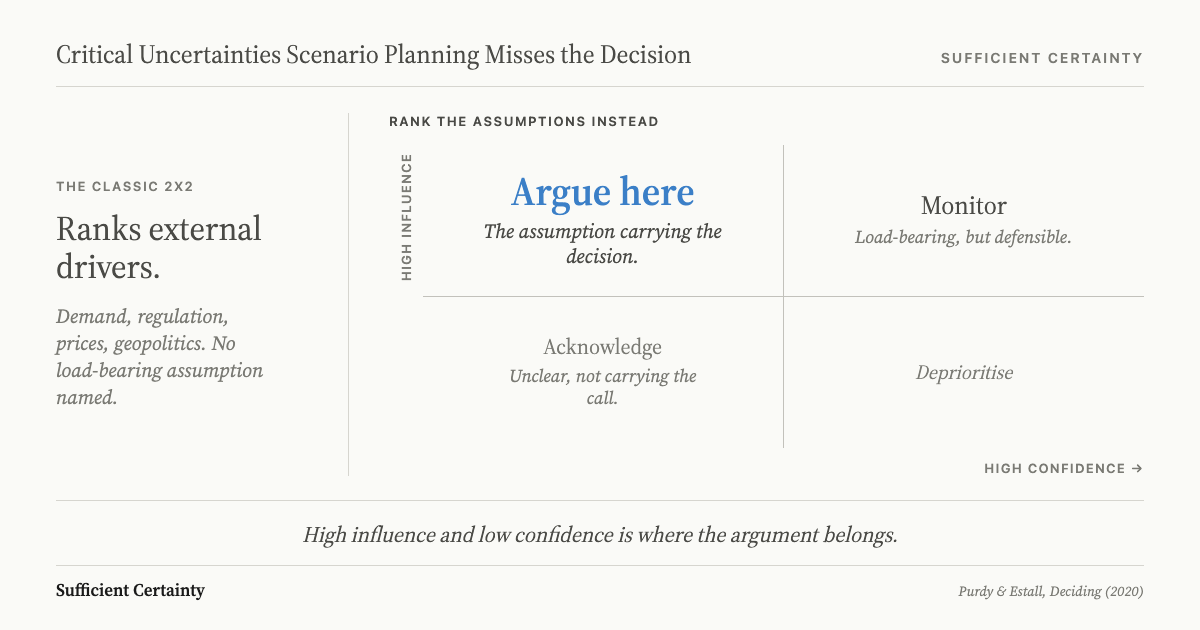
I still want the uncertainties surfaced. I just refuse to stop at the drivers. I translate each driver into an assumption inside the live decision, then judge that assumption on two blunt questions: how much influence does it have on the outcome I want, and how confident am I that it will hold?
That influence-confidence ranking, set out in Deciding, does more work than the classic 2x2 because it tells me where the real exposure sits. High influence and low confidence is the danger zone. That is where I want the board arguing. A volatile commodity price may dominate the workshop wall, yet the decision may actually turn on planning approval or a grid connection date. The matrix will not tell you that until someone does the harder translation. A facilitator once warned a client that inviting me meant losing the wall chart. He was right, though the client kept the decision.
Roger Estall and I built the method that way because bad decisions do not usually collapse under every uncertainty on the map. They give way where one or two weak assumptions were asked to do all the carrying. In my experience, that distinction becomes obvious the moment you look at real scenario planning examples rather than workshop folklore.
Critical uncertainties scenario planning only earns its keep with triggers
A 2x2 has no afterlife unless somebody writes down what will reopen the decision. That is what any serious guide to scenario planning ought to force into the open: the assumption carrying the choice and the trigger that forces review. If demand slips below the case or the law changes, who notices and what happens next? Without that, the quadrant sheet becomes an alibi, proof that a workshop happened, not proof that the decision can survive contact with events.
That is why I keep returning to monitoring. The polite scenario deck eventually meets the rude world, and somebody has to own the trigger when it does. The only output I trust from critical uncertainties scenario planning is a short list of assumptions with their significance made plain, plus a clear view of what gets watched after the decision is made. If nobody owns that watching, the exercise survives only as an excuse.
What to do with critical uncertainties after the workshop
The workshop ends. The matrix is photographed and sent round. Critical uncertainties sit on their axes and nobody comes back to them. I have watched this happen so many times that the photograph itself has become the warning sign. If the only output is a picture, the decision has already been abandoned to drift.
The practical next step is translation. Each axis endpoint on the matrix represents a future state. That future state rests on something the business is assuming today. The job after the workshop is to write those assumptions down in plain language. Not "geopolitical instability" or "technology disruption." Those are themes, not assumptions. An assumption sounds like this: we assume demand for this product will remain above 14,000 units per quarter through the contract period. That is testable. A theme is not.
I once sat through a debrief where the two axes were "pace of regulation" and "customer consolidation." Handsome labels. But when I asked what the organisation was actually assuming about regulation, the room went quiet. They had not translated the axis into a bet. The truth was simpler and more useful: we assume the current licensing regime will still apply when we commission the plant. Once that sentence existed, the conversation changed. People could argue about it instead of admiring the quadrant.
The method Roger Estall and I set out in Deciding treats this translation as the hinge. An uncertainty on a wall is decoration. An assumption written in a sentence is something a room can judge. That judgment has two parts: how much influence does this assumption have on the outcome we want, and how confident are we that it will hold? High influence and low confidence is where the argument belongs. Everything else can wait.
Once the assumptions are plain, each one needs three things. First, an owner. Not the team, not the steering committee, not "risk and compliance." One person whose job it is to watch whether the assumption still holds. Second, a monitoring signal. What observable evidence would tell the owner that conditions have shifted? If demand is the assumption, the signal might be order volume falling below a threshold for two consecutive months. If regulation is the assumption, the signal might be a consultation paper from the regulator. The point is to decide now what counts as news, not to wait until the news arrives and argue about whether it matters.
Third, a trigger point. This is the line that means "we are now in scenario B, not scenario A." It reopens the decision. Not a vague review clause buried in an appendix. A named condition that obliges the owner to bring the decision back to the Decider. Without it, monitoring is passive observation. With it, monitoring connects back to the decision the workshop was supposed to serve.
Most scenario planning tools stop at the matrix and call the job done. I have written separately about what to do after scenario planning when the workshop output needs to become a decision. That is convenient for facilitators and consultants, because a revisit clause means somebody has to do real work after the invoice is paid. But a matrix without assumptions, owners, and triggers is an intellectual exercise that the business forgets by Friday. The quadrant photograph goes into a shared drive. Nobody opens it again.
The test is simple. If I ask for the trigger list six weeks after the workshop, and nobody can produce it, the critical uncertainties were never critical to the business. They were critical to the workshop. Those are different things.
You could map four futures and still never name the assumption driving today's choice.
Work through your decisionNo sign-up. Just pick your decision and start.
Grant Purdy is the co-author, with Roger Estall, of Deciding (2020), and the architect of the Universal Decision-Making Method.