
Analysis paralysis examples are almost never described correctly. People call it overthinking. The real failure is that nobody defined what would count as enough. Every instructive case shares one pattern: review expanded because the process had no stopping condition and nobody was willing to impose one.
Analysis paralysis examples are everywhere, but they are almost never described correctly. People call it overthinking when the real failure is that nobody defined what would count as enough. The cases that teach something useful share one pattern: review expanded because the process had no stopping condition and no one was willing to impose one.
By December 2021 the Ajax armoured-vehicle program had spent GBP3.2 billion and was already 12 years from first approval. Crews were reporting serious noise and vibration problems. No vehicle had entered service. Review kept breeding review. If you want analysis paralysis examples, start there.
That is why the silly menu examples do nothing for me. The cases worth your time come wrapped in respectable process. Roger Estall and I wrote Deciding because we had seen too many organisations hide the missing decision under committee paper, risk language, and clever models. If you want the broader mechanism, read the broader case against analysis paralysis. If you want the practical exit, I set it out in how to overcome analysis paralysis. Here I want to stay with the cases, because the cases show what the apparatus costs when nobody interrupts it.
Analysis paralysis examples are cases where a decision stalls because extra investigation replaces a test of the key assumption.
Why these analysis paralysis examples belong in boardrooms
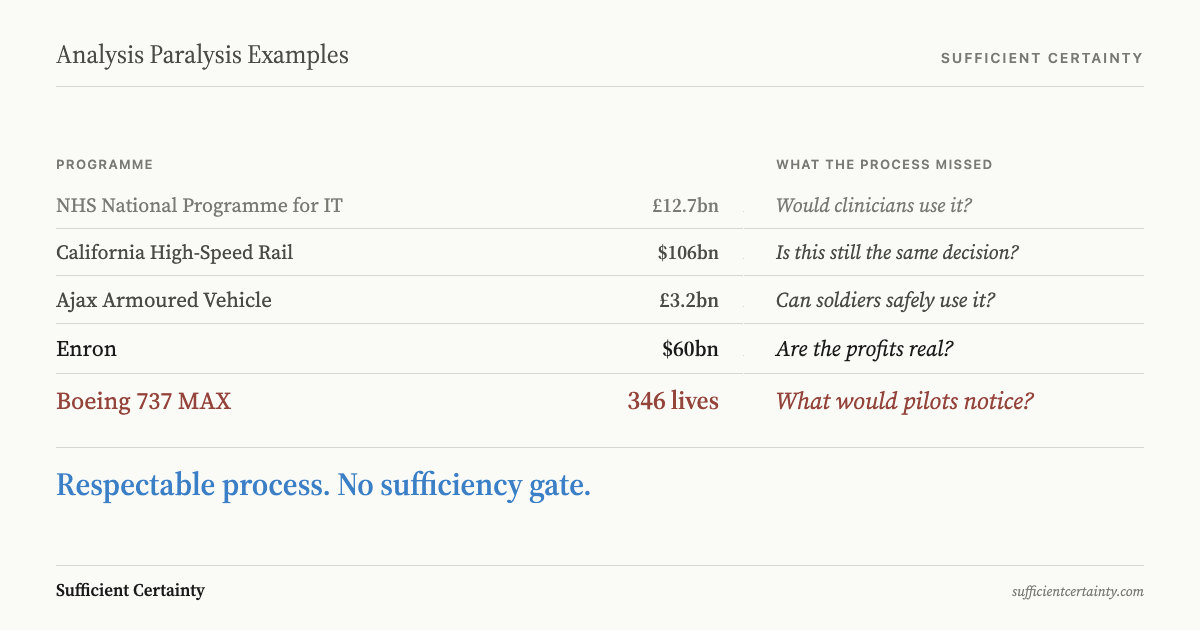
The United Kingdom's National Audit Office report on Ajax is useful because it shows the trick without needing much decoration. The program could keep looking governed while the only useful question remained unanswered: can soldiers safely use the thing? Ajax shows activity replacing judgement. The assumption being carried along was deployability, and once noise and vibration made that doubtful, the Decider needed a narrower call, not another layer of program comfort.
If noise and vibration prevent soldiers from operating the vehicle safely, the rest of the program furniture is decorative. Assurance reviews and senior oversight can both exist while the Decider has still not judged the assumption on which the outcome depends. I have seen that trick often. The room discusses everything around the decision because the decision itself has become too embarrassing to name. The paperwork is calmer than the verdict, which is why people who enjoy paperwork so often prefer it.
California high-speed rail has the same smell, with more zeros. The California State Auditor said flawed decision-making and poor contract management had produced billions in cost overruns and delays. The 2024 Business Plan put full Phase 1 at USD88.5 billion to USD127.9 billion and Merced to Bakersfield alone at USD29.8 billion to USD33.0 billion, with a Legislative Analyst's Office update later describing a roughly USD7 billion funding gap for completing that segment. A new plan is wonderfully convenient: it employs the planners and postpones the admission that the old decision no longer fits the money.
The decision being avoided was plain enough. Is this still the same decision voters, legislators, and program sponsors thought they were making, or has the scope changed so much that continuation is just a polite way of refusing to decide again? Program offices recognise this move very well. The larger the program becomes, the more livelihoods and reputations depend on treating continuation as prudence and cancellation as recklessness. That is not courage. It is institutional self-preservation wearing a hard hat.
Test the decision you keep reviewing against these cases and find the assumption respectable process is hiding. Start the Walk →
Boeing is an analysis paralysis example with a body count
Boeing is a brutal case because the organisation had certification artefacts in abundance. The U.S. House Committee's final report on the 737 MAX described repeated and serious failures by Boeing and the FAA. Two crashes killed 346 people. The documentation did not force a hard decision about the assumptions underneath MCAS, especially what pilots would notice, how quickly they would respond, and what a single sensor failure could set in motion.
The NTSB's safety recommendation report focused on assumptions used in the safety assessment process and on the combined effect of cockpit alerts and indications on pilot performance. That is exactly where I would have gone. A safety assessment that leaves pilot response as a tidy modelling input, rather than a live human assumption, is not protecting the decision. It is protecting the file. The process had enough forms to look respectable after the event. It did not have enough honesty to say that the assumption carrying MCAS involved human lives.
Enron treated complexity as reassurance
Enron had the same failure in financial dress. The Powers Report shows formal oversight wrapped around structures that were hiding debt and flattering earnings. A Senate investigation later said the board failed to safeguard shareholders and contributed to the collapse. By December 2001 the company was bankrupt. Calling Enron an ethics failure is true, but too comfortable. The more useful question is how so many clever people, paid to scrutinise complexity, managed to treat complexity itself as reassurance.
The board economics question was not exotic. Were the reported profits backed by real economic substance, or were special-purpose entities and related-party deals manufacturing confidence for public consumption? Complexity spreads responsibility very politely. A board pack can become a rented conscience if Deciders let the model, the adviser, or the clever structure do the judging. I have seen milder versions of this for years: the spreadsheet grows more elaborate as the commercial question becomes less welcome.
The NHS shows the public-sector version
The NHS National Program for IT is the public-sector version of the same habit. Centralisation is very attractive to people who prefer one enormous unresolved decision to several smaller accountable ones. Years of central contracting and review did not answer the smaller decision buried inside the giant one: what system should be built, for which clinicians, and what evidence existed that they would actually use it?
The National Audit Office said delivery of detailed care records was years late and the original vision was not being delivered. The Public Accounts Committee later described the program as dismantled. Those words sound administrative, which is part of the problem. The buried assumption was clinical adoption: which clinicians would change which workflows, and why would they trust the system enough to use it? Supplier capability and local workflow fit mattered too. These were not stakeholder-management chores to be swept up after contract signature. They were the decision.
Any Decider should watch for that pattern. Once a program gets large enough, managers defend the spend instead of narrowing the decision. I described the ordinary business version in analysis paralysis in business, where the same habit appears without a national IT budget attached. The scale can change without making the habit any less damaging.
What these cases have in common
Each case looked diligent from the outside. Testing and certification lent these programs confidence they had not earned. In each of these analysis paralysis examples, the live assumption stayed hidden while the machinery kept running. That is what happens when problem solving and decision making are never separated. The arrangement is comfortable for nearly everyone except the Decider: advisers get scope, and advocates get one more reason to say the decision is not quite ready. Meanwhile the assumption that matters remains untested in plain sight.
The test I apply is deliberately plain. What is this decision assuming, and do we know enough about that assumption to commit? Ajax and Boeing show the safety end of the problem: a decision can carry a weak assumption about human use while the file keeps looking serious. Enron shows the commercial version, where economic substance gets buried under clever structure. The longer public programs do it with scope, funding, and adoption. Those are not background matters. They are the decision itself.
The reason Roger and I keep coming back to the Universal Decision-Making Method is that it forces you to test for sufficient certainty early. If the answer is no, you do targeted work or you change the decision. These cases matter because they show the bill for refusing to ask that question while the answer was still cheap.
You could ask for one more review and keep the vehicle off the road.
Work through your decisionNo sign-up. Just pick your decision and start.
Grant Purdy is the co-author, with Roger Estall, of Deciding (2020), and the architect of the Universal Decision-Making Method.