
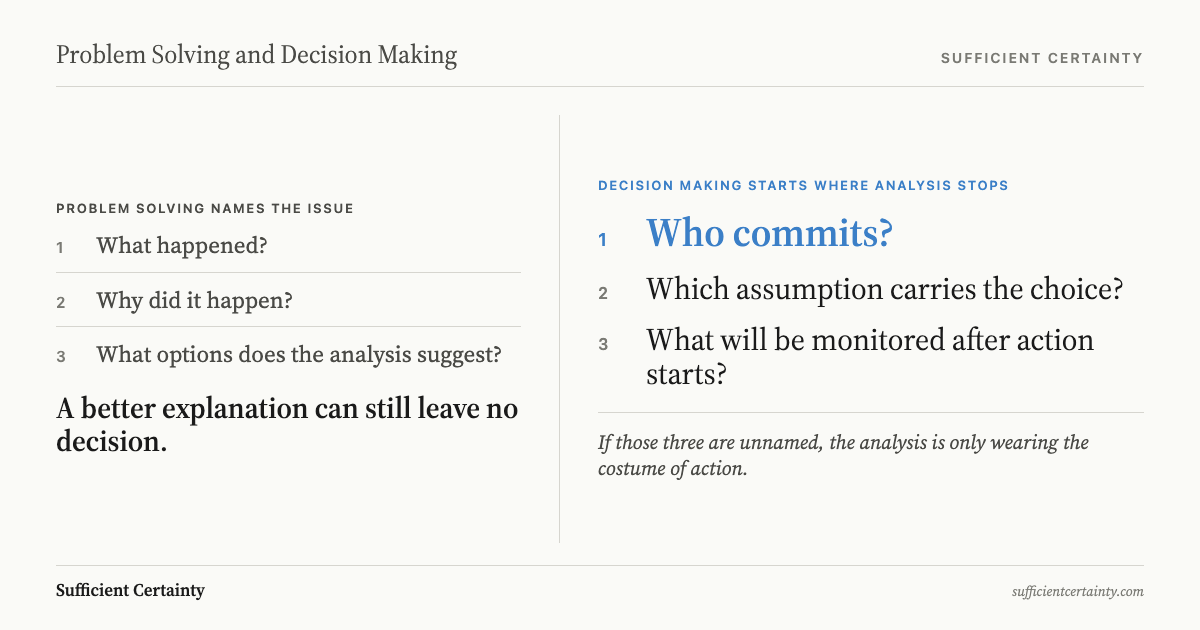
Problem solving and decision making look alike and fail differently. Problem solving identifies what is wrong. Decision making tests whether the proposed fix rests on assumptions strong enough to act on. Most teams solve problems all day and never make a decision because nobody checks the belief underneath the fix.
Problem solving and decision making are separate disciplines that most organisations conflate. Problem solving identifies what is wrong and generates options. Decision making selects which option to commit to and tests whether the assumptions beneath it are strong enough for the stakes. Conflating them lets teams analyse endlessly without anyone naming the commitment or the belief it rests on.
A hospital board paper I once saw spent 62 pages proving that something had gone wrong. The proposed action was buried near the end, where accountability often goes to hide. The room discussed the incident for 40 minutes and never named the decision. Nobody objected. The paper had done its real job: it made avoidance look thorough. That is the common failure in problem solving and decision making.
In the Universal Decision-Making Method, problem solving explains what is happening, while decision making commits a Decider to action once certainty is sufficient for the Purpose at stake. The distinction matters because analysis can be excellent and still leave the live decision untouched. Roger Estall and I wrote Deciding because too many organisations confuse the appearance of careful thought with the act of deciding.
Problem solving and decision making are separate disciplines: problem solving identifies what is wrong, while decision making tests whether the proposed fix rests on assumptions strong enough to act on.
Why problem solving and decision making get mashed together
The confusion is tempting, and David Jonassen is useful evidence of why. In Designing for Decision Making, he treated decision making as a common form of problem solving, especially where the problem is ill-structured. Ill-structured problems do contain decisions. That does not mean a solved problem is a decision, any more than a map is a journey. In real work, diagnosis, judgement and action sit close together. The useful distinction is whether someone has committed to action and named what that commitment rests on.
I have seen teams explain the cause and point to a preferred option. Then the meeting ends. Nobody has said what assumption carries the option or what would prove it wrong after the choice leaves the room. That is why committees enjoy problem solving. Explanation feels diligent and exposes nobody. Commitment does. The problem solving examples in the workplace that get studied share exactly this shape: a room full of analysis and nobody willing to name the bet.
Diagnosis is useful until it pretends to be the decision
I am not citing diagnostic-error figures to complain about diagnosis. Diagnosis is essential. The error begins when the diagnosis is treated as the end of the decision. The National Academies' Improving Diagnosis in Health Care report cited a conservative estimate that 5% of U.S. adults seeking outpatient care each year experience a diagnostic error. It also reported that diagnostic errors contribute to about 10% of patient deaths and 6% to 17% of hospital adverse events. That is what happens when an explanation is allowed to masquerade as a settled course of action.
A diagnosis explains what is likely happening. The next decision may be to treat now or test further. Each choice carries different consequences and different assumptions. If the assumption is that the initial diagnosis is right enough to act on, the Decider must know what would show otherwise.
The missing work is monitoring: deciding in advance what signal would tell the Decider that the diagnosis, treatment or waiting strategy no longer deserves confidence. Many organisations prefer to hold a review after the bad outcome, call it learning, and then send the next decision into the world with the same hidden assumptions. The world is rarely polite enough to hold still out of respect for the minutes.
Separate the diagnosis from the choice by walking one live issue through the point where assumptions start deciding. Start the Walk →
Where decision making begins
The Uber self-driving crash in Tempe on 18 March 2018 is usually filed as a technical failure. That filing is convenient. The automated driving system detected Elaine Herzberg 5.6 seconds before impact, according to the NTSB report, but it never accurately classified her as a pedestrian or predicted her path. Uber ATG had also deactivated the Volvo forward collision warning and automatic emergency braking systems without replacing their full capabilities.
That was not only a classification problem. It was a decision about testing on public roads and about how much rescue capacity the human operator really had. The live assumption was that a human could recover a suppressed braking system in time. This is the point where problem solving and decision making must be deliberately separated: the first explains the failure mode, the second accepts or rejects the exposure.
The phrase lets a room believe the technical explanation has carried the moral and organisational burden. It has not. The problem-solving work may explain why the system failed. The decision-making work asks who is being exposed while the organisation learns, and what must be true for that exposure to be tolerable. For the broader map, read the wider map of decision-making frameworks, but do not let any framework hide that question from the Decider.
The assumption is where the two jobs meet
The bridge between analysis and commitment is the assumption. Problem solving produces explanations and options. Decision making tests the assumptions that let one option deserve action. That is why Step 3 in the Universal Decision-Making Method is Recognise assumptions. If the assumption stays buried inside the analysis, the decision leaves the room carrying a belief nobody has had the courage to state.
The UK National Audit Office made the same point in public-sector terms in its 2025 report on governance and decision-making on mega-projects. It warned, in official language, that government can commit to budgets and timetables before it knows enough about what would make the project work. Less politely: the promise is made before the assumptions have been faced, and the public receives the invoice.
London 2012 worked better because Purpose and authority were strong enough to make uncertainty discussable across government and the delivery bodies. Purpose did not remove uncertainty. It made the uncertainty answerable to something. Without that, project planning becomes a hiding place for optimism. Consultants can sell the plan, officials can quote the timetable, and nobody has to say which assumption will break first.
This is also why I dislike process language that starts with an answer. The moment a room begins with the purchased answer, it has already begun to avoid the question. I have watched organisations buy a branded method or a board-ready dashboard when they needed a decision. The vendor gets a sale. The sponsor gets cover. The decision remains unmade, which is apparently tolerable so long as the cover page looks expensive. I walk into a room and ask what the project is assuming. The room finds a reason to adjourn. When the first brief also sets the wording, the framing effect has done its work before the question reaches the table.
I call it the substitution trick: buy the process, skip the decision. The trick works because nobody looks foolish when the framework has a logo. But a framework without an exposed assumption is decoration. The same failure shows up at the technique level: most problem solving techniques in business start after somebody has already accepted the frame, so they decorate rather than diagnose.
How to separate problem solving and decision making
I separate the work by asking two questions. First, what have we learned about the problem? Second, what decision does that learning now support? If the second answer is vague, the first answer is not yet useful enough. Analysis that cannot name the decision it serves has become paperwork.
The five steps are simple enough, which is why people underestimate them. Problem solving contributes most to Frame the decision and Develop options. The decision hardens when the room moves through Recognise assumptions and Sufficient certainty. It becomes responsible only at Design monitoring, when someone writes down what will be watched after action starts.
That is the practical test: if the work ends with a better explanation, it is not finished. If it ends with a choice but no named assumption, it is still evasive. If it ends with approval but no monitoring, it is pretending that implementation is a ceremony rather than contact with reality.
I would rather have a rough one-page decision that names its assumption than a 60-page analysis pack that lets everyone admire the problem from a safe distance. The rough page can be tested. The polished pack usually protects its authors.
You could diagnose everything in the paper and still leave the decision untouched.
Work through your decisionNo sign-up. Just pick your decision and start.
Grant Purdy is the co-author, with Roger Estall, of Deciding (2020), and the architect of the Universal Decision-Making Method.