
Overcoming decision paralysis does not require more willpower. It requires naming the one assumption the decision depends on and testing whether it holds. Paralysis persists because the process generates more analysis without a stopping condition. Insert a sufficiency test and the paralysis resolves itself.
Overcoming decision paralysis does not require more willpower. It requires naming the one assumption the decision depends on and testing whether it holds. Paralysis persists because the process generates more analysis without a stopping condition. Insert a sufficiency test and the paralysis resolves itself, because the team can see the point at which they know enough to act.
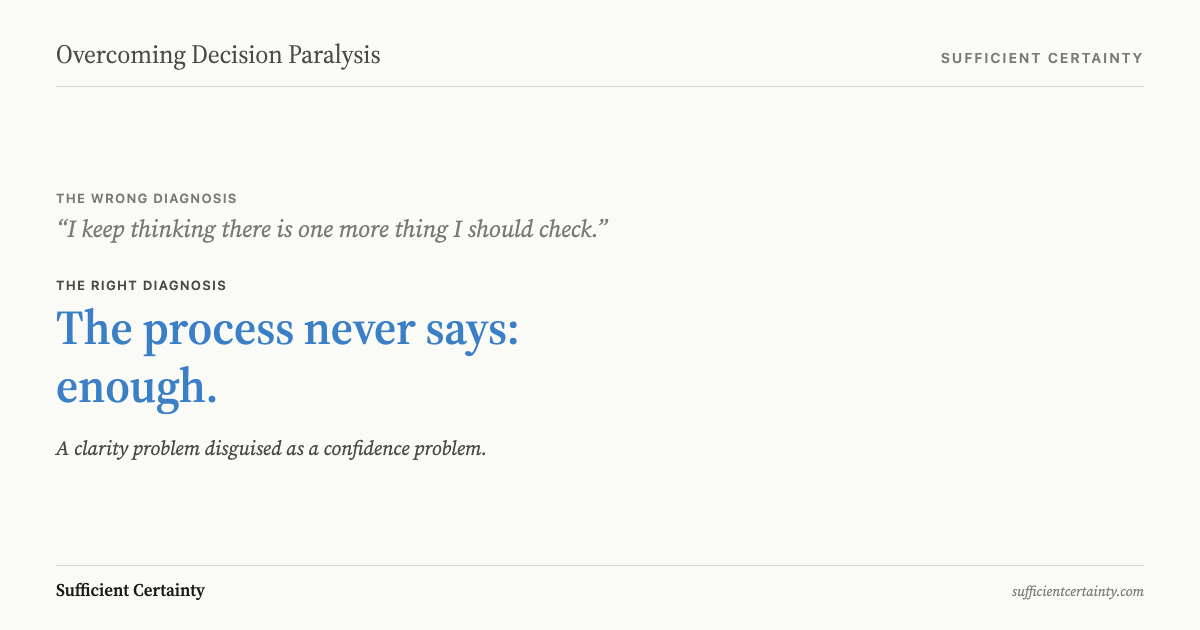
The people most prone to decision paralysis at work are almost always the conscientious ones. A senior manager I worked with had a restructure decision on her desk for three months. Two consultants had delivered reports. The working group had met four times. Her team had mapped consequences across three departments. She knew which option made sense. She could not make the call. "I keep thinking there is one more thing I should check," she told me.
Roger Estall and I call that test sufficient certainty: enough confidence for this decision, in this context, at this time. She had none of those anchors. So she kept checking.
Overcoming decision paralysis is the act of restoring movement to a stalled choice by defining what matters and who can close the call.
What decision paralysis actually is
The person paralyzed by indecision at work is rarely short of data. They are short of a sufficiency test. In 2023, researchers studied indecision among 20 senior decision-makers responsible across 19 countries in one complex organisation. They interviewed people who knew they needed to act and could not bring themselves to do it. The finding that mattered: organisational pressure and interpersonal dynamics produced the indecision, not personal weakness. The fear of making decisions was doing its job; the process was not. The consequences were real: delayed strategic initiatives and team demotivation that compounded over time. Hierarchical structures reward delay. Nobody gets fired for commissioning another report. Plenty get fired for a visible decision that went wrong.
That asymmetry is the governance apparatus working as designed. Reports and committees exist to demonstrate due diligence, not to produce decisions. Consultants are paid well to build those artefacts. Nobody pays a consultant to write one sentence: "You have enough information. Decide." The consulting industry does well out of this arrangement. The organisations paying the invoices, less so.
What decision paralysis costs
The cost of workplace indecision is a steady bleed in the performance data. Gartner surveyed 2,280 employees in 2023 and found that only 41 per cent were performing optimally. The cause was missing decision context, not missing effort. People given authority without clear framing spent their time on alignment and second-guessing. Give them autonomy plus decision context and optimal performance became 2.4 times more likely. Those without it contributed up to 25 per cent less value and were 14 per cent more likely to leave. That is a large number of people burning time on work the organisation's own governance system made necessary.
I have seen this in every organisation that asks for my help. A decision sits on someone's desk. The data is there. The governance system has no exit condition, so the person responsible keeps working, not because the work is needed, but because nobody has told her she can stop. The reports multiply and the decision stays unmade while the window for acting on it quietly closes. By the time someone finally makes the call, half the original options have expired. The organisation then commissions a review to understand why the decision took so long. That review, naturally, produces another report.
PMI confirmed this from the other direction. In 2025 they surveyed more than 3,000 project professionals globally. Only 18 per cent fell into the high business-acumen group: the people who could connect day-to-day calls to strategic purpose. Those 18 per cent met their goals at 83 per cent versus 78 per cent for everyone else, stayed on budget at 73 per cent versus 68 per cent, and failed less often. They also used more performance factors to judge success: 9.1 on average versus 6.3 for the rest. The difference was the ability to frame a decision by its Purpose and make the call. That ability is not taught in any risk-management certification I have encountered.
Walk your stalled restructure through the five steps and force the process to produce an exit instead of another loop. Start the Walk →
Five steps from paralysed to decided
Roger Estall and I built the Universal Decision-Making Method, published in Deciding, around one question: do I have sufficient certainty that this decision will achieve its Purpose?
The significant assumptions have been identified and either confirmed or accounted for. Nobody is asking you to predict the future. Pretending you can eliminate all uncertainty is what created the governance apparatus in the first place.
The method has five steps. Frame the decision: state the Purpose and the context. Develop options: not twenty options, two or three. Recognise assumptions: name them and assess which ones have real influence on the outcome. Sufficient certainty: look at the significant assumptions and ask whether you have enough confidence to proceed. Design monitoring: after you decide, specify what you will watch and what would trigger a course correction.
Step 1 is where the loop most often breaks. The senior manager I mentioned at the start had never written down the Purpose of her restructure. She had reports and meetings but no statement of what the restructure was meant to achieve. When she wrote it down, two of the three options fell away. The third was obvious. What she had called paralysis was a clarity problem disguised as a confidence problem.
If you reach Step 4 and the answer is "not yet," the method tells you what to do next. Obtain specific information about the assumptions blocking you, or choose a different option with fewer critical assumptions. Those responses are the exit ramp. You cannot "just analyse more" because the method does not permit open-ended inquiry. Each response is concrete and terminable.
If you are stuck on a decision right now, I can tell you that courage is not the missing ingredient. Start with Step 1. Write down the Purpose of the decision you are avoiding and name the outcome you want. What feels like paralysis is a missing exit condition. Once you have one, the decision follows.
You could keep checking and drag your next restructure through another round of decision paralysis.
Work through your decisionNo sign-up. Just pick your decision and start.
Grant Purdy is the co-author, with Roger Estall, of Deciding (2020), and the architect of the Universal Decision-Making Method.