
Organisations that try to avoid analysis paralysis by imposing deadlines usually create it instead. The deadline fires, the decision is not ready, and another round begins. The problem is not time. The problem is that nobody defined what would count as enough analysis before the work started.
Organisations that try to avoid analysis paralysis by imposing deadlines usually create it instead. The deadline fires, the decision is not ready, and another round begins. The problem is not time. The problem is that nobody defined what would count as enough analysis before the work started. Without a sufficiency test, more information always looks responsible.
A chief operating officer once put a 28-page option paper in front of me on a Monday morning, with minutes from two steering committees clipped to the back. A risk memo with twelve coloured boxes was waiting in her inbox.
By Tuesday she was meant to decide whether to move one production line before a tariff change bit into margins, yet six options were still alive and nobody had written down what would be watched after the move. Everyone in the building had been useful except the person who had to decide. That is how organisations try to avoid analysis paralysis and create it instead.
Most advice on decisiveness arrives after the room has already gone soft in the head. By the time people are telling one another to be bolder, the paper has been allowed to widen faster than the decision. Roger Estall and I wrote Deciding because we had seen this too often.
I cover the wider loop in the analysis paralysis overview, but the short version is that the paper widens because reviewers, advisers, and committee furniture all get to stay important when nobody writes the stopping rule. The Universal Decision-Making Method deals with the earlier moment, when somebody decides what goes into the paper and what will count as enough.
Avoiding analysis paralysis means giving a decision a clear purpose and a test for when you have enough to act, before analysis begins.
Avoid analysis paralysis by fixing the Purpose first
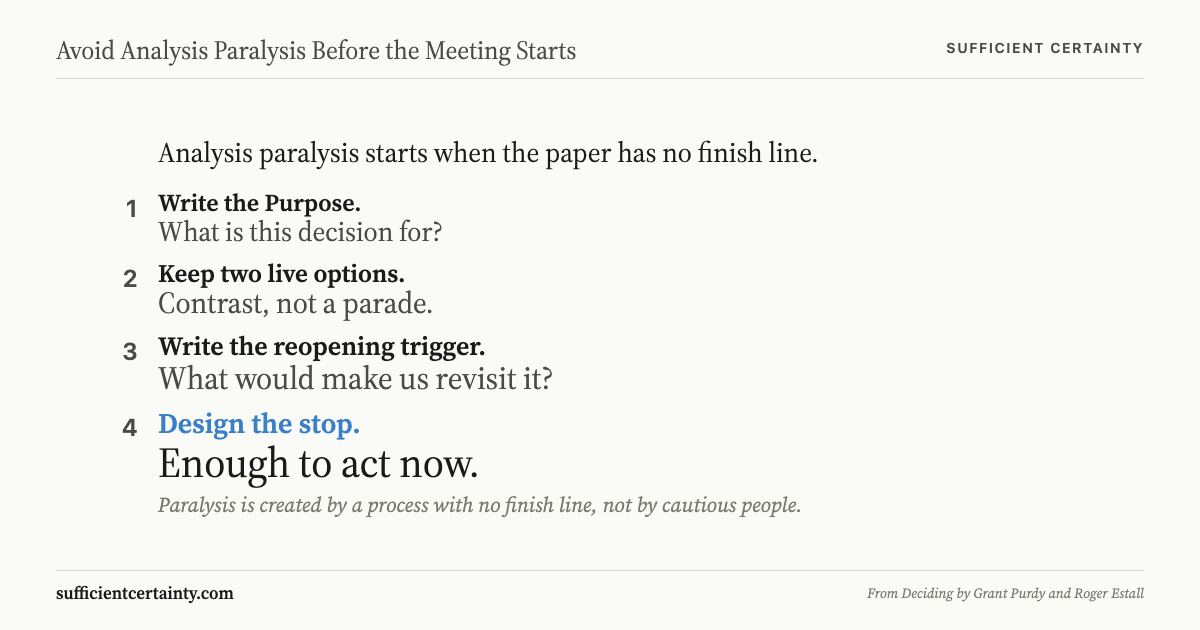
The first defence is plain. State what the decision is for before anybody starts decorating it. A study of 105 self-managing teams in the Dutch public sector found that goal clarity improved performance alongside self-management. I take the simpler lesson. When the aim is clear, people stop mistaking movement for progress, and before the meeting starts I can usually strike whole annexes that were only there to make the paper look industrious.
That chief operating officer was not deciding a supply-chain strategy. She was deciding whether one line had to move within eighteen months to protect margin on a specific product. Once she wrote that down, two options died immediately. They solved for prestige and geography, not margin. A third looked different only because it had prettier slides. I see that pattern constantly. Every interested party smuggles in a different question, and businesses freeze because nobody notices until the paper is too wide to read.
Before the first meeting I want the Purpose written down and a rule for what would justify keeping another option alive. That cuts paperwork at the source. Leave the Purpose mushy and competent people drift into arguments that have nothing to do with the call in front of them.
Cut your current decision to two real options and write the reopening rule before the meeting multiplies the noise. Start the Walk →
Two live options are usually enough
Once the Purpose is fixed, I usually keep two live options. A Cornell and Microsoft paper on shortlists found that cutting the live field improved judgement, which matches what I see in board papers. A decision needs contrast, not a parade of sponsored variants. Longlists survive because nobody wants to kill a patron’s favourite before the meeting, so six mild variations of the same idea stagger into the room and call themselves diligence. That is how choice overload gets manufactured in organisations that should know better, and by then the options are doing political work, not decision work.
Two is not a magic number. Sometimes three survive because they genuinely differ. The test is whether each option solves the Purpose in a different way. If two options differ only in timing or vendor, they are one option wearing a change of clothes and the room should say so. I have watched steering committees keep a weak third option alive for an hour because the person who sponsored it was senior. That is courtesy, not analysis, and courtesy does not improve decisions.
Avoid analysis paralysis by writing the reopening rule now
Most teams treat monitoring as admin to be bolted on after approval. That is backward. Monitoring is one reason a sensible person can commit without pretending uncertainty has vanished. A 2024 Nature Human Behaviour paper found that choices became more efficient and less conflicted when options were framed as less mutually exclusive. A written reopening rule does that in practice, which is why separate assurance functions often like monitoring left until after approval; the paperwork keeps flowing without reopening the decision that caused the trouble.
I ask for the trigger before the vote. What will make us revisit this? A cost blowout is too vague. A supplier miss on an agreed date may be concrete enough. So may a defect rate above an agreed threshold. Once the trigger is written, people stop demanding impossible certainty now for fear they will never get another chance to correct course. If the room has already frozen, I deal with the rescue version in how to overcome analysis paralysis, but the clean move is to Design monitoring before approval.
The Thames plan shows what prevention looks like
The best public example I found was the Environment Agency’s 2021 review of the Thames Estuary 2100 plan. What matters here is not the size of the program but the logic. The plan uses five-year assessments and ten-year full reviews, and the 2021 review says sea-level rise was accelerating quickly enough to bring some deadlines forward. That is how you avoid analysis paralysis when the forecast will never be perfect. They chose a pathway, wrote down when to look again, and moved when conditions changed.
This is flood protection on a scale that punishes fantasy. Nobody there gets to wave a thick briefing pack and hope the river has read it. They wrote the reopening logic into the decision, which is the point of Design monitoring in the method. In my experience, when that rule is absent, the room either freezes before the meeting or keeps defending yesterday’s decision after reality has changed, and other people pay for both mistakes.
You could carry six options into the meeting and leave with none tested.
Work through your decisionNo sign-up. Just pick your decision and start.
Grant Purdy is the co-author, with Roger Estall, of Deciding (2020), and the architect of the Universal Decision-Making Method.