
Choice overload is real, but cutting options is the wrong fix. The overload comes from missing criteria, not from the number of alternatives. When nobody has written down what the decision is for, every option looks plausible and every new criterion feels necessary. State the purpose first and the irrelevant options fall away.
Choice overload is real, but cutting options is the wrong fix. The overload comes from missing criteria, not from the number of choices. When nobody has written down what the decision is for, every option looks plausible and every new criterion feels necessary. State the purpose first and the irrelevant options fall away on their own.
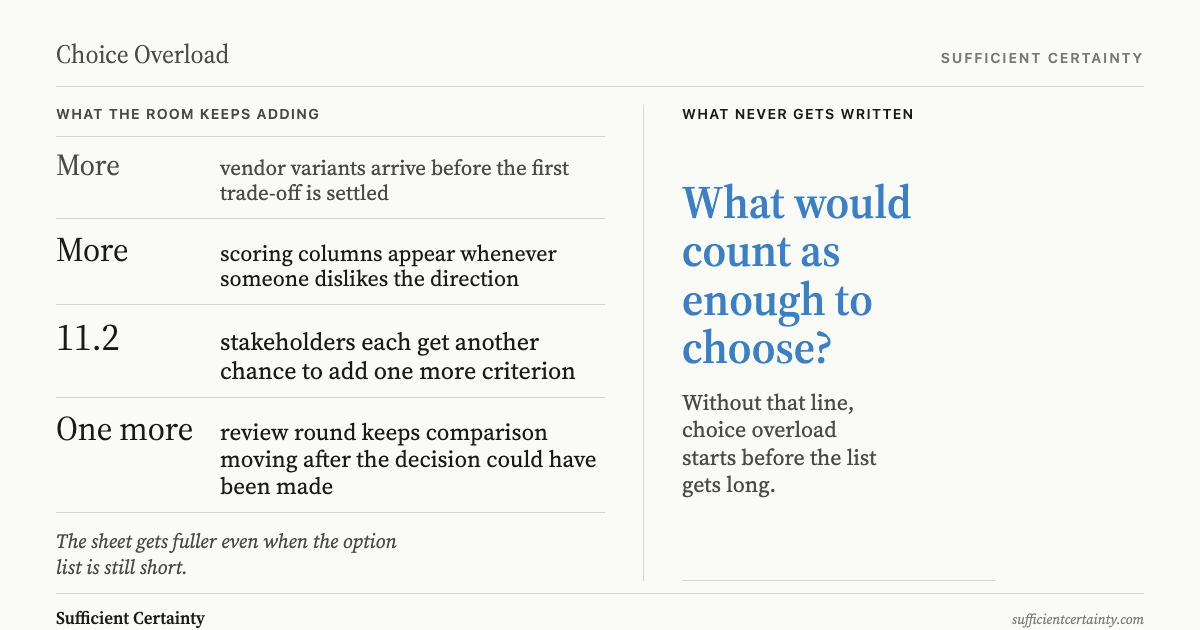
I have sat in procurement rooms with eight vendors on the paper and a scoring sheet already breeding extra columns. Every time someone disliked the direction, a new criterion appeared. By the time the paper reached the board, nobody could say what would count as enough to choose. That is choice overload.
Once a room has no finish line, every variant gets a hearing and every hearing breeds another criterion. I do not begin by cutting the list. I begin by asking what decision is being made today and what evidence would justify stopping. Without that, fewer options merely leave the same choice overload on a shorter sheet.
A live standard is not a magic formula. It is a plain statement of what would persuade the room to stop comparing and choose. Scoring criteria are not the same thing. A long list of criteria is often what people build when they cannot admit the standard is missing.
Choice overload is the paralysis that sets in when a team adds options or criteria without first defining what good enough looks like for this decision.
Choice overload appears under specific conditions
Benjamin Scheibehenne, Rainer Greifeneder and Peter Todd re-examined 63 effects from 50 experiments covering 5,036 participants. Their overall finding was close to zero. More options were not automatically worse. Overload showed up when options were hard to compare and people lacked settled preferences. That should have retired half the slide-deck trade, yet tidy myths about magic list length kept circulating, which is handy if your deck promised a neat answer.
In my experience, two options can be enough for choice overload if the criteria are mushy. Twenty can be manageable if the room has a live standard. Once that standard goes soft, extra information does not rescue judgement, it becomes data paralysis with nicer stationery.
Committees create these conditions in an afternoon. Every extra reviewer gets a chance to add one more criterion no one will later delete. I have watched a board settle seven options in half an hour because two assumptions carried the result, and spend weeks on three vendors because nobody would say which trade-off they were prepared to live with.
This is why I mistrust grand claims about how many options people can handle. The count is usually the least interesting fact in the room. The interesting fact is whether anyone can still say which difference matters.
The retirement and health-plan evidence shows where choice overload becomes real
In consequential decisions, the effect stops being academic. In retirement plans, Sheena Iyengar, Gur Huberman and Wei Jiang studied nearly 800,000 employees across 647 plans and found that every additional ten funds was associated with a 1.5 to 2.0 percentage-point fall in participation. In Medicare Part D, Florian Heiss, Daniel McFadden and Joachim Winter found that fewer than 10% of beneficiaries chose the cheapest plan available to them, and the average overspend was about $300 a year.
I do not read those results as proof that people are feeble. I read them as proof that menu designers can dump the burden of judgement onto the buyer and call the exercise choice. When one menu asks people to predict future use and downside at the same time, comparison becomes a substitute for choice.
Procurement papers do the same trick. They ask a sponsor to compare features and downside in one pass, then call the swollen pack support. That is why so much analysis paralysis in business arrives dressed as diligence while producing nothing anyone can sign.
Cut through your crowded options and decide what would actually count as enough. Start the Walk →
Organisations manufacture choice overload for themselves
The institutional evidence is almost comic. Administrators on HealthCare.gov had to start stopping insurers from flooding the menu with cosmetic variants. The Commonwealth Fund reported that the average number of plans more than quadrupled between 2019 and 2023. Seven state marketplaces capped non-standard plans. Nine required any new plan to be meaningfully different from what was already there. When a market needs referees to prevent fake variety, suppliers are padding the shelf.
Business buying does the same thing with stakeholders instead of product lines. Challenger's 2024 research covered 667 B2B buyers making purchases above $50,000. The average buying group had 11.2 stakeholders, 86% ran a formal RFP, and 38% of purchase attempts ended in no deal at all. Eleven point two stakeholders means 11.2 chances for someone to add one more criterion that nobody will later remove.
I see the same absurdity in RFP scoring. Legal adds protective wording. Finance adds a fresh scoring column. Nobody volunteers to delete anything, especially the people whose authority depends on another review round. A short list with a stopping rule ends the argument quickly. A swollen scoring regime can explain itself for weeks.
The machinery survives because it spreads blame and keeps respectable people occupied. That is marvellous news if your role begins after the decision should already have been made.
The sufficiency test is what stops choice overload
This stops when the room uses a sufficiency test instead of a tidying exercise. In the Universal Decision-Making Method, I Frame the decision. Then I Recognise assumptions and judge Sufficient certainty before I let a scoring sheet pretend it has done the thinking. I set out the working sequence in how to overcome analysis paralysis, because once the live assumptions are named, decorative variants usually die very quickly.
I often write one question in the margin of an options paper: what would have to be true for this option to deserve approval today? Rooms dislike the question because it kills decorative criteria, which is precisely why I ask it. Decorative criteria are where respectable delay goes to hide.
Roger Estall and I wrote Deciding after years of watching exhaustive comparison pass for sound judgement. A procurement head once told me, "Grant Purdy has ruined scoring matrices for me." He meant that I kept asking which assumption the matrix was supposed to settle. I took it as progress. A scoring sheet can sort paperwork. It cannot own a decision.
Once a group states what outcome matters and what uncertainty still matters enough to test, half the menu usually turns out to be scenery. The remaining choice may still be hard, yet at least the room is deciding rather than comparing for sport. Somebody then has to Design monitoring, because if nobody writes down what would reopen the call, the next paper will start the same farce again. The wider pattern sits in the analysis paralysis picture.
You could add one more criterion and leave the room unable to choose.
Work through your decisionNo sign-up. Just pick your decision and start.
Grant Purdy is the co-author, with Roger Estall, of Deciding (2020), and the architect of the Universal Decision-Making Method.