
Business ethics and decision making survive scrutiny only when someone is named on the decision and the reasoning is written down. A values policy on the intranet cannot defend a call under review. The record of who decided, on what grounds, and what they assumed is the only document that holds.
I once sat with an executive team whose code of conduct was current and whose speak-up channel had been tested. The incident review was 38 pages, which seemed to comfort everyone until it was asked to do actual work. When I asked for the record of the business ethics and decision making behind the call now being challenged, the comfort left the room. They had proof that ethics had been administered. They had no proof that ethics had constrained the call.
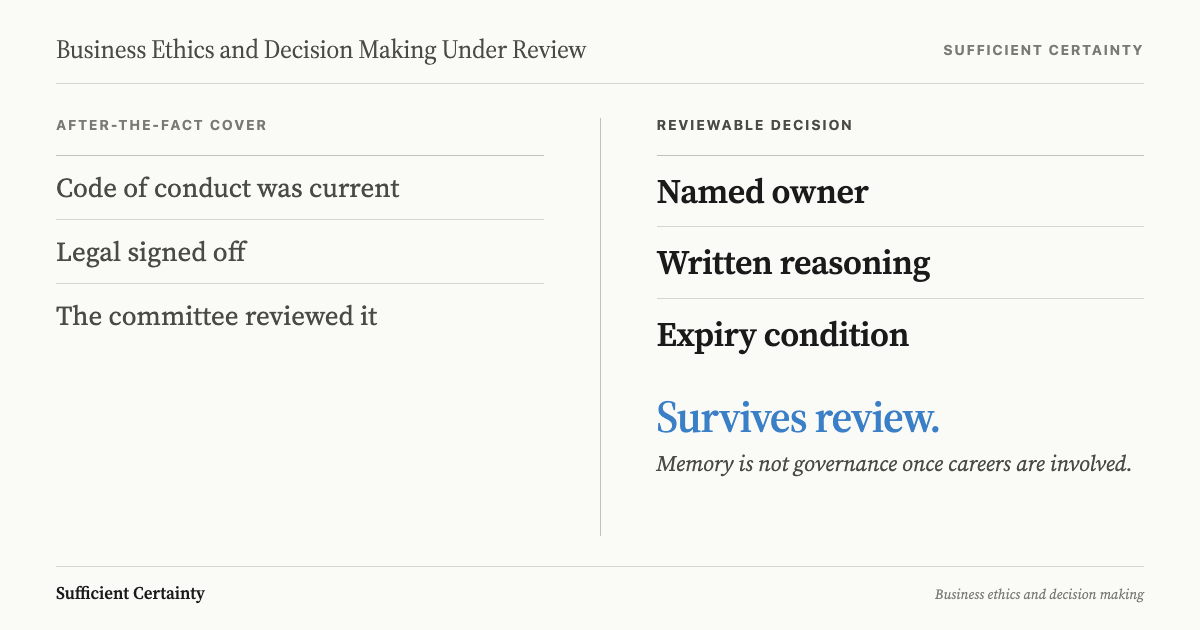
That distinction matters when the question comes from a regulator or a harmed customer. People remember feeling uneasy. Someone says legal signed off. Someone else says the matter went to committee. None of that is a record. It is memory dressed as governance, and memory becomes impressively vague once careers are involved.
Business ethics and decision making is the practice of making commercial choices by naming who owns the call, who may be affected, and why the chosen action remains acceptable.
Business ethics and decision making fail when no one owns the call
The first ethical weakness I usually find is diffusion: consultation gets mistaken for accountability. Everyone has been asked, everyone has nodded, and the organisation later treats attendance as responsibility. This is convenient for the people who wanted the decision without wanting the fingerprints.
The APRA Prudential Inquiry into the Commonwealth Bank of Australia is useful because it was not a story about a firm lacking governance paraphernalia. APRA described a large, successful institution whose success had, in its phrase, "dulled the senses". The $1 billion capital add-on was severe, but the more interesting failure was softer: weak ownership of non-financial risk and poor challenge. The sales machine and the executives reading green reports both benefited from calling customer harm a non-financial risk.
In the Decider sense, ethics becomes practical only when a person with authority owns the choice and its outcome. Advisers can challenge and test the call. The decision still needs an accountable human being. If the answer to "who decided?" is the name of a forum, the organisation has built a hiding place.
That is why ethical business choices need more than a values statement. They need the moral boundary attached to a live decision, with the person approving it unable to melt into the machinery. Committees are very good at receiving comfort. They are less good at being cross-examined.
Codes of conduct do not decide under pressure
A code is useful only if the real decision path forces it into the room before pressure has settled the answer. Otherwise it becomes the noblest document in the filing system (a crowded field).
The Federal Reserve's 2018 enforcement action against Wells Fargo followed the fake-accounts scandal and related consumer harm. The growth cap was severe. The board letter was more instructive: oversight had relied too much on reporting that offered comfort without enough concrete action plans or metrics. This was not a vocabulary failure. The sales target had more authority than the ethics code, which is the usual arrangement until the penalty arrives.
I have never met a large organisation that lacked values language. I have met many that let the incentive plan do the actual ethical work. Once pay and status point one way, a laminated statement of principles has the moral force of office furniture.
If the sales-target decision had been written honestly, the awkward assumption would have appeared early: staff would somehow chase aggressive numbers without creating accounts customers had not asked for. That is not an ethics-training problem. It is a decision problem with a moral cost hidden inside the commercial case.
Compliance can prove the file was blessed. It cannot prove the call was decent. That is why governance cannot be reduced to compliance, although many people keep trying because compliance leaves better audit trails and fewer awkward conversations. The useful artefact is the decision record: what was assumed and what fact would have made approval indefensible.
Name the person who owns your ethical call and record the threshold that turns legal permission into a decision to stop. Start the Walk →
Legal permission is often the wrong threshold
The most dangerous ethical decisions are often lawful. Legal advice is most popular when it lets the people gaining from the decision pretend the moral question has been outsourced. I have seen that move made politely enough to pass as prudence.
Rio Tinto's board review after the destruction of the Juukan rockshelters made the point brutally. The company had legal authority to proceed. The review still found that decisions and omissions over time produced an outcome inconsistent with the company's standards and values. That is the whole scandal: the timetable could keep moving because the people who wanted the blast could treat permission as judgement.
In these choices, law is a starting constraint. Treating it as a moral laundromat is how polite wrongdoing survives. If the assumption is that affected people have been properly heard, the record should show why that belief was sound. If the assumption fails, approval should not keep rolling forward because the file still looks tidy.
I cover the wider board machinery in the full guide to organisational governance, but the ethics point is narrower. Ethics earns nothing by appearing after the blast. By then it is a caption for the apology, usually written by people who were nowhere near the decision.
The record is where business ethics and decision making become real
The test of an ethical decision is whether the reasoning can be examined later by someone who was not in the room and has no reason to be kind. Sincerity is cheap and, in my experience, generously distributed.
That is why I keep coming back to the decision record. If the record cannot say who carried the moral cost and what condition would have made the justification expire, the thing on the file is a souvenir.
When Roger Estall and I wrote Deciding, I was not trying to give ethics another annex. I wanted the live decision dragged into daylight before the room could hide behind better words. The Universal Decision-Making Method starts by making the decision itself clear. If the decision is "improve customer outcomes", nobody is accountable. If the decision is "approve this incentive design for this channel from this date", the ethical question has somewhere to attach.
The next move is to Recognise assumptions. In ethical decisions, the dangerous assumptions are often the polite ones, such as customers understanding the change or staff not gaming the target. Those assumptions stay polite because impolite versions would embarrass the sponsor or threaten the bonus. I prefer them written where the Decider has to look at them.
Sufficient certainty is the point at which the Decider knows enough to act, while admitting what is still unknown. If a board cannot say why it knew enough to act, the policy did not give it courage. It gave it cover.
Ethical decisions need expiry conditions
Approval does not finish an ethical decision; the call remains defensible only while the facts that justified it remain true. Many organisations fail here because approval is treated as the finish line and monitoring arrives later (with the calm expression of an auditor who missed the interesting part).
Hino Motors is a blunt manufacturing example. The U.S. Department of Justice said in 2025 that Hino admitted to a long-running conspiracy involving false engine-certification data and non-conforming engines. The court imposed a $521.76 million criminal fine, a $1.087 billion forfeiture judgment, and five years of probation. Read as misconduct it looks like a culture problem, and culture problems belong to nobody. Read as a decision it is sharper: every batch reached a release point where someone could certify or halt, and the record shows which way that call went each time. The lesson is smaller and nastier than the numbers. Shipment had become easier than stopping.
A real certification record would name the Decider and state the condition that made release indefensible. I would want the required confidence in the test data on the same page, not hiding in a lab folder discovered after sentencing. Evidence that should stop the line has to be given authority before the line is profitable.
This is the point of Design monitoring. The Decider checks whether implementation has drifted from the decision and whether new evidence has destroyed the basis for continuing. The ethical question becomes useful at that moment, when a decision can be stopped before the apology committee is formed.
An ethics framework that cannot stop a shipment or a sale is a brochure. One plain page with authority to halt the work is worth more than a handsome framework that survives every failure it failed to prevent.
You could sign off on the call today and stand alone defending it later.
Work through your decisionNo sign-up. Just pick your decision and start.
Grant Purdy is the co-author, with Roger Estall, of Deciding (2020), and the architect of the Universal Decision-Making Method.