
On February 1, 2003, Columbia broke apart over Texas and seven astronauts died. The board did not throw the foam. Engineers and managers made a string of smaller calls long before the launch, and those calls shaped what senior leaders believed. What is a decider? In my experience, it is anyone in that chain whose judgment changes what the next person thinks is safe.
I call this out because organisation charts flatter the people at the top and hide the people loading the real assumptions into the machine. If you are working through the overview of decision-making frameworks, keep that in view. In practice, the hidden decision-maker is usually the person who can quietly turn an uncertainty into an inherited premise.
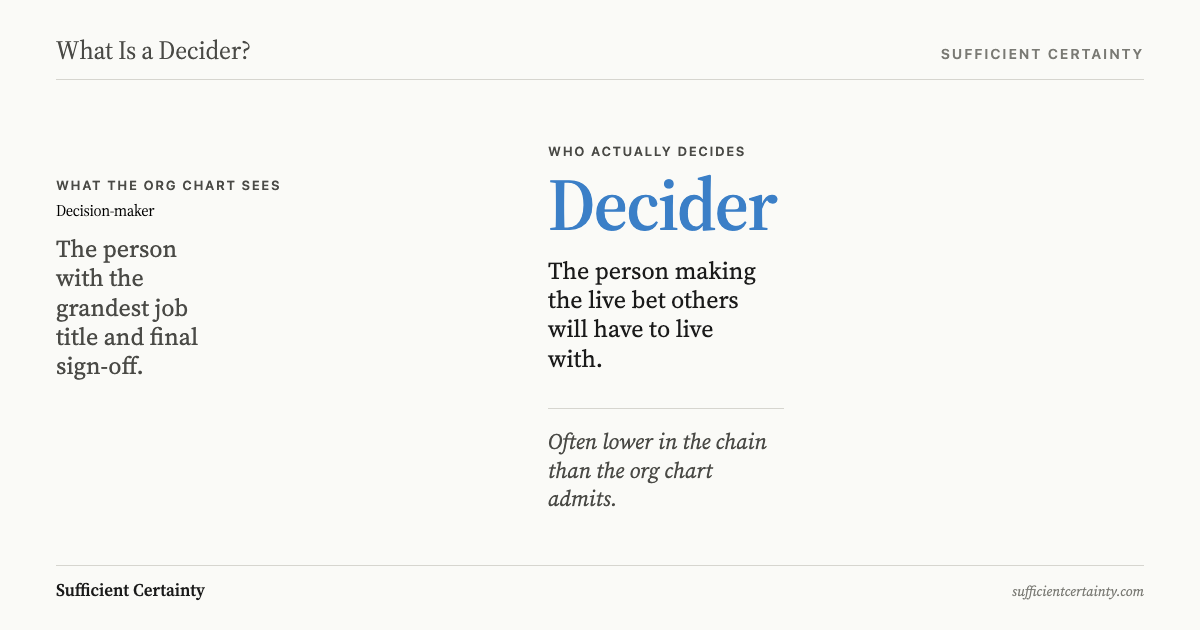
Decision-makers are the people whose judgments set direction, constrain options, or load assumptions that others must later live with.
Why the real Decider sits below the org chart
The Columbia Accident Investigation Board report described a culture in which foam shedding came to be treated as acceptable rather than alarming. Read it and you can watch the chain form: engineers reinterpret the anomaly as acceptable, and by the time senior leaders see it the story is cleaner than reality deserved. I have watched boards do the same with safer stationery.
I distrust the lone-decision-maker mythology. The final signature matters, of course, but the earlier judgment about what to escalate matters just as much. The engineer who says acceptable and the manager who lets the exception pass are both making live bets for the organisation. Call only the chief executive a Decider and you will train the least exposed person in the chain while leaving the more exposed ones to improvise.
What a Decider actually does
The job is less glamorous than leadership books suggest. It is to expose the assumption being handed upward or outward, then test whether it deserves to travel. That is the discipline behind the Universal Decision-Making Method. I do not care whether the person is in gumboots or polished shoes. If the person is loading the next stage of the organisation with an untested belief, the exposure is real.
The WHO Ebola Interim Assessment Panel is painful reading for exactly this reason. The panel said the organisation suffered from slow understanding and too little open, critical dialogue, and it records that the Public Health Emergency of International Concern was not declared until 8 August 2014. I read that as a chain of Deciders protecting assumptions about the outbreak and about how long there was to wait. Prestige did not save them from that. Prestige rarely does.
Committees adore this arrangement because delay looks prudent and spreads blame nicely. Training vendors adore it too, because they can sell another course on communication while the live skill, deciding, stays oddly unmentioned. I have seen this dodge in public bodies and in private ones. It keeps the paperwork modern and the judgment medieval.
Find the person carrying your live decision through the five steps and make the real Decider visible before governance blurs them. Start the Walk →
When governance hides the decision
The Boeing 737 MAX case shows the same defect wearing an engineering badge. The FAA's Joint Authorities Technical Review said Boeing made several assumptions that directly influenced the design and certification of MCAS, including the assumption that MAX pilots would already be experienced 737 NG pilots. It also said visibility of those assumptions was lost through the development assurance process. That sentence should frighten any board more than a red box on a dashboard. Once assumptions disappear inside process, nobody knows which person is really deciding anymore.
When people say I am hard on process, I tell them I am hard on concealment. A process that hides the live assumption is not neutral. It protects the committee chair and the consultant who sells reassurance around the paperwork. Compliance people do not mind it either. A fine arrangement for everyone except the person who carries the loss when the assumption fails.
I see this every time an executive arrives with heat maps and risk registers and still cannot state what the preferred answer depends on. The room may be busy. That does not mean it has decided. If a difficult choice is being smothered under a commissioned study, start with the person who commissioned it. Too often the $80,000 consultant report is not there to help the decision. It is there to make ownership harder to pin down.
The Wivenhoe Dam case in Queensland makes the same point in gumboots. The Queensland Floods Commission of Inquiry devoted an entire chapter to the operation of Wivenhoe and Somerset dams because a manual and a role chart still left human judgment exposed when the water arrived. I have never seen a procedure take the witness stand. People decide, then paperwork gets blamed or praised after the fact.
I have never met an organisation that lacked people willing to decide. I have met plenty that hid those people behind approval chains and called it governance. If the shelf also holds an ethical decision making model nobody applies to the live call, the disguise is complete. That habit suits senior titles because it preserves the fiction that control sits neatly at the top. Regulators do not mind it either, because a chart is easier to inspect than a judgment. The person making the next live call is left with the exposure and almost none of the language.
How to find the Decider in your organisation
If you still ask what is a decider, start with the person whose assumption other people are being forced to live with. Sometimes that is the chief executive. Sometimes it is the operator on a wet Tuesday with a forecast in one hand and a manual in the other. Roger and I wrote Deciding because I grew tired of watching organisations train the visible authorities and neglect the people actually loading the decision.
I have spent nearly fifty years watching the same trick. The board gets dashboards. The front line gets procedures. Everyone is told the system is rigorous. Often it is only ornate. Whether the organisation can think strategically at the leadership level depends on that wiring, not on the talent in the room. If you want accountability in leadership that works, train the person making the live bet and make the assumption visible before it can hide inside a workflow. More apparatus is the usual excuse for not doing that, especially from people paid to maintain the apparatus.
You could leave the hidden decider unnamed and trust the next assumption anyway.
Work through your decisionNo sign-up. Just pick your decision and start.
Grant Purdy is the co-author, with Roger Estall, of Deciding (2020), and the architect of the Universal Decision-Making Method.