
A decision record that skips the reasoning is a filing exercise. Most templates record the conclusion, the date, and the approver. Not one asks what assumption the commitment rested on or what change in conditions should trigger a review. That missing section is the only part that matters.
A managing director I worked with last year was deciding whether to pull his firm out of its only European market. He had a consultant's report and a financial model. Somewhere along the way, someone told him to document the decision properly. He searched for a decision record template. What came back was a set of Architecture Decision Record formats for software engineers and a project management spreadsheet with columns for date, owner, and status. Neither had anything to do with the bet he was about to make.
The term has been captured almost entirely by software teams. Michael Nygard proposed the Architecture Decision Record in 2011: a short document per significant design choice, stored alongside the code. ThoughtWorks adopted the pattern by 2017. It works for software because a wrong architecture decision gets replaced next sprint; the cost of reversal is low and the evidence is sitting in the repository. A business decision about whether to exit a market or restructure a division is not reversible on that schedule, and the people who made it may not be around when the consequences arrive. The assumptions shift, sometimes overnight, and nobody tracks whether they still hold. On the project-management side, templates record conclusions and keep people informed, but never ask what the choice depends on or when someone should check. That is the gap decision coaching exists to close.
A decision record is a written account of one consequential choice: the reasoning behind it, the assumptions it depends on, and the conditions that would reopen it.
What most decision records contain
The templates filling the search results share a shape. They record the conclusion and the participants. Atlassian's DACI template assigns governance roles and prompts for options considered, a due date, and an outcome. Project management decision logs add a date stamp and sometimes a "why" column. I have reviewed dozens of these across industries that should know better. They are built for coordination, which is convenient for the industry that sells coordination workshops and role-assignment frameworks. The "why" column, when anyone fills it in at all, captures a sentence of justification, not the assumptions the justification rests on.
The layer that is always missing
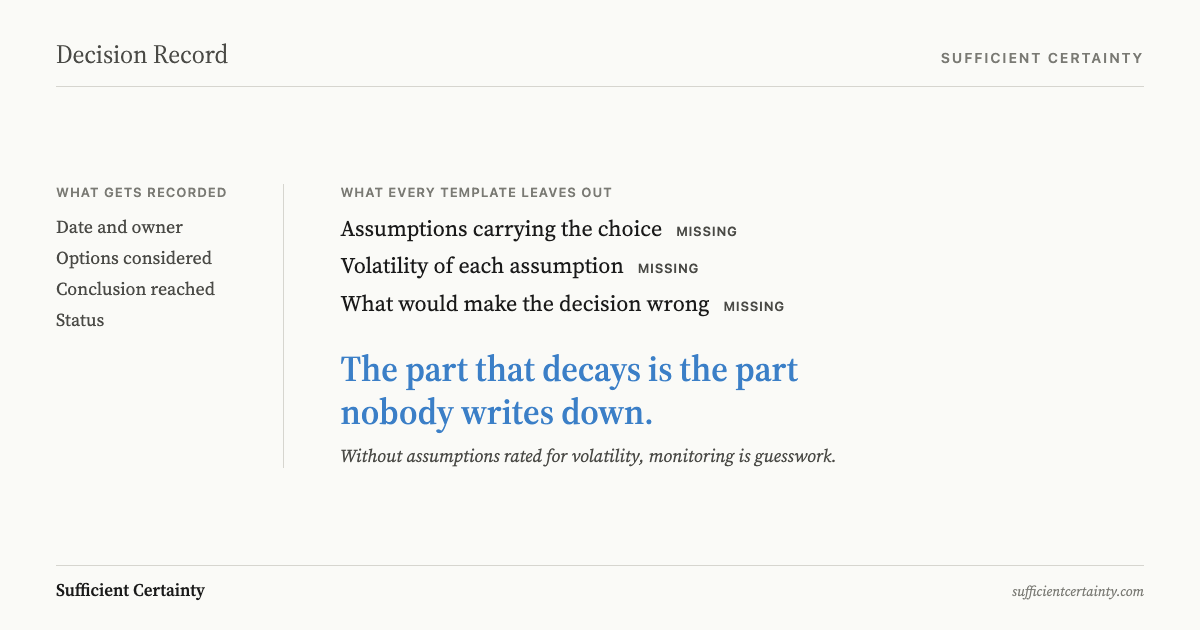
Roger Estall and I spent years watching organisations make consequential choices and keep almost no usable trace of the reasoning. They had plenty of process but no discipline for recording what the decision depended on. Risk registers and heat maps were in place; the actual assumptions behind the bets were not. In Deciding, we put it plainly: recording the assumptions as well as the decision itself allows monitoring for any subsequent change in the circumstances on which the assumptions are based. If the record does not name those assumptions and say something about how volatile they are, monitoring is guesswork.
Oregon's health benefit exchange cost US$248 million and never launched a functional website. The audit found the project's decision log had nine entries. Nine. Each was a one-line conclusion, no reasoning, no assumptions. Not because nobody made decisions, but because nobody thought the reasoning behind them was worth preserving. A decision record with nine entries across a program of that scale is a filing exercise that existed so someone could say documentation was in place.
The PMI's own advice on defending decisions argues that scrutiny arrives later, after people have forgotten the rationale. Their fix is a searchable journal. PMI sells certification and methodology, so their answer is predictably another methodology artefact: it preserves memory but never rates the fragility of the reasoning, which is the only thing that makes monitoring possible instead of ceremonial. That gap is most expensive in ethical decisions, where the question asked later is not what was filed but who was willing to own the call.
Write the decision you are about to make as a record that captures what would reopen it later. Start the Walk →
What a decision record should carry
In the Universal Decision-Making Method, every important assumption gets a view on volatility: how likely is it to change, and would we see the shift coming? That distinction matters because not all assumptions fail loudly. Some erode quietly, and by the time anyone notices, the cost is sunk. The method does not require elaborate scoring or a risk matrix. It requires asking two questions of each critical assumption and writing the answers down where the next person can find them. The record should capture the choice, the context at the time, and the assumptions the reasoning depends on. It should state plainly what would make the choice wrong, in terms specific enough to monitor. Written that way, it also does the work of making a decision transparent at work, because the people who must act on it can see what it rested on.
The managing director I mentioned earlier ended up with a single page. It named the decision and the two assumptions the exit hinged on: that the European operation's losses would continue at the current rate, and that the regulatory environment in that market would not shift before the exit completed. Under each assumption, a single line stated what would make it false. Six months later, the regulatory environment shifted in a direction nobody had predicted. Because the record named that assumption explicitly, he caught the change while the exit could still be paused. That is what a decision record is for.
Why the record matters later
At the moment of deciding, the reasoning feels obvious. Everyone in the room knows the context. Nobody can imagine forgetting it. A year later the context has faded and the people may be different. New leadership inherits the decision without inheriting the reasoning. The board wants to know why the firm left that market, and the only trace is a slide deck with "Approved" stamped on the cover. The decision coaching process produces a record that outlives the meeting: one with enough structure that anyone opening it months later can check whether the conditions behind it still hold. Without that structure, the document sits in a shared drive, useful only as proof that someone once held a meeting. It is also the difference between reading a decision out and reconstructing one in front of the people it affects. The record deals with a decision already taken, which is why the harder work happens earlier, when you still have to test the case being put to you.
When a consultant hands over a report, the reasoning lives in the consultant's head and the client's memory. When a consequential call gets proper treatment, the reasoning lives in a written record with assumptions rated for volatility and monitoring triggers attached.
You could save the next template and still forget what would reopen the decision.
Work through your decisionNo sign-up. Just pick your decision and start.
Grant Purdy is the co-author, with Roger Estall, of Deciding (2020), and the architect of the Universal Decision-Making Method.