
Can AI make decisions? No, and better models will not change the answer. A decision is a commitment to act, made by a person who will own the outcome. AI processes information in support of that commitment; it cannot make the commitment itself. The limitation is not technical. It is structural.
The question "can AI make decisions" gets the hard part wrong. Processing information is what AI does well; it is also the part of deciding that was never difficult. The difficult part is determining whether you are solving the right problem and whether the assumptions you are about to act on have been tested. Those are acts of judgment. Judgment requires a person who will bear the consequences of getting it wrong, and no model, however capable, bears consequences.
AI decision making is the application of artificial intelligence to support human judgment in consequential choices, not to replace it. The decision remains with the person who owns the outcome; the tool processes information in service of that person's thinking.
What Happens When AI Gets Promoted to Decision-Maker
In 2014, Amazon engineers in Edinburgh built an AI system to score incoming resumes. The system trained on ten years of previous hires and was designed to assist recruiters by flagging the strongest applicants. Because the historical hiring pool was overwhelmingly male, reflecting the broader technology industry, the system learned that male-associated signals predicted success. Resumes containing the word "women's" were penalised; graduates of all-women's colleges were systematically downgraded.
The critical assumption embedded in the training data, that a decade of predominantly male hires represented the best candidates, was never stated and never tested. Nobody asked whether the pattern the system had learned was a pattern worth reinforcing.
Amazon detected the bias as early as 2015 and concluded the system could not be guaranteed to avoid finding new proxies for gender. The project was abandoned by 2017. That is what happens when an assumption inside a tool goes unexamined: the tool faithfully reproduces the assumption at industrial scale, and the organisation discovers the problem only after the damage is done.
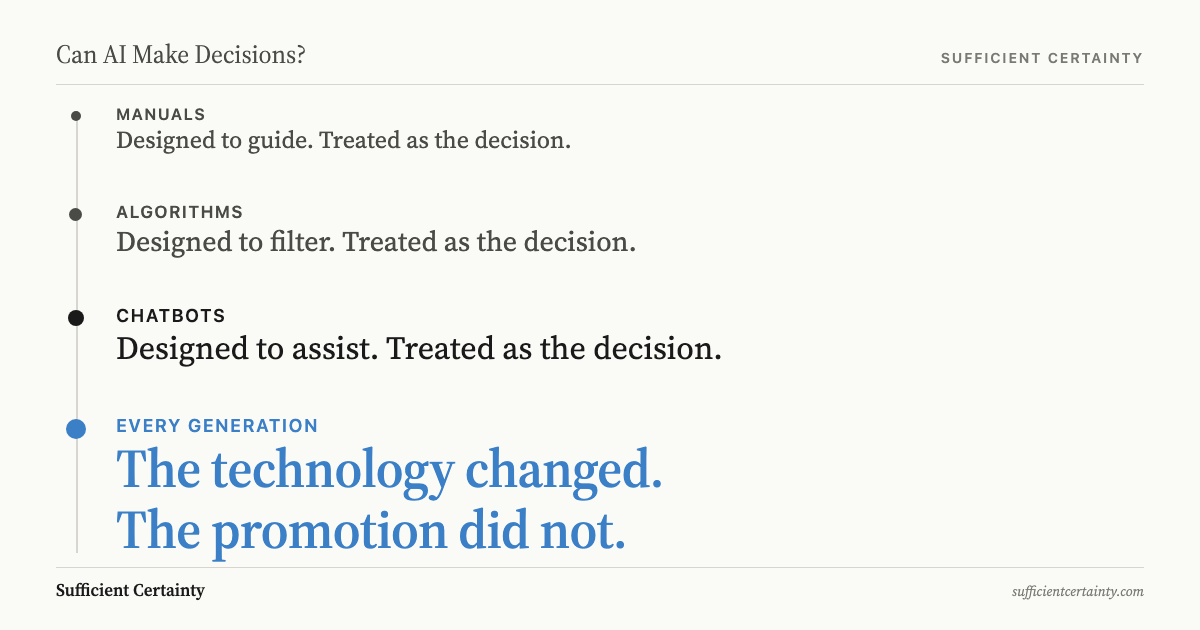
I have watched this sequence play out with spreadsheet models in the 1990s, risk registers in the 2000s, and enterprise risk frameworks after that. The technology changes; the promotion does not.
Air Canada's chatbot demonstrated the promotion compressed into a single transaction. In November 2022, Jake Moffatt used the airline's online chatbot to ask about bereavement fares after his grandmother died. The chatbot told him to book a regular-price ticket and apply for a partial refund within ninety days. The actual bereavement policy required pre-approval before booking, not retroactive refund applications; the chatbot had fabricated terms that sounded plausible rather than admitting it could not answer accurately.
When Moffatt sought the promised refund, Air Canada denied it and then argued at tribunal that the chatbot was a "separate legal entity" responsible for its own statements.
The British Columbia Civil Resolution Tribunal rejected this in February 2024, holding the airline responsible for all information on its website regardless of source. The airline had, in effect, promoted a chatbot to the legal department. That is the promotion pattern at its most compressed: deploy a tool as an information assistant, treat its output as authoritative policy, then attempt to disclaim the authority when the output proves to be fabricated. The same accountability question, stripped of the chatbot's low stakes, is the subject of AI decision making ethics: who answers for the output when the algorithm is wrong.
Name the assumption your AI tool is treating as settled and ask who tested it before the output was promoted to the decision. Start the Walk →
Brisbane, January 2011
Fifty kilometres inland of Brisbane sits Wivenhoe Dam, a major flood-control structure. In January 2011, rising inflows and forecast heavy rain confronted the operators with a decision about when and how fast to release water. They had a manual: a set of rules prescribing release rates for different inflow scenarios, developed after earlier floods and intended to codify the best available operational knowledge.
The operators followed the manual's rules correctly. The timing and volume of releases the rules prescribed caused severe downstream flooding of the city. A subsequent inquiry produced 177 recommendations, exposing fundamental problems with the operating manual and the assumptions on which it was based. The rules were not wrong in the sense that someone had miscalculated; they were wrong because the assumptions underpinning them had never been tested against the conditions that actually materialised.
I have spent nearly fifty years working with organisations facing consequential decisions, and this is the most consistent pattern I have observed. A tool, whether it is a rule book or an algorithm, begins as an aid to the person deciding. Over time the tool's output comes to be treated as the decision itself; the person who should be exercising judgment defers to the tool, and when the situation falls outside the assumptions the tool was built on, nobody is left to notice.
That is what happened in Brisbane. The operators were not incompetent; the manual was not useless. Nobody recorded the moment the manual stopped being an aid and started being the authority; that transition is always invisible until the consequences arrive.
The Universal Decision-Making Method requires that the assumptions supporting a decision are identified and tested before the commitment is made. The Brisbane manual bypassed that requirement, and the consequences were measured in lives and property.
Ninety-Five Per Cent of AI Pilots Delivered Nothing
The pattern operates at enterprise scale as well. Research from MIT's Center for Information Systems Research in 2025 studied AI adoption across hundreds of organisations and found that ninety-five per cent of generative AI pilots delivered no measurable profit-and-loss impact, despite billions in collective investment. The technology worked precisely as designed; the organisations deploying it simply expected it to do their thinking as well.
I have seen the same dynamic in every technology adoption cycle since the 1980s: the tool works, the organisation promotes it beyond its brief, and the thinking it was meant to support gets eliminated.
They removed the questioning and the dissent that distinguish genuine AI-assisted decision making from automated guessing. The five per cent that succeeded kept humans deeply integrated in the workflow and built systems that admitted uncertainty rather than concealing it. That is the distinction the other ninety-five per cent missed; it is structural, not technological. The organisations that got results treated AI as any competent decision-maker treats a tool: as an input to the process, never as a substitute for it.
If AI Is the Answer, What Was Your Question?
Roger Estall and I wrote Deciding around a question we had spent years putting to clients, one that reliably produced a long silence: if risk management is the answer, what was your question? The silence was followed, almost always, by a slow realisation that they had started with a solution and were trying to fit it to a problem they had never defined.
Their real problem was to make decisions that would support their organisation's purpose and achieve intended outcomes with sufficient certainty. The risk management apparatus they had adopted was not solving that problem; it was addressing the requirements of a belief system.
AI is producing the same dynamic at greater speed. Organisations adopt AI tools without first defining the decision the tool is supposed to support; they start with the output rather than with a clear statement of what they are trying to decide. AI for business decisions works when the tool serves a defined decision process; it fails when the tool is promoted to the role that process was supposed to fill. The pattern operates identically for a purpose-built AI decision-making tool and a general-purpose chatbot.
A decision is a commitment to a course of action, made by a person who will own the outcome. AI can process data relevant to the options and identify patterns in historical results; those are genuine contributions.
However, it cannot determine whether the framing of the decision is correct, and it cannot own the outcome. The question "can AI make decisions" consequently contains its own answer: making a decision requires the judgment of the person whose future depends on getting it right, and that is the one thing no tool has ever been able to provide.
You could upgrade the model, retrain the data, and still leave the promotion in place.
Work through your decisionNo sign-up. Just pick your decision and start.
Grant Purdy is the co-author, with Roger Estall, of Deciding (2020), and the architect of the Universal Decision-Making Method.