
AI assisted decision making works only when the person deciding retains authority to override or discard the AI output. The word "assisted" carries a specific obligation: the human applies judgement the model cannot supply and remains accountable for the result. Most systems wearing that label dropped the obligation years ago.
The distinction matters because it determines who is actually deciding. In 1978, Peter Keen and Michael Scott Morton published the founding text on decision support systems and drew the line explicitly: the computer couples the intellectual resources of individuals with the capabilities of the computer to improve the quality of decisions. The system they described was for problems where judgement is essential because the data alone does not resolve the question. The computer processes data; the human supplies judgement. That compact is what every tool labelled "AI-assisted" claims to inherit.
AI-assisted decision making is the use of artificial intelligence to inform a human decision while the person accountable for the outcome retains authority to override or discard the output.
What "Assisted" Was Designed to Mean
Keen and Scott Morton's definition endured for nearly fifty years because it described something real: decisions where the data informs but cannot settle the question, because the outcome depends on assumptions about future conditions that no dataset can confirm. A plant closure or a market entry sits in this category; the computer processes the volume faster and more completely than any person, while the human weighs the assumptions the data rests on.
Roger Estall and I wrote essentially the same principle into Deciding: deciders must be wary of treating calculations or mathematical models intended to assist with making decisions as if the results are the decision. The warning has nothing to do with the specific technology; I first encountered the pattern with risk registers and scoring matrices decades before any large language model existed.
Genuine assistance works from inside the existing decision context: a second reader on a CT scan, or a structured conversation that forces the team to name the assumptions behind its preferred option. What most organisations get instead is something manufactured externally and delivered as if the thinking has already been done.
Full Apparatus, Zero Assistance
I have sat in rooms where the quarterly risk report was delivered and filed without a single question about whether the assumptions behind the numbers still held. The report's purpose had shifted from informing a decision to proving that someone had been informed. I have watched this mechanism across industries for nearly fifty years; the apparatus grows and the labels improve while the decisions deteriorate, because nobody is using the output to inform a judgement. The reports become the process, and the assistance becomes decorative.
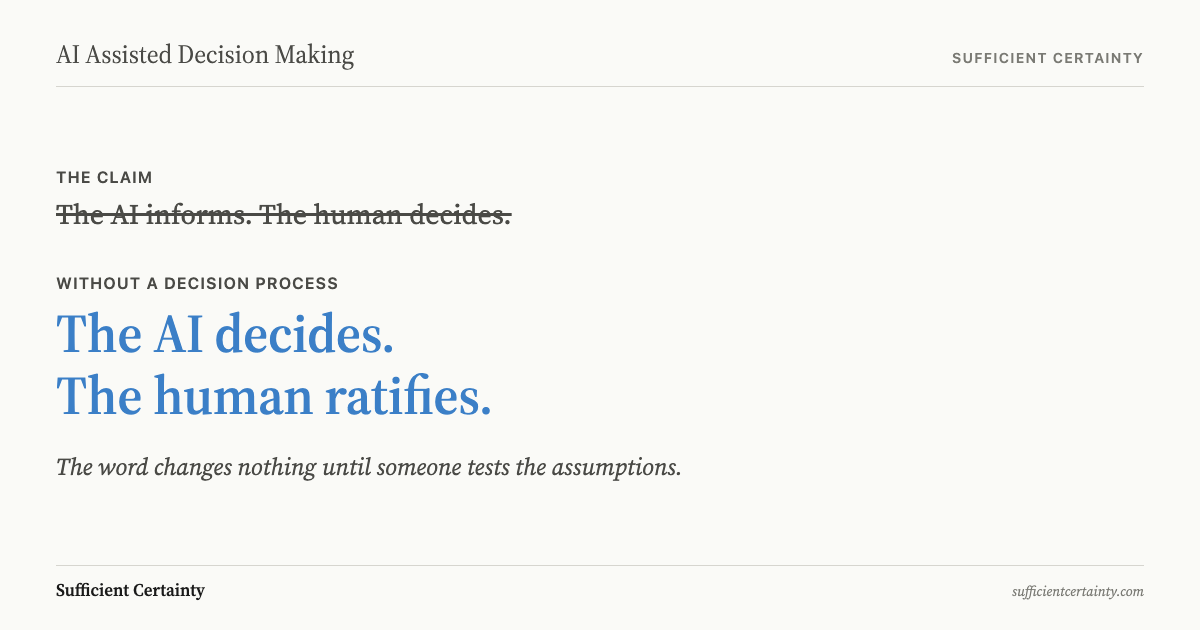
The Hayne Royal Commission documented precisely the failure the word "assisted" exists to prevent. Every major Australian bank had the complete governance apparatus, yet the commission found a deeply disturbing trail of practice including charging customers for services never provided. The broader pattern of AI decision making repeats this with a more convincing interface, and the more convincing the interface, the harder it becomes for anyone in the room to challenge the output.
The same mechanism is visible in AI hiring tools marketed as "assisted." In Mobley v. Workday (2023-2025), a California federal court allowed discrimination claims to proceed under an "agent" theory: the AI was making screening decisions on behalf of employers, not assisting them. Derek Mobley applied to over 100 jobs through platforms using Workday's AI screening and was rejected every time; no human had meaningfully reviewed his applications. The court's reasoning is precise: if the AI acts as the employer's agent rather than its tool, AI-assisted decision making is a misdescription of what the system actually does. That question of where accountability lands is the core of AI decision making ethics, and it does not resolve in the tool's favour just because the tool was labelled an assistant.
Write down the assumption your team's AI recommendation rests on and ask whether anyone verified it before the meeting. Start the Walk →
When AI Assisted Decision Making Actually Works
A 2025 prospective study across 67 medical organisations in Moscow tested what happens when the human genuinely stays in the loop. Researchers compared three commercial AI systems operating on their own against radiologists using those same systems as auxiliary tools for detecting intracranial haemorrhage on brain CT scans; the study covered 3,409 scans over fifteen months, 1,101 of which contained haemorrhage.
AI-assisted radiologists achieved 98.91% sensitivity and 99.83% specificity; the standalone AI systems managed 95.91% and 87.35% respectively. The accuracy gap was nine percentage points: 99.53% versus 90.11%. The specificity gap is particularly telling: that twelve-percentage-point difference represents patients who would have been incorrectly flagged for haemorrhage if the AI had been operating without human oversight.
That nine-point gap is the cost of the word "assisted" when nobody enforces what it means; the vendors selling "AI-assisted" labels collect their fee regardless of whether the hospital funds the workflow that makes the label true.
What each one misses explains why the combination works. All 12 cases the radiologists missed were caught by the AI; all 45 cases the AI missed were caught by the radiologists. That complementarity is what the word "assisted" looks like when it is honoured: two different failure modes cancelling each other out, because the radiologist brings clinical context the algorithm cannot access and the algorithm catches statistical patterns the radiologist's attention cannot hold.
I saw the same complementarity in industrial safety reviews decades before AI entered the conversation; the structured checklist caught what the experienced engineer's familiarity had normalised, and the engineer caught what no checklist author could have anticipated.
The engagement is fragile: research by Parasuraman and Manzey across aviation and healthcare settings established that humans default to deferring to automated outputs, and that this deference cannot be overcome by training (a finding the vendors prefer not to quote); it worsens under cognitive load, which is precisely when the highest-stakes decisions are made. The moment the radiologist defers without exercising clinical judgement, the complementarity collapses and what remains is the standalone AI's 90% accuracy with a human signature on it.
The Moscow radiologists maintained their accuracy because the clinical workflow required them to form an independent reading before seeing the AI's output. The same structural requirement underpins effective decision coaching: the person deciding forms a view before the tool or the coach offers one.
Why AI Assisted Decision Making Needed a Legal Definition
On 2 August 2026, the EU AI Act's human oversight requirements took effect. Article 14 establishes that humans overseeing high-risk AI systems must be able to interpret the system's output and, where their judgement warrants it, "decide, in any particular situation, not to use the high-risk AI system or to otherwise disregard, override or reverse the output." Non-compliance carries fines up to EUR 35 million or 6% of global annual turnover. I have spent decades watching the distinction between "assisted" and "automated" dissolve in every industry where the economic incentive favoured speed over deliberation; the regulation exists because the market proved it could not maintain that distinction without enforcement.
A 2023 study by Alon-Barkat and Busuioc tested how public-sector decision-makers in the Netherlands interact with algorithmic advice, across three experiments totalling over 2,800 participants including practising civil servants. They found no significant automation bias in the classic sense; participants did not defer to AI more than to human experts. What they found was selective adherence: participants adopted AI recommendations more readily when the recommendation confirmed existing beliefs, but the accept-reject pattern followed pre-existing preferences (which is to say the AI was confirming, not challenging) rather than independent analysis. The AI had become a confirmation device.
That finding is more troubling than simple deference, because selective adherence is invisible; it looks like critical evaluation. The person points to an AI output that states near-certainty whether right or wrong and claims the decision was evidence-based, while the actual decision was made before the AI was consulted.
I recognised the mechanism immediately because I had described it decades earlier: the fiction that mastery of an apparatus and its language was the key to success, when in fact the apparatus served the interests of those who built and sold it. AI-assisted decision making carries the same structural flaw; the vendor sells the apparatus and the buyer adopts the label, while the actual judgement about what the output assumes falls into the gap between them.
That is why Roger Estall and I built the Universal Decision-Making Method the way we did. The person deciding names the assumptions behind the preferred option and judges whether the evidence is sufficient before committing.
That structure prevents the human from deferring entirely to an AI decision making tool, and it prevents the human from cherry-picking the output that confirms a pre-existing preference. The AI becomes one input to a structured method designed to test inputs, not ratify them. In my experience across every sector I have worked in, no room asks the critical question without that structure: what assumption does this rest on, and would we still commit if that assumption proved wrong?
You could bolt AI onto every decision and never test the assumption any output rests on.
Work through your decisionNo sign-up. Just pick your decision and start.
Grant Purdy is the co-author, with Roger Estall, of Deciding (2020), and the architect of the Universal Decision-Making Method.