
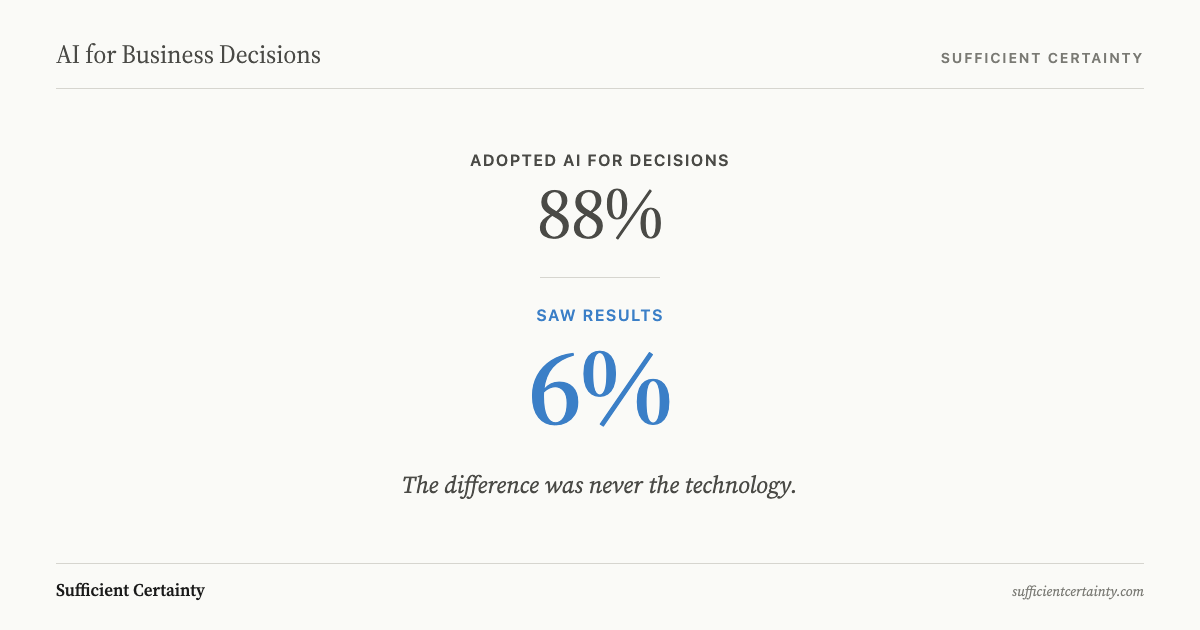
AI making wrong business decisions is the norm, not the exception. Roughly six per cent of organisations that adopt AI for decisions see measurable results. The rest added a tool to a process that was already producing poor decisions, and the tool accelerated the failures.
McKinsey's 2025 State of AI survey found that 78 per cent of organisations were using AI in at least one business function. By 2026 that figure had reached 88 per cent. The share qualifying as high performers, meaning more than five per cent of operating profit attributable to AI, stayed at roughly six per cent year over year. Near-universal adoption with negligible impact is not an adoption problem; it is a process problem.
I have spent nearly fifty years watching organisations adopt new tools for decision-making, and the pattern repeats with remarkable consistency. The tool arrives with reasonable promises: faster processing and more data. The organisation bolts it onto whatever process already exists. When results fail to improve, the diagnosis is always that the tool needs more data or more executive commitment; nobody asks whether the process the tool was added to was the actual problem.
AI making wrong business decisions is the systematic production of poor commercial outcomes when organisations add algorithmic tools to decision processes that were already unsound.
Why AI Keeps Making Wrong Business Decisions
The McKinsey numbers are striking on their own, but the supporting data makes the pattern unmistakable. RAND documented an AI project failure rate exceeding 80 per cent (double the failure rate of non-AI IT projects). S&P Global found that 42 per cent of companies had abandoned most of their AI initiatives entirely. Deloitte surveyed 3,235 director-to-C-suite leaders across 24 countries and found that only 25 per cent of organisations had moved 40 per cent or more of their AI experiments into production; of the employees who had access to company-provided AI tools, 85 per cent were not using them in ways that generated measurable business value.
The consultants who sold those projects are not the ones absorbing the loss. That is what adoption without a decision process actually costs.
These are not early-adopter problems in a nascent technology. Roger Estall and I described exactly this pattern in Deciding: the label "risk management" acquired the appearance of substance and authority, was adopted by organisations under pressure from consultants with a financial interest in its spread, and produced no measurable improvement in actual decisions.
The consultants became inventors of the methods and advocates for their own inventions (the sequence matters, because advocacy was the more reliable revenue stream). The organisations that adopted those frameworks spent heavily and changed nothing about how they actually decided. The parallel to current AI adoption is structural, not coincidental.
AI decision tools follow the same trajectory because the vendors selling them have the same incentive the risk management consultants had: revenue depends on adoption, not on whether adoption improves the organisation's decisions. That is the vendor incentive dressed up as your transformation. Understanding how AI and decision-making actually interact requires starting with the decision process, not the technology.
Write down the decision process your AI tool will sit on top of, and ask whether it has ever been tested. Start the Walk →
Zillow Spent $500 Million Letting an Algorithm Decide
In February 2021, Zillow began using its Zestimate algorithm to generate cash offers and buy homes directly from sellers. The company had spent years building the model, and it was by most external assessments the most sophisticated automated home-valuation system in the United States. By mid-2021, Zillow Offers was purchasing approximately 7,000 homes across 25 metro areas at prices the algorithm set.
The algorithm had been trained on a relatively stable housing market. When the pandemic boom introduced volatility that the model's historical data did not contain, the Zestimate kept overvaluing properties because it had no mechanism to detect that its own assumptions had stopped being valid. By the third quarter of 2021, Zillow had written down $304 million, with total losses exceeding $500 million. The company shut down the program entirely in November, eight months after launch, and cut 25 per cent of its workforce.
CEO Rich Barton blamed the algorithm's inability to predict prices, which is a convenient diagnosis when the alternative is admitting you let an algorithm buy 7,000 houses without supervision. I have watched organisations hand decisions to models and then blame the model when the assumptions underneath it shifted; Zillow followed the pattern precisely.
It did not use the algorithm to inform human judgement about property values; it used the algorithm to replace human judgement entirely. When the model's central assumption (that the market would behave broadly as it had during the training period) became invalid, nobody was positioned to notice. That is predictive analytics promoted to the role of decision-maker. Zillow had the most advanced AI valuation tool in the industry; it did not have a process that treated the tool's output as an input rather than an answer.
Three Fixes for AI Making Wrong Business Decisions
A field experiment published in Harvard Business Review in August 2026 studied 228 experienced evaluators assessing submissions to an MIT innovation challenge. The finding that matters for anyone whose AI is making wrong business decisions: repeatedly accepting machine recommendations without friction gradually erodes the decision-maker's own judgement. The skill atrophies, and the organisation does not notice until it needs the skill back and discovers it has gone.
I described three uses that consistently produce value in the parent piece on AI decision making. All three share a structure: the AI works on the process, not on the decision. Zillow's collapse shows what each one looks like when it is absent, and what each would have done if anyone had thought to use the tool that way.
Assumption-surfacing would have asked what the Zestimate model depended on. Using AI to make decisions starts with exactly this step: tell the AI what you are planning and ask it what you are taking for granted. In every organisation I have advised, the assumptions that matter most are the ones nobody has said out loud.
At Zillow, the central assumption was that the housing market would continue behaving roughly as it had during the model's training period. A second assumption was that overvaluation in individual properties would average out across a portfolio of thousands. Nobody asked the algorithm to name what it was assuming; they asked it to name a price. An AI tool pointed at those assumptions, rather than at the purchase price, would have named them before the first offer went out.
Stress-testing would have shown what happened to the portfolio if the market moved five, ten, or twenty per cent in either direction. The algorithm was well-equipped to answer that question (it had all the data it needed); nobody asked it. Instead, they asked it to set the purchase price and called that a decision.
Monitoring would have caught the divergence between the model's assumptions and actual market conditions before Zillow had committed to 7,000 houses. The Universal Decision-Making Method treats monitoring not as a reporting function but as a condition of commitment: if you cannot watch the assumptions your decision rests on, you are not ready to commit. Choosing an AI decision-making tool that serves these functions is fundamentally different from choosing one that promises to make the decision for you.
When the Tool Becomes the Point
Every tool that promises to improve decisions follows the same arc. It arrives with genuine utility and gets adopted widely; within a few years it exists as apparatus that runs parallel to how anyone actually decides. I have watched this happen with risk registers and appetite statements; the organisations that invested in them rarely consulted them when a consequential choice was in front of them. The apparatus existed for the auditors and the board papers. It did not exist for the person in the room who had to decide. That is the difference between a tool someone uses and a tool someone reports on.
AI decision tools across most organisations today are on the same trajectory. They will be built and maintained at considerable expense, and most will produce outputs that never enter the room where the consequential decision gets made. The person in that room will not reach for a tool that was never integrated into how they actually think about the problem.
The consultants selling these tools have not stopped selling them; they have merely updated the label from "risk management" to "AI transformation" and carried on. The pitch has not changed: adopt the apparatus, and the quality of your decisions will improve. It did not improve last time.
The difference between organisations where AI makes wrong business decisions and the six per cent where it does not is not the quality of their tools. It is whether the organisation has a structured decision process that the AI was designed to serve.
When that process exists, AI serves it. When it does not, AI produces expensive outputs that belong in the same drawer as the risk register.
You could adopt the next AI tool and still leave the decision underneath it unexamined.
Work through your decisionNo sign-up. Just pick your decision and start.
Grant Purdy is the co-author, with Roger Estall, of Deciding (2020), and the architect of the Universal Decision-Making Method.