
A leader cannot yet say, "We will close the plant on 1 October and keep customer service unchanged," when the assumptions behind that sentence are still hidden. I have watched leaders approve a message because it sounded settled, then discover that the people expected to deliver it were working from a different understanding of the change. A useful change communication plan catches that gap before the message travels.
Communication carries a decision; it does not make an untested decision sound safe. The record still has to support ordinary communication work. It tells managers what to say and where questions go. Its first job is to preserve the decision's meaning and show the condition under which the decision must be reopened.
A change communication plan is a working record that states a proposed change plainly and routes evidence from affected people back to the person who can reconsider it.
A change communication plan begins with a decision test
Start with a sentence the leader is prepared to own: what will change, for whom and by when? Then write the assumption that must remain true for that sentence to deliver its intended result. I use the Universal Decision-Making Method because its sequence separates the primary decision from the supporting work and makes assumptions visible before mobilisation.
The one-page record I take into an approval meeting is a small table, not a presentation. Each row has a named owner and a sentence that can be checked:
| Field | Entry |
|---|---|
| Decision sentence | State the action, scope and date. |
| Assumption under test | Name the operating fact on which the action relies. |
| Evidence test | State what will be observed and by what date. |
| Decision owner | Name the person authorised to change the action. |
| Stop rule | State the result that pauses the next release. |
| Communication route | Record how each group receives the message and how evidence reaches the owner. |
For a plant closure, a worked entry might read: "Close Plant B on 1 October and move its orders to Plant A." The assumption is that Plant A can absorb peak volume without missing the service level. The evidence test is a capacity trial; the stop rule pauses the transfer when that service level is missed. That gives a leader something to approve or reject, rather than a document to approve because it is complete.
Those fields force a useful approval question: is the remaining uncertainty acceptable for this change, in this context, for this duration? If the leader cannot answer, the document is not ready to carry the decision. The Universal Decision-Making Method calls this Sufficient certainty; it is a judgement about whether to act, not a claim that uncertainty has disappeared.
TSB's 2018 platform migration shows the cost of approving without that work. A significant proportion of its 5.2 million customers and every branch were affected when the new platform failed. The bank did not return to business as usual until December, paid GBP32.7 million in customer redress, and received combined FCA and PRA fines of GBP48.65 million. The regulators found inadequate planning and weak governance. A launch announcement could not make an unready platform safe.
For the change lead with two days, this record is the work to put before the leader. A channel grid can follow it. When the approval sentence and its test are on the same page, the people who carry the message know what is decided and what evidence can still change it.
Write the assumption behind your change and test whether the message still makes sense when you remove the leader's briefing. Start the Walk →
Test the message before it travels
A message must arrive with the decision's meaning intact. Roger Estall and I recount a First World War signal in which "send reinforcements" was received as "send refreshments". The words changed in transmission, so the recipient acted on a different instruction. I have seen a qualified decision move through a senior team until each layer has removed the qualification.
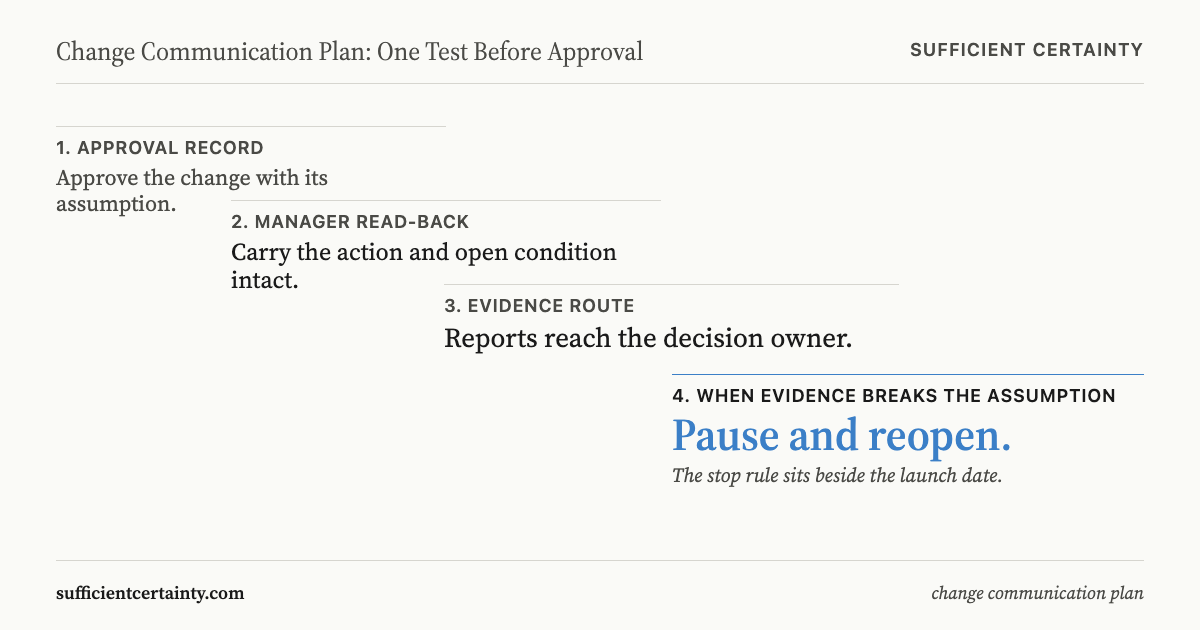
I run a manager read-back before release. I give two managers the proposed message without explaining it, then ask each to write the action they think their team must take and the condition that remains open. I compare those answers with the decision record. If either manager has turned an assumption into a promise or changed the scope, the message is rewritten and tested again. The result belongs in the record beside the audience and channel.
Roger Estall and I use a flat-pack example for a different reason. The design was sound, but a mistranslated instruction produced faulty assembly. I use that example as a transmission check: remove the source document, hand a manager the instruction and inspect the action it produces. A changed word, timing or handover is a control failure when it changes what people are being asked to do.
The practical communication work remains specific. Record the message and its delivery details for each affected group. Prepare the manager who will deliver it; give questions a route that reaches the owner. The record is useful only when a person can trace a question back to the assumption it tests.
Make the change communication plan a route for evidence
People need a route that can alter what happens next. I name an intake owner and give that person a short response deadline. The owner logs each report, checks it against the assumption under test and sends either a correction to the message or an escalation to the decision owner. A response route is part of the decision, not a courtesy added after launch.
The Department of Veterans Affairs paused further deployments of its electronic health record in April 2023 after five medical centres had gone live. The Government Accountability Office reported that 54 of 71 selected users said the system had decreased or greatly decreased their productivity, while the programme had obligated about USD12.71 billion by the third quarter of fiscal year 2024. Veterans' and clinicians' reports were part of the reason for the pause, but the GAO also records an absent VA-specific change-management strategy and largely unimplemented recommendations. The case supports an evidence route; it does not prove that feedback alone caused the pause.
Cheshire West and Chester Council communicated before formal consultation during a review of its 130-building estate. More than 200 people attended ideas workshops and the council received 1,095 staff survey responses. The case shows that leaders invited input before consultation and continued to report when there was no new decision. It does not establish that the workshops changed the estate decision.
A German study of 608 employees who had experienced workplace change measured support and resistance, not decision quality. It found that involvement, participation and appreciation in communication explained the largest share of variation among the factors tested, as reported in the study. That finding tells me to give people a credible way to speak. My recommendation is separate: when a report tests an assumption, the owner must consider whether the decision still stands. That is also the useful question behind stakeholder buy in.
Put the stop rule beside the launch date
The record must say what pauses the next release and who can order the pause. I write the rule in ordinary language: "Pause the next rollout when [evidence] shows that [assumption] is false; [owner] decides within [time]." The bracketed fields are completed before approval, not after the first warning.
The evidence must be observable. A service level missed by a defined margin, a safety incident, or a measured capability absent from a pilot can trigger the rule. A general feeling that the change is unpopular cannot, by itself, tell the owner what to do; it may still point to a workload or capability problem that the intake owner must investigate. This is where the change management plan records ownership and monitoring as part of implementation.
I also record the response time. If a manager raises a failure on Tuesday and the owner waits for a monthly review, later teams inherit the same defect. Monitoring has value only when a competent person with authority understands the result and takes the necessary action. The owner can clarify a misunderstanding, change the supporting communication or reopen the decision; those are different actions and the record makes the choice visible.
The broader guide to change management starts from the same question: is this change ready for mobilisation? A communication document answers the narrower operational question by carrying the decision accurately, testing its transmission and reopening it when evidence shifts. That is the page a leader can approve in 48 hours.
You could polish the message and still carry an untested decision to every team.
Work through your decisionNo sign-up. Just pick your decision and start.
Grant Purdy is the co-author, with Roger Estall, of Deciding (2020), and the architect of the Universal Decision-Making Method.